In 1979 China’s banks had to pool their dollars to buy Deng’s plane tickets.
When Deng Xiaoping visited the US in 1979, the entire Chinese banking system had $38,000 in USD and had to collect money from banks to buy plane tickets. Four decades later China holds $3 trillion in forex reserves, one of the most extraordinary accumulations of capital in history. It also carries $10T+ in hidden local government debt and 65 million empty homes. Debts like these set off crises elsewhere. Why not here?
The answer is that the money can’t leave, and the way it was kept from leaving is also what makes the system fragile.
A family with its wealth in an apartment
Take an ordinary urban family. Like most, it holds the bulk of its wealth in an apartment: 70% of household wealth in China is tied to property, and that property is now worth 30-50% less than its peak. The family’s alternatives are poor by design. Financial repression means bank deposits pay 1-2%, below real inflation, and domestic stocks and wealth products are rigged or collapsing. Moving money abroad runs into capital controls, including a $50K-per-year limit on converting yuan to foreign currency.
So the family stays put, and its trapped savings are what keep the rest of the structure standing. Local Government Financing Vehicles (LGFVs) borrowed $10T+ off-balance-sheet for infrastructure and ghost cities. Developers overleveraged and built 65 million empty homes. State-owned banks were made to lend to zombie projects and hide the bad loans. Land sales, 40% of local government revenue, have fallen 50% since 2021, and total debt-to-GDP exceeds 300% once hidden debt is counted. Nothing goes bankrupt; loans are extended and everyone pretends. Elsewhere, depositors would flee. Here their money has few places to go, so the state banks can decline to recognize losses, and the Minsky moment is deferred and enlarged rather than prevented.
The currency works the same way. The PBOC sets a daily fixing rate instead of letting the yuan trade freely, enforces the capital controls, and burns forex reserves to prop up the RMB. Estimates put the free-market rate around 8.0-10.0 CNY/USD against the managed ~7.3. That gap is the measure of artificial support, and the family is on the wrong side of it: if the RMB is let go, its cost of living spikes.
The family’s dilemma
From inside, the choice looks like this. Stay in China and live cheaply, with $4 haircuts, $3 meals and $20 healthcare visits in dense, efficient cities, but risk confiscation and devaluation. Leave and preserve wealth in hard currency, but face costs five to ten times higher in the West. Those who can are already hedging through Singapore trusts, Dubai real estate, golden visas, smuggled gold and Tether. The tighter the state holds the money, the more inventive the exits become.
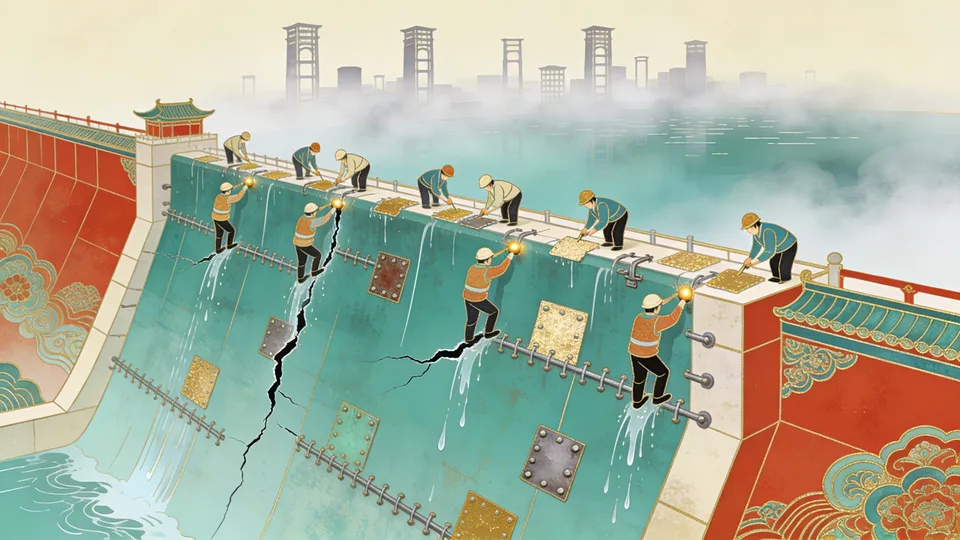
So the likeliest outcome is neither a crash nor a recovery: the system works until it doesn’t — no sudden crash (the CCP will hide losses), no recovery (debt is too big, reforms too weak), and the most likely path is a slow-motion deterioration resembling Japan’s lost decades, with the worst case being an Argentina-style inflationary crisis. The PBOC is trying to hold too many contradictions at once: propping up the currency while money needs to leave, stimulating growth while debt needs to shrink, and encouraging entrepreneurship while punishing anyone who succeeds too visibly. Like a dam, it works perfectly right up to the moment it breaks.
The usual triggers to watch are USD/CNH breaking 7.5, a major LGFV default, bank runs larger than Henan’s in 2022, or CPI inflation above 5%. But the earlier signal is the family itself. When the ceiling keeps getting lower, the talented leave first, and the departure of talent is the leading indicator for everything else. Capital controls can stop money at the border. They are much worse at stopping the people who know how to make it.
References:
- Various analyses of Chinese financial architecture
- Byrne Hobart on Deng-era banking