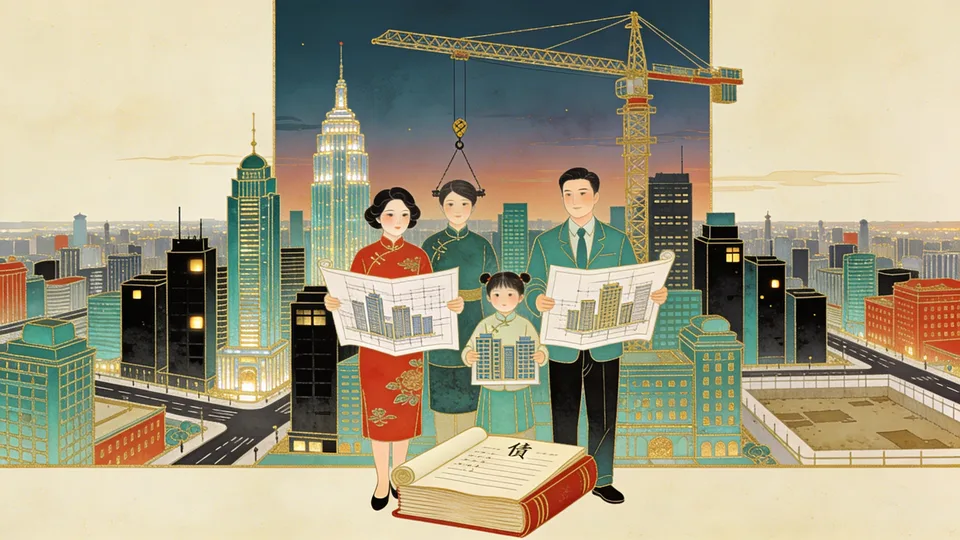
The bridge to nowhere still counts toward GDP the year it gets built.
Suppose you are a Chinese local official, and your career depends on hitting a GDP target. The easiest way to hit it: tell state-run banks to lend to favored companies to invest in as much infrastructure, manufacturing, and real estate as necessary. Whether the investments are worthwhile is irrelevant. All that matters is that the quantity of spending generates enough reported GDP.
For decades that method produced one of the great economic miracles in history. So why did the same method turn into a trap, and why can’t China simply stop?
When almost any investment paid
At least until the mid-1990s, the investment-led model was not a problem, because the shortage of infrastructure and manufacturing capacity was so large. Almost any investment raised productivity by far more than it cost. A road between two isolated towns created connections that multiplied each other, so total factor productivity was enormous.
So the official’s shortcut and the national interest pointed the same way. The trouble is that the official kept being judged on the same number after the shortage had been filled. In response to the 2008 financial crisis, Beijing doubled down with a massive $568 billion stimulus that told local governments to go wild with infrastructure spending. They did, and by then each new bridge connected less, cost more to maintain, and added to a debt that the reported GDP did not subtract.
Each step looked good on the metric that mattered, which is what made the path locally optimal: more lending, more building, more GDP. But the cumulative effect was a system that could not stop without collapsing. Every advantage that powered Deng’s reforms has flipped into a disadvantage: minimal debt became a mountain of debt, barely any infrastructure became endless maintenance costs, and the demographic dividend became a demographic crisis.
Who pays for it
The building is funded by savers. An investor once asked, half joking, for help getting his money out of China. His options were to put savings in a state bank for a 2% yield, invest in the perpetually struggling stock market, or very little else, because capital controls trap money inside the country.
This creates a stealth tax on savers. Nobody is allowed to start a competitive bank that pays real market rates by lending to productive private companies. Instead, state banks funnel the trapped deposits to local government projects and state enterprises, which may build empty cities and bridges to nowhere efficiently, but without market pressure to build anything useful. The financial mechanics show how deep this goes: $10T+ in local government financing debt, 65M empty homes, and 70% of household wealth in property now worth 30-50% less.
That arrangement also explains why the system resists change. Tiananmen taught the party that inflation and urban hardship could become an existential threat, and it drew two conclusions: keep urban residents happy at all costs, and maintain strict control over prices and financial stability. Letting the banks recognize their losses, or letting savers move their money, would threaten both.
Not a paper tiger
The tempting conclusion is that China is a paper tiger about to collapse, but investment-led growth was the right approach when starting from scratch, and for a long time the official with the GDP target was doing what the country needed. China’s economic model is a case study in how locally optimal strategies become traps at scale. The tragedy is that the institutions, incentives and power structures built around the old model are what resist the transition, so the efficiency that powered the catch-up now powers the malinvestment.
That is why a future Chinese reformer faces a tougher challenge than Deng did in 1978, even though the world’s second largest economy looks like a better starting position. Deng started with minimal debt, so borrowing was cheap; barely any infrastructure, so every investment was productive; and history’s largest demographic dividend. Japan and the Soviet Union showed what happens when a mature economy runs into a debt bubble. The reformer’s first problem is the official at the start of this story: someone who must still be told what to be judged on, now that building more is no longer the answer.
References:
- Michael Pettis and Matthew C. Klein, Trade Wars Are Class Wars
- Dwarkesh Patel, China’s Economy