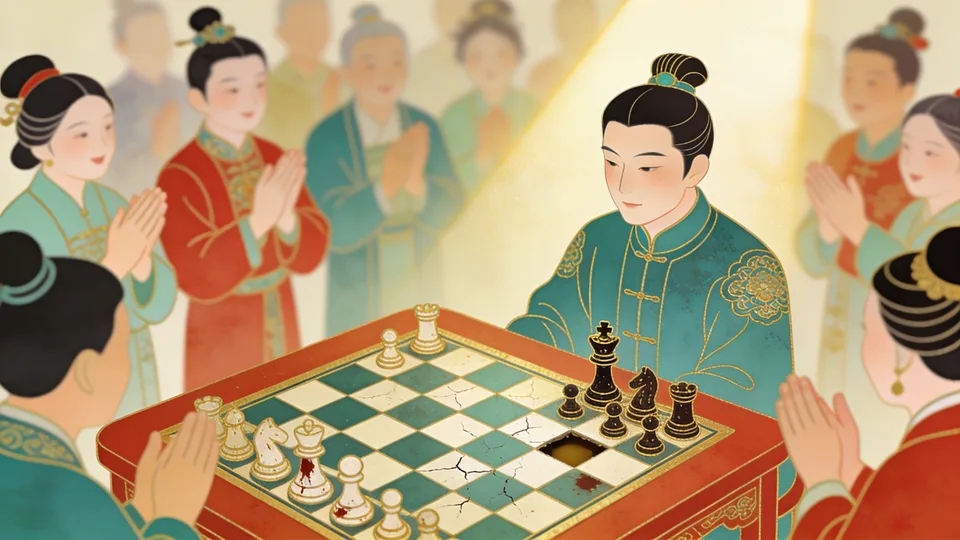
The safest way to purge your rivals is to arrest them for something they actually did.
Deng Xiaoping spent the end of his career building guardrails so that China would never have another Mao: term limits, collective leadership, a balance between factions. They held for two successions. Then Xi Jinping took them apart, ending term limits by 2018, and much of the public cheered the campaign that made it possible. How do you dismantle protections that nobody would openly vote to remove?
The guardrails
If the two-word description of US politics is “democracy, checks-and-balances,” the two-word description of Chinese politics is “oligarchy, patron-client.” Every leading politician cultivates a network of loyal supporters and, on taking power, fills key posts with them.
The system worked, imperfectly. Jiang Zemin followed Deng’s rules while filling key positions with his Shanghai Gang, the east coast urban elite. Hu Jintao, from the rival Communist Youth League, spent his decade being outmaneuvered by Jiang’s remaining bloc. Factions checked each other, and for Hu’s successor they agreed on Xi as the compromise candidate.
The weapon nobody could oppose
Xi launched the most extensive anti-corruption campaign in Chinese history, run by his old friend and loyalist Wang Qishan. The timing made it easy to defend. Corruption was genuinely pervasive, and the public had been spooked by the Bo Xilai scandal, in which a Politburo member’s wife murdered a British businessman and Bo tried to cover it up. The leadership needed to show it took the problem seriously.
The anti-corruption campaign was simultaneously real and instrumental. It caught genuinely corrupt officials, and it also systematically targeted Xi’s political rivals. When almost anyone could be investigated, choosing who actually was became a political decision that looked like a legal one. The public saw justice. Insiders understood a loyalty test disguised as a moral crusade, with anyone who resisted next in line.
And nobody could resist in public, because opposing anti-corruption sounds exactly like defending corruption, the trap of orthodoxy as virtue. So the guardrails against dictatorship were dismantled using the one tool that guardrails cannot defend against: a campaign that is both genuinely beneficial and politically weaponized. The corruption was real and the purge was real, and those facts don’t contradict each other; together they are the mechanism.
As rivals fell, Xi had people ready to replace them. Tsinghua University had spent years placing and subsidizing its graduates in provincial government posts, so Xi, a Tsinghua graduate, inherited an instant faction. With rival factions marginalized, he removed term limits, centralized decision-making and tightened censorship.
The cost
Terrorized by anti-corruption, the bureaucracy has become paralyzed and risk-averse, because any decision might later be investigated while doing nothing is safe. The result is a government that struggles to act without orders from the top: exactly the dependency consolidation requires, and a poor way to run a large country.
The pattern isn’t unique to China: any popular reform can be weaponized for consolidation, and the more genuinely it is needed, the better it works as a weapon. Better rules don’t obviously help, since Deng’s rules are what failed. The defense would have to be a public that can tell the reform apart from the consolidation hiding behind it, at the very moment the reform is doing real good. Is any public good at that?
References:
- Scott Alexander, Dictator Book Club: Xi Jinping, Astral Codex Ten