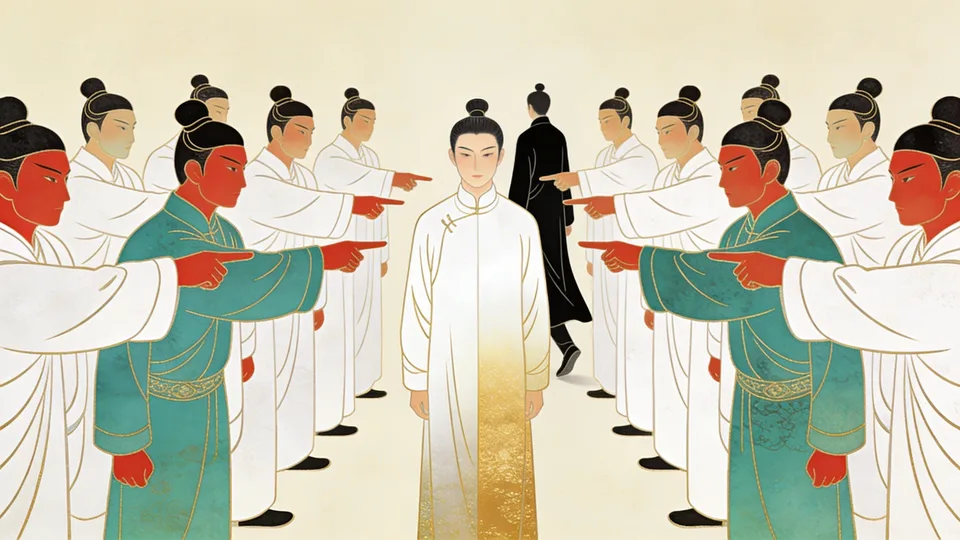
The fastest way to look good is to catch someone else being bad.
Picture a decent, conscientious colleague who uses a phrase that was ordinary last year and is forbidden now. The coworker who reports it is known around the office for being difficult, not kind. Within a week the colleague is apologizing and the accuser is admired. How does a campaign about being good end up rewarding people who aren’t?
Paul Graham’s answer is that whenever a society has a concept of heresy and orthodoxy, orthodoxy becomes a substitute for virtue. You can be the worst person in the world, but as long as you are orthodox, you are better than everyone who is not. This makes orthodoxy very attractive to bad people.
Why the rules keep changing
For orthodoxy to substitute for virtue, it has to be difficult. If all it took was avoiding some word, everyone would do it, and the only way left to seem virtuous would be to actually be virtuous. So the rules that serve best are shallow, complicated and frequently changing, which is what tripped up the colleague. The result: a world in which good people who were not up to date on current moral fashions were brought down by people whose characters would make you recoil.
The rules spread in a recognizable way. Zealots invent a new impropriety, and fellow zealots adopt it, eager for new ways to signal virtue. If there are enough of them, a much larger group follows, motivated not by virtue-signaling but by fear. Most people already worry that they are breaking rules they don’t know about, so when told they are, they believe it. The rest of the office keeps quiet about the colleague not to signal anything but to avoid being next.
Who supplies the zealots? Graham’s answer is the prig. Prigs are prigs by nature. They need rules to obey and enforce, and since Darwin cut off their traditional supply of religious rules, they are hungry for new ones. They only become dangerous when some new ideology gets a lot of them pointed in the same direction at once. That is what happened during the Cultural Revolution.
The last step makes it permanent. A new class of bureaucrats pursues the agenda as if their jobs depended on it, because they do. If you hire people to keep watch for a particular kind of problem, they will find it, because otherwise there is no justification for their existence. The office that investigated the colleague needs a steady supply of them.
Not one ideology’s problem
The obvious objection is that this is a partisan critique that ignores the real injustices such movements responded to. But nothing in the pattern depends on its content. The pattern has three parts: zealots define new heresy, fear-driven conformists amplify it, and institutional capture makes it self-sustaining. Victorian prudishness and religious fundamentalism ran on it too. The orthodoxy changes every generation; the mechanism doesn’t. Some of the new rules may also be right, which is why the remedy can’t be to ignore them all.
Keeping prigs bottled up
There will always be prigs, so the question is how to keep them bottled up rather than how to eliminate them. One tool is laughter. Political correctness seemed to burn out in the late 1990s partly because it literally became a joke. Humor is one of the most powerful weapons against priggishness of any sort, because prigs, being humorless, cannot respond in kind. Humor was what defeated Victorian prudishness.
The other is a rule of thumb: have a conscious bias against defining new forms of heresy. Whenever anyone tries to ban saying something previously permitted, the initial assumption should be that they are wrong. If they can prove you should stop saying it, then stop, but the burden of proof is on them. Organizations already treat religion this way: you can explain your beliefs, but you cannot call your coworkers infidels for disagreeing.
Under that custom, the colleague’s accuser would have to argue in the open that the phrase does harm. Some accusers would win. A rule that exists only to sort the orthodox from the heretics would not, which may be the best test of whether a new rule is about virtue at all.
References:
- Paul Graham, The Origins of Wokeness