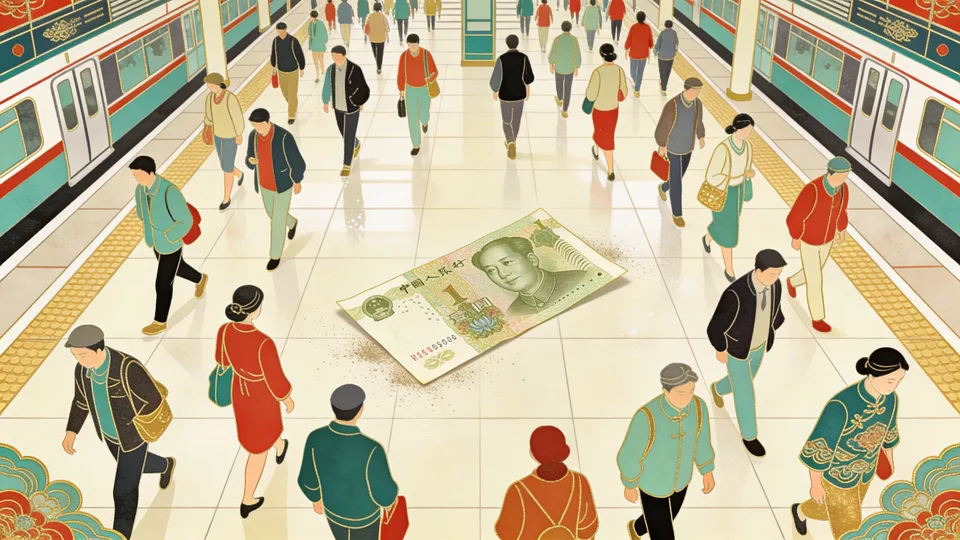
Sometimes the $20 bill really does sit on the floor for a decade, because whoever bends down first looks like a fool.
There is a respectable argument that you should rarely believe you have spotted an obvious improvement the world has missed. If a $20 bill were lying on the floor of Grand Central Station, a thousand greedy people would have picked it up already. Stretched far enough, the efficient market hypothesis becomes a theodicy: the world should be close to perfect, because someone clever would already have fixed whatever isn’t.
Then consider the Bank of Japan. For years Japan’s economy stagnated under deflation while its central bank kept money tight, and critics argued that looser money would help. Japanese stock prices moved in ways suggesting that most investors agreed. Better monetary policy was a bill worth trillions of dollars, lying in plain view. And yet the bill sat there for a decade. Eliezer Yudkowsky’s Inadequate Equilibria asks how that can happen: when everyone can know the right answer, why does the world still do the wrong thing?
Who would have picked it up?
Start with who could have picked up the bill, and what would have happened to them. The investors who saw the mistake had no way to profit from correcting it, because you cannot short a central bank’s policy. The central bankers who could correct it were paid in prestige rather than outcomes, and among central bankers tight money reads as responsible while loose money gets you laughed at. So each banker, looking at his own payoffs, saw that the wrong policy was safe and the right one was a career risk. As Scott Alexander put it in his review:
It should be horrifying that this system weights a small change in the reputation of a few people higher than adding trillions of dollars to the economy, but that’s how the system is structured.
Nobody in this story needs to be stupid. The knowledge existed, but the pathway from knowing to doing was cut, and Yudkowsky argues it breaks in one of three ways. The first is the Bank of Japan’s: those who notice the mistake have no way to benefit from correcting it. The second is that those who know cannot credibly convey it to those who decide, as in a Lemon Market, where buyers who cannot tell good used cars from bad discount them all until honest sellers leave. The third is a bad Nash equilibrium: people who hate Facebook stay because their friends are there, and without common knowledge that the others would leave too, nobody goes first.
The default state
The usual reactions to a broken system are that it is run by idiots, or that it only looks broken because you are missing something. The Bank of Japan defeats both. The better conclusion is that inadequate equilibria are the default state of complex systems, not the exception. So knowing the right answer is not the bottleneck. Someone who wants to improve things should map the specific inadequacy that keeps a known answer from being used, because the fix is rarely more knowledge and usually a change in what people are rewarded for.
The efficient-market argument still deserves weight, because most people who think they have found a bill are wrong. The outside view says most new restaurants fail; the inside view looks at your chef and your location, and every founder’s inside view says they are the exception. The skill is using the outside view as a check on overconfidence while using the inside view to identify the specific mechanism that makes your case different — if it actually is. The three ways give that check its content. If you cannot say who would profit from the fix, why the people who know are not believed, or what stops everyone from moving together, the outside view should win.
What finally moved the bill
Japan’s policy did change, in 2013, after Shinzo Abe’s government installed Haruhiko Kuroda as governor to loosen it. Nobody had learned anything new about monetary policy; the payoff facing the person in the chair had changed.
A bad Nash equilibrium has no chair to fill. Hobart and Huber offer a controversial candidate for breaking that kind of trap: a bubble, whose shared mania suspends the cost-benefit calculus that keeps each actor waiting for the others. Whether a mania is a fair price for escaping a stuck equilibrium is a question the efficient-market theodicy never has to ask.
References:
- Eliezer Yudkowsky, Inadequate Equilibria: Where and How Civilizations Get Stuck
- Scott Alexander, Book Review: Inadequate Equilibria, Slate Star Codex