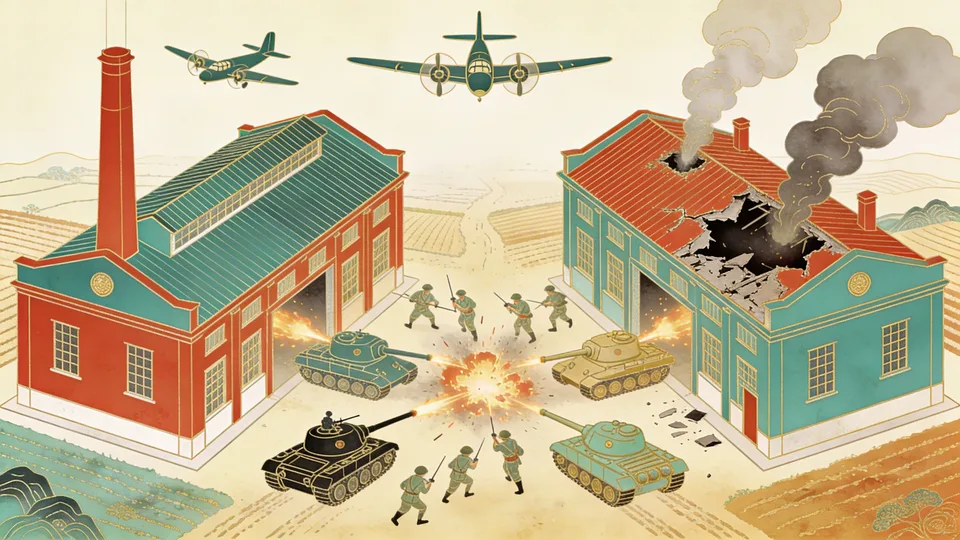
Armies couldn’t destroy tanks as fast as factories could build them.
The Second World War is usually told as a string of battles: Stalingrad, Midway, D-Day. The natural assumption is that whoever won enough of them won the war. But a battle only matters if it changes something behind the front. The question that decides it: does the occupation or non-occupation of that point on the map affect the ability of a combatant to keep fighting?
Asked of the whole war, the answer is surprising. Even massive armies could not destroy tanks, airplanes and ships on the battlefield fast enough to remove the other side’s ability to continue. If factories produce faster than the front consumes, fighting at the front settles nothing. What could and did happen was the destruction of the other side’s ability to produce and distribute weapons. The Allies won the war by using air power to destroy German and Japanese capacity both to produce military equipment and to transport it to the battlefield.
Bombing the factory
Most of the fighting against Germany was done by the Soviets. The decisive Anglo-American contribution was the aerial bombing campaign against German factories and transport. The Germans moved production underground, which insulated them from the worst effects, but the damage to transport meant that even what was produced could not reach the front. Japan, which went to war in no small part because the US cut off its oil, depended entirely on shipping conquered resources home, and after Midway the US simply outproduced it.
Hitler’s response shows the trap. The bombing provoked him into authorizing the V-2 rocket program, proportionally as expensive as the Manhattan Project, with essentially no strategic goal beyond the psychological importance of striking back. The V-2s killed several thousand civilians and were basically irrelevant to the war. Germany poured scarce production into a weapon that felt decisive and ignored the constraint it was losing on.
The factory is the front
So wars are production problems — the constraint is not courage or tactics but the capacity to produce and distribute weapons faster than they are consumed. This is the Theory of Constraints applied to war: any battlefield improvement that leaves production untouched is, in Goldratt’s terms, an illusion. The frame has a limit, though. It explains who could keep fighting, not who did the dying: Soviet soldiers held the line long enough for production to become victory.
The present application is uncomfortable. China builds half the world’s ships while the US builds three to five, and in this frame that is a measure of war-readiness. Quantity has a quality all its own, because production capacity decides whether any other capability can be sustained. A country that has outsourced production may have outsourced the constraint that decides wars.
References:
- Historical analysis of WWII strategic bombing campaigns