When everyone stays busy, the company ships less.
Picture a company whose work flows from Sales through Product and Design to Engineering. Engineering is the slowest stage and already full, so sending it more work produces no more finished product. Meanwhile Sales, Product, and Design have idle hours, and idle hours frighten everyone. Managers dread an underused resource, and employees dread the feeling that there isn’t enough work to justify their jobs. So everyone follows the universal rule of the modern workplace, “stay busy,” and the upstream teams start new projects. By the end of the quarter every team is busier than before, and the company ships less. How can more effort everywhere produce less output?
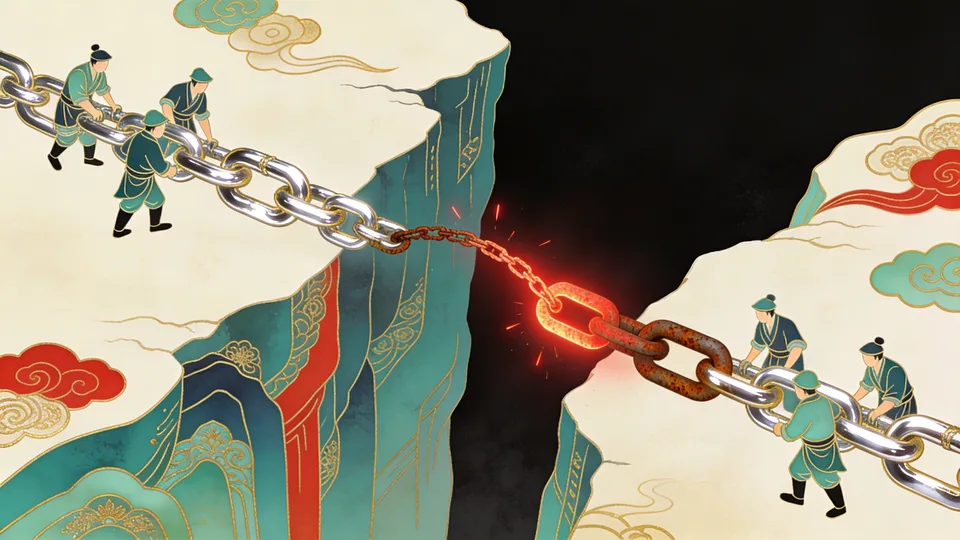
Eliyahu Goldratt’s answer, the Theory of Constraints, starts from a plain observation. Every system has one bottleneck tighter than all the others, in the same way a chain has only one weakest link, and only the bottleneck’s output sets the output of the whole. Any improvement not at the constraint is an illusion.
How busyness makes it worse
If the extra work upstream were merely wasted, the company would only be inefficient. The trouble is that it lands on Engineering. Even when Engineering has the discipline to turn requests down, just deflecting the incoming takes up precious capacity: more emails, more estimates, more political maneuvering to fend off pressure. So the one stage that determines throughput now spends part of its day defending itself.
That starts a spiral. As Engineering’s throughput drops, work piles up in front of it, so upstream teams have even less to do and start even more projects. Downstream teams, waiting on Engineering, start side projects that generate “requests for Engineering input.” Management sees the crisis and reaches for the tools it knows: “Look even busier!”, or hire more people, who create more busywork and more overhead for the bottleneck. Brooks’ Law, that adding people to a late software project makes it later, is the same mechanism, because the scarce thing is usually shared context rather than hands.
So the usual complaint about local optima, that they are merely less good than they could be, understates the problem: in an interdependent system, local optima actually make things worse. Each team that raises its own utilization does so by spending the bottleneck’s time.
Working at the constraint
Goldratt’s remedy runs in five steps: identify the constraint, exploit it, subordinate everything else to it, elevate it, and repeat. Identifying it is harder than it sounds. Goldratt’s most counterintuitive finding was that even in manufacturing the tightest constraint was almost always a soft constraint, a policy rather than a machine. In one Microsoft team, an innocuous-seeming policy of providing time estimates within 24 hours consumed 40% of the team’s total capacity. A dysfunctional machine breaks down where everyone can see it, while a dysfunctional policy can warp behavior for years before anyone notices.
Once the constraint is found, every minute lost there is a minute lost for the entire company, so investments that looked too expensive become the first priority: a queue of ready work in front of it, quality checks before work reaches it, offloading anything someone else can do, and protection from interruptions. Only then does it make sense to elevate the constraint by adding capacity, and then a new bottleneck appears somewhere else.
The third step, subordination, is the one organizations resist. It asks Sales, Product, and Design to run deliberately below capacity and to accept visible slack, against every instinct the workplace has trained into them. Toyota built this discipline into its factory floor. Ford’s assembly line had already limited work-in-process inventory by leaving no room on the conveyor for work to pile up; Taiichi Ohno got the same effect with Kanban cards that capped inventory between stations, so the power of Kanban lay in telling each worker when not to produce. With so little inventory, the line is designed to break quickly and in ways that surface the most useful lessons. In that sense the Toyota Production System is not mainly a process for maximizing throughput of finished products. It is a process for maximizing the throughput of process improvements, even at the expense of short-term profit. Ohno kept this from Western visitors on purpose:
I did my best to prevent the visitors from fully grasping our overall approach. I explained it by talking about reduction of the seven wastes (muda)…and by talking about techniques with Japanese names like kanban. — Taiichi Ohno
Where the theory is weakest
A factory’s bottleneck sits still long enough to study. In knowledge work the constraint is often a policy, someone’s attention, or shared context, and it moves when you relieve it. Misidentifying it is costly, because capacity added upstream of the real bottleneck sends it more work and capacity added downstream turns into busywork. So the theory cannot hand you an answer. It hands you a hypothesis that you must be willing to have tested, and a single question to keep asking: where is the bottleneck, and what is preventing it from running at full capacity? That question is the practical force of the claim that the constraint determines throughput, and everything else is noise.
Back in the opening company, the idle hours in Sales and Design were never the problem. They were the buffer the system needed, and the company spent them on projects that choked Engineering. The fix requires accepting something every organizational instinct resists: for even one part of the system to be fully utilized, every other part must have excess capacity. Finding the bottleneck is the analytical part. The harder part is letting a manager walk past a team with nothing to do and leave it that way.
References:
- Eliyahu M. Goldratt, The Goal
- Tiago Forte, Theory of Constraints 101
- Taiichi Ohno, Toyota Production System