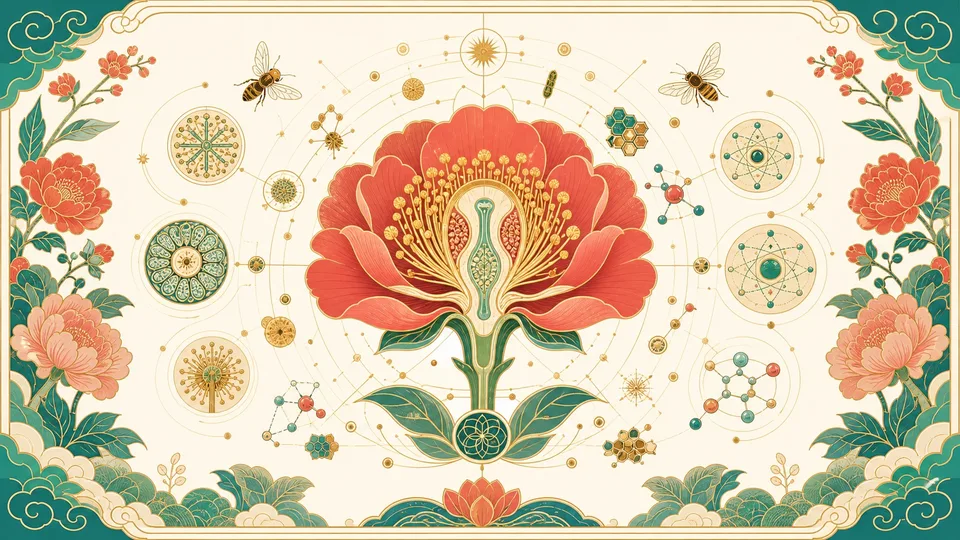
The scientist sees everything the artist sees in the flower, and the bee as well.
Many people quietly share the belief of the artist in Richard Feynman’s story: that explaining something uses up its beauty. Keats gave the fear its best-known form in Lamia, where cold philosophy will “unweave a rainbow.” If that were right, every gain in understanding would cost some wonder. Feynman answers the artist directly below, and then explains why, for him, the trade never comes due.
I have a friend who is an artist, and has sometimes taken a view which I don’t agree with very well. He’ll hold up a flower and say, “Look how beautiful it is,” and I’ll agree. And he says, “You see, as an artist I can see how beautiful this is, but you as a scientist take this all apart and it becomes a dull thing.”
And I think that he’s kind of nutty. First of all, the beauty that he sees is available to other people and to me too, I believe, although I may not be quite as refined aesthetically as he is; but I can appreciate the beauty of a flower. At the same time, I see much more about the flower than he sees. I could imagine the cells in there, the complicated actions, which also have a beauty. I mean, it’s not just beauty at this dimension of one centimeter; there’s also beauty at smaller dimensions—the inner structure, also the processes.
The fact that the colors and the flower are evolved in order to attract insects to pollinate it is interesting. It means that insects can see the color. It adds a question: Does this aesthetic sense also exist in the lower forms? Why is it aesthetic? All kinds of interesting questions which science knowledge only adds to the excitement, and mystery, and the awe of a flower. It only adds. I don’t understand how it subtracts.
[…]
The way I think of it is that we are exploring; we’re trying to find out as much as we can about the world. People say to me, “Are you looking for the ultimate laws of physics?” No, I’m not. I’m just looking to find out more about the world, and if it turns out there is a simple ultimate law that explains everything, so be it. That would be very nice to discover. If it turns out it’s like an onion with millions of layers and we’re just sick and tired of looking at the layers, then that’s the way it is.
“I can live with doubt and uncertainty and not knowing. I think it’s much more interesting to live not knowing than to have answers which might be wrong.”
The two halves belong together. The artist’s fear assumes that explanation heads toward a final answer that leaves nothing to wonder at. Feynman, ready for an onion with millions of layers, rejects that assumption. On his view each explanation of the flower, from its cells to the insects it evolved to attract, opens questions as fast as it closes them. Explanation subtracts wonder only for someone who expects it to finish, and Feynman’s willingness to live with doubt is what keeps the flower unfinished.
References: