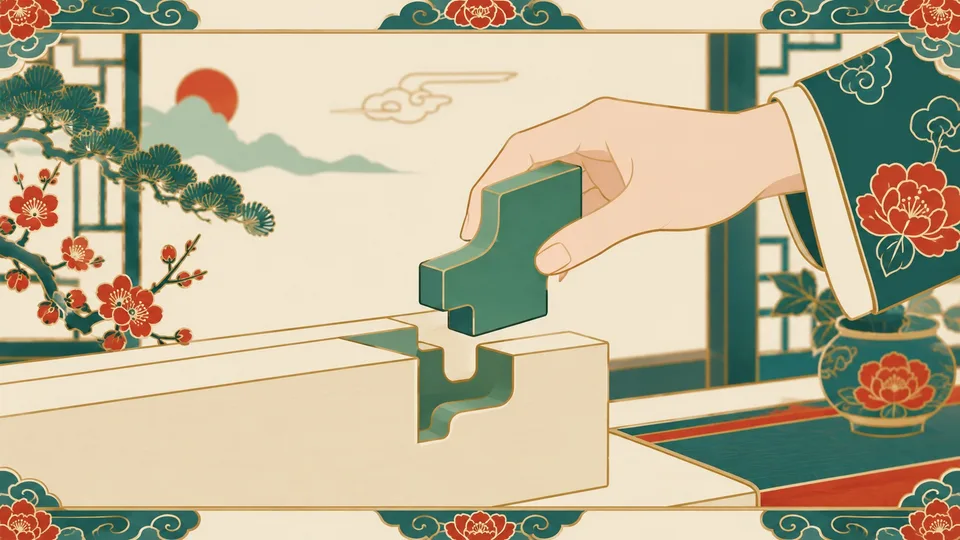
The fixture catches the mistake before the customer does.
A worker can install the same part correctly a thousand times and reverse it on the next assembly. A better fixture has an asymmetric opening: the reversed part simply will not seat. The worker does not need another lecture about attention, and the defect does not reach a customer. This is poka-yoke, usually rendered as mistake-proofing: design the task so a predictable slip cannot become a finished defect, or becomes unmistakable while it is still easy to correct.
The distinction is between an error and a defect. A person may reach for the wrong part; the process need not let that part enter the product. A warning light can reveal the mismatch. A keyed fixture can refuse it. The Lean Enterprise Institute describes both warning and shutdown forms, from a photocell that checks whether a required part was picked to a washing machine that will not start with its door open. Toyota’s production history places poka-yoke within the larger practice of building quality into the line rather than discovering trouble only at the end.
Move the check to the point of action
Inspection asks whether the finished unit is bad. Poka-yoke asks what condition allows it to become bad and intervenes there. If the wrong component is found after assembly, someone must disassemble the product, trace the mistake, and repair the damage. If the fixture refuses the wrong component before assembly, the same correction costs a few seconds. The operator still works and notices; the system makes noticing timely.
This gives Theory of Constraints a physical quality rule. A defect that consumes the scarce downstream station is not just a bad unit. It steals capacity from every good unit waiting behind it. The best protection sits before that station, near the action that creates the error, where the person doing the work can correct it. Quality control moves the pain earlier and makes it smaller. Poka-yoke can go a step further: a fitting piece need not reject anyone’s judgment at all.
The same arrangement appears in software. A form that refuses an impossible date before submission, a connector that accepts only the intended orientation, or a release step that fails when a required test fails can interrupt the error close to its source. But a checklist that asks someone to remember to check the date is a weaker intervention. It may be useful; it still leaves the original memory burden in place. The practical order is: make the wrong move impossible when you can, make it immediately conspicuous when you cannot, and use later inspection for what remains.
The guard can become the mistake
Poka-yoke works best for a known, repeatable failure whose correct condition can be tested reliably. It is not a license to hard-code every manager’s preference into the workflow. Delete Before You Optimize supplies the prior question: does this step need to exist? If the requirement is wrong, mistake-proofing it makes the wrong requirement harder to escape.
A gate can also become a solution that creates a larger problem. Suppose a team adds three approvals to prevent a rare typo. Every ordinary release now waits for three people, while rushed staff find a way around the gate. That is not the same as a cheap sensor at the source. It has moved the constraint from quality to permission. The better design measures whether the guard catches real errors, how often it fires falsely, what it costs to recover, and whether people bypass it. A guard that cannot be revised from actual failures eventually protects its own existence.
This matters especially when delegating to AI. Doing versus specifying cannot be solved by demanding a longer prompt: the user does not know every failure state in advance. A bounded check can still prevent a known dangerous transition—publishing without a source, sending to the wrong address, or overwriting an unrelated file. For uncertain creative work, however, a rigid gate may erase the exploration that fat thinking needs. Put hard stops around irreversible loss and cheap, reversible feedback around discovery. Treat the unknown as a reason to preserve judgment, not to automate an imagined specification.
The best mistake-proofing device is almost boring. It fits the work, has a visible reason, fails clearly, and can be removed when that reason disappears. A good process does not demand perfect people; it makes ordinary human slips cheap to find and hard to propagate.
References
- Lean Enterprise Institute, “Poka Yoke” and “Error-Proofing”.
- Toyota Motor Corporation, 75 Years of Toyota: Production System.