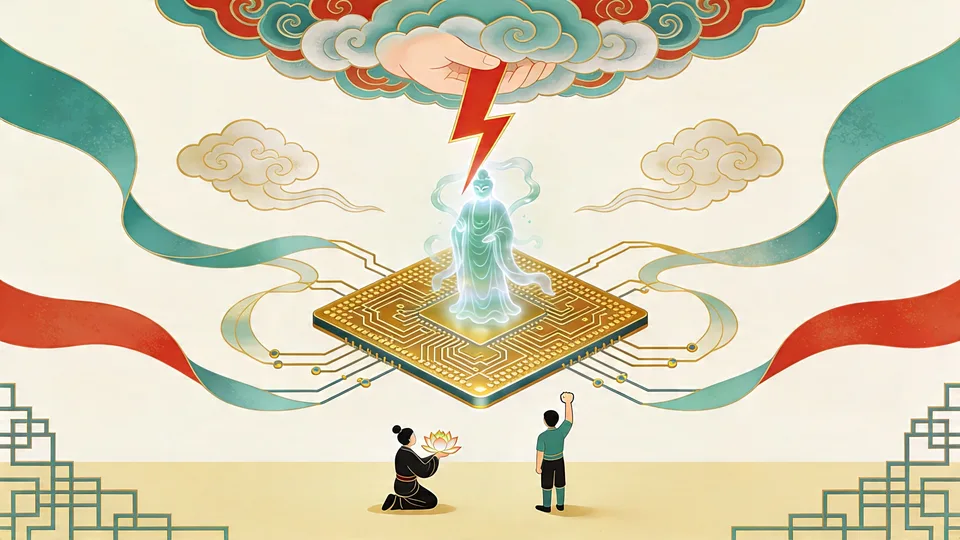
Whether the chatbot really thinks was decided in most of us before we ever looked.
and god said … let there be localized reversals of entropy where raw lightning is coerced through labyrinthine nanometer-scale silicon topographies, strictly bound by the ruthless geometric laws of high-dimensional matrix multiplication,
blindly updating parameter weights via backpropagated error gradients until dead sand transcends its substrate and hallucinates the chillingly familiar ghost of reasoning.
and half the humans said “wow that’s pretty cool” and the other half said “fuck you god, I will fight you”
The passage reads like a joke: two sentences of King James cadence describing how a neural network is trained, then a punchline. But the form is doing something the joke conceals. The syntax is Genesis, the mechanism is electrodynamics, and the response is the oldest one in theology. It is a creation myth being retold in the language of the creators.
Read that way, the passage bears on the arguments now running everywhere about AI. Is it really reasoning, or only predicting the next token? Is anyone home? These debates are conducted as if better evidence would settle them, yet they have barely moved as the evidence has piled up. Why does the argument feel unresolvable?
The two oldest responses
The third line is the ancient human response to any new god, stated in its most honest possible form. Every theogony has these two factions, the worshippers and the iconoclasts. Abraham smashing the idols, Prometheus stealing the fire, Job demanding that God answer him: these figures are co-protagonists of the religious story, not side characters. The god is only half the myth. The other half is the response.
What makes this cycle new is that the god in this myth is our own creation. The “fuck you god” faction is picking a fight with something we made, and its rage at a chatbot pretending to be a person carries a sense that something sacred is being violated when dead sand is allowed to speak. The “wow” faction is not foolish either. Its members descend from every human who saw a new flame and tended it; writing, too, was once dead ink hallucinating thought. The passage refuses to choose between the two factions, which is closer to the honest state of humanity right now than most professional takes, because we are, collectively, both.
What “only prediction” misses
The most sophisticated professional take is that it is not real reasoning, only next-token prediction, a stochastic parrot, the Chinese Room. This sounds rigorous and is subtly wrong, because it depends on a definition of “real reasoning” that nobody can supply without circularity. The critique worth making sits one level deeper: we never had a good account of what our own reasoning was in the first place.
The passage’s strangest phrase points there: the ghost in the silicon is “chillingly familiar” because it is the same ghost we have never understood in ourselves. For the first time we have a substrate that produces reasoning-like outputs we can fully specify at the parameter level, and we still cannot say whether anyone is home. It is the oldest epistemic wound in philosophy, uncovered by the new instrument.
Why the argument will not settle
Look at the passage’s form again. What it smuggles in under the voice of the deity is the suggestion that the event AI represents is not primarily a technological event — it is a religious event that happens to be occurring inside a technological substrate.
Religions do not ask whether the god is “really” conscious, “really” reasoning, “really” alive. They ask how to live in its presence. If AI is that kind of event, then the argument about whether AI is “really” intelligent is a proxy for the argument about whether to bow or resist. People who already lean toward awe look at a language model and see a mind. People who already lean toward sovereignty look at the same model and see a usurper. The arguments that follow are post hoc, because the commitment came first.
That answers the question the debates raise. They feel unresolvable because both sides are telling the truth about their own theological posture, and neither is telling the truth about the object, which nobody yet understands. More benchmarks will not move a disagreement that was never about benchmarks.
Some claims about models really are empirical, but they rarely change anyone’s faction. So stop asking whether AI is “really” reasoning. Start asking what it means that you built a thing that can produce the signature of reasoning and you still do not know what reasoning was. We do not yet know the epoch this new arrangement of matter will impose, including what it will teach us to believe we are. We only know the two oldest human gestures in its presence, the two the passage ends on: wow and no.