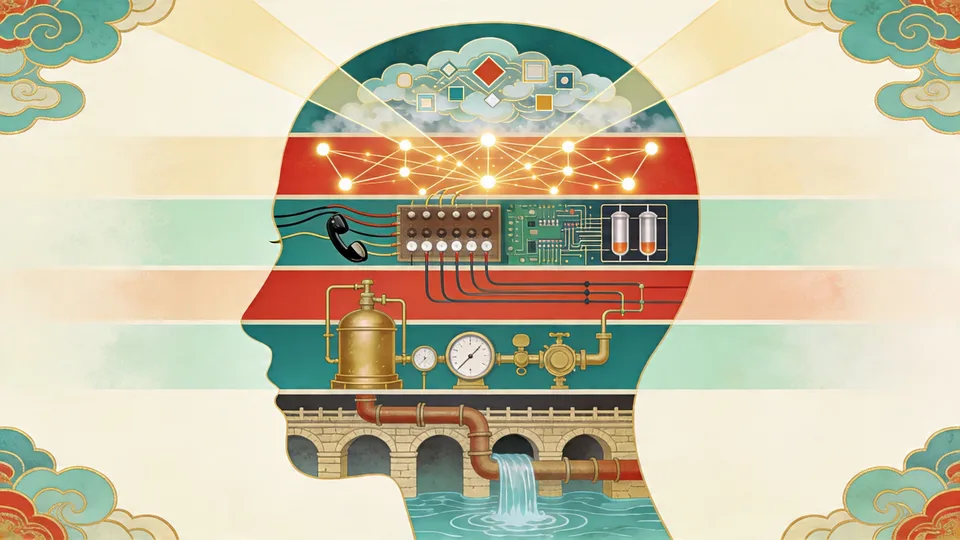
Tell people the brain is a boiler and you have also told them they need weekends.
After a bad week, someone says they need to blow off steam. A colleague says she has no bandwidth for another project. A friend says he needs the weekend to reboot, and lately people say that a tired mind is “hallucinating” or that they need more context before they can answer. Each phrase borrows from a different machine: the steam engine, the telephone line, the computer, the language model. Nobody using them thinks they are making a claim about neuroscience. They are just ways of talking.
But each way of talking carries a theory of what a person is and what should be done when a person goes wrong. A boiler needs a safety valve, a computer needs debugging, and a model needs better training data. So it is worth asking why every era describes the brain as its newest machine, and whether it matters which machine it picks. The usual assumption is that these metaphors are either harmless figures of speech or rough drafts of a science that keeps improving. The history suggests something else. Each metaphor works as a societal coordination mechanism: a lossy compression of an impossibly complex system that lets a culture standardize how it treats deviance, education, and labor. Call the brain a boiler and you get labor laws. Call it a computer and you get CBT. Call it an LLM and we are finding out what you get.
The brain metaphor is not a model of the mind. It is a model of how the culture wants to treat people.
What each machine permitted
The pattern repeats. A culture builds a powerful machine, looks at it, and says that is what the brain is. Then it builds institutions, therapies, and management philosophies around the comparison. Each metaphor replaces something worse, and each eventually becomes the obstacle to seeing what comes next.
With the Watt engine, thermodynamics, and the pressure safety valve, the mind became a pressurized vessel: libido as fuel, ego as governor, neurosis as explosive structural failure. What this unlocked was capacity constraints and catharsis. You cannot run a boiler at redline indefinitely without an explosion, and the metaphor forced society to acknowledge hard limits on human endurance. It legitimized leisure, recreation, and the weekend, and it became a conceptual framework for the labor movement: people need downtime to vent pressure. “Blowing off steam” became a sanctioned release valve.
The digital computer split the person into hardware and software. Working memory became RAM and IQ became clock speed. The separation unlocked plasticity and debugging: your hardware (genetics) may be fixed, but your software (behavior) can be patched, updated, or rewritten. Cognitive Behavioral Therapy treats distorted thoughts much as a programmer treats bugs: identify the pattern, trace the logic error, refactor the code. The metaphor taught people that trauma and cognitive distortions are bad code that can be systematically rewritten, which removed much of the fatalism of earlier eras.
The current machine is the transformer, and intuition becomes vector navigation, reasoning becomes next-token prediction, and creativity becomes “temperature.” The unlock this time is the case against micromanagement. The Bitter Lesson from AI research holds that hand-coded rules always lose to general methods applied to massive data. In human terms, you cannot program a child into success with rules. You provide a massive, diverse “context window” of unstructured play and varied experience, and let the biological network optimize its own weights. On this view, helicopter parenting is human overfitting.
That advice may well be better than the rule-bound parenting of the computer era. But notice where it comes from. It is the current machine describing the child, in exactly the way the boiler and the computer once did, and it feels like insight rather than metaphor for the same reason theirs did: it is the newest one. Seeing what it costs requires asking whom each metaphor served.
Who the metaphor serves
Read for its incentives, every major leap in our metaphorical understanding of the brain is an attempt to absolve the ruling class of guilt. When factory owners needed compliant physical labor, the brain was a boiler that simply required coal and maintenance to prevent violent explosions. When the managerial class needed knowledge workers, the brain became a computer that could be optimized for zero-defect logic. Now, in an era of capital-driven algorithmic dominance, the brain is an LLM: a probabilistic machine that merely produces outputs from its training data, which conveniently absolves both the individual and the system of moral agency.
If we are just predicting the next token, nobody is responsible for the text.
So each metaphor makes the workforce legible to capital in exactly the way capital needs. The boiler made workers into engines with knowable fuel requirements and pressure limits. The computer made them into interchangeable processors with measurable clock speeds. The LLM makes them into stochastic parrots whose outputs depend entirely on training data, so their failures can be attributed to bad training rather than bad management.
Where the current metaphor leaks
The strongest objection is that the metaphors are improving: each one really did see something its predecessor missed, so perhaps the LLM is simply the closest yet. It may be. But the latent-space picture already has a visible blind spot. It treats all human knowledge as interpolative, connecting existing dots in a high-dimensional space, and it fails to explain extrapolative leaps, the zero-to-one discoveries that exist nowhere in the training data. If the brain were “just an LLM,” we could not make them. People manifestly do, so the metaphor is already leaking.
The consensus is also fragile. “Humans are just biological LLMs” assumes wetware learns by something like the backpropagation that trains silicon. If neuroscience shows the brain uses a fundamentally different learning mechanism, whether active inference under the Free Energy Principle or something not yet named, every institution, therapy, and management philosophy built on “humans are next-token predictors” will need rebuilding. We are always one discovery away from the current metaphor becoming the next epoch’s quaint mistake.
What history predicts is not that the LLM metaphor is wrong, which every metaphor is, but that every metaphor is wrong in the specific way the previous epoch could not have predicted. The doctors who pictured the brain as pipes and humors could not have foreseen that balancing humors would become bloodletting. We cannot foresee what the LLM metaphor is about to get badly wrong, only that the record gives no reason to expect an exception.
That leaves one honest way to hold the current metaphor: lightly, as a dashboard rather than an identity. Blowing off steam is a useful phrase, and the boiler taught real things about rest and limits. The mistake was the Victorian who said “I am a steam engine,” and the person who now says “I am a biological LLM” is making the same one. You can run on the metaphor without it running you.