The green isn’t in the leaf, and whoever is seeing it isn’t anywhere you can look.
Look at a leaf. It seems obvious that the green belongs to the leaf, and that your eyes simply report what was already there. Physics tells a different story. The leaf reflects light of certain wavelengths, the light strikes the retina, signals travel along nerve fibers, and somewhere in all that the experience of green appears. The green is not in the light wave and not in the nerve fiber. No color exists in the external world. The same goes for sound, taste, smell and texture. What arrives is information, and the greenness is how consciousness renders it.
That ordinary fact leads straight to the hardest question in the philosophy of mind. If the world is made of matter with no experience in it, how does a brain made of the same matter produce the green? Neuroscience has mapped which neurons fire when you see green, and has said almost nothing about why there is anything it is like to see it. Peter Russell, in From Science to God, argues that the problem stays hard because it is being asked the wrong way round.
You never see light
Start with light itself. You never see it directly. The light that strikes the eye is known only through the energy it releases, which the brain translates into an image. The image seems to be made of light, but the light you see is a quality appearing in consciousness; what light actually is, you never touch. Kant argued two centuries ago that the mind actively constructs experience rather than passively receiving it, and modern neuroscience supplies the mechanics: the brain generates predictions from the top down and updates them only when the error coming up from the senses is large enough to surprise it. Perception is closer to dreaming and checking than to seeing, a controlled hallucination that feels like unmediated contact.
None of this makes the world unreal. The world is real, but the world-as-experienced is an interface. Like icons on a computer screen, experience is useful because it hides the machinery. And when you press on the machinery, “matter” gets less solid, not more: physics describes structure, relation and measurement, and “energy” is one more name inside the model. The most conservative statement is that something is informing experience, and consciousness renders that information as a world you can see and touch.
The backwards problem
So look again at how the hard problem is posed. It takes matter as given and asks how experience comes out of it. But how do we know about matter? Through the leaf’s green, the needle on the meter, the numbers on the screen. Every observation exists as an experience first and a physical fact second. Descartes could doubt his perceptions, his philosophy, even whether the room in front of him was being supplied by some deceiving power. He could not doubt that experiencing was happening. Strip away “I am this personality” and “my perceptions are accurate,” and what is left is simply: there is awareness.
That is why the hard problem is hard because it is backwards — we are trying to derive the one thing we know with absolute certainty (consciousness) from the thing we know only through consciousness (matter). The assumption that matter is primary and consciousness derivative is not a finding. It is a metaphysical commitment science inherited from its origins and has rarely examined.
Russell’s proposal is to stop treating consciousness as something that has to be manufactured. Consciousness is not an object; it is the capacity for objects to appear at all. On this view awareness is inherent in life, and evolution does not create it from nothing but enriches what appears in it as organisms develop richer senses and nervous systems. Consciousness is not inside the universe the way a lamp is inside a room. The experienced universe is inside consciousness, which means Space and time are not fundamental dimensions of the underlying reality. They are fundamental dimensions of consciousness.
That claim should be held at the strength the argument earns. The certainty belongs to the fact of experience, not to any theory of what experience is. You can grant that you know matter only through consciousness and still believe brains produce it; the reversal shows that materialism is an assumption, not that it is false. What it does settle is where the evidence starts.
The flashlight
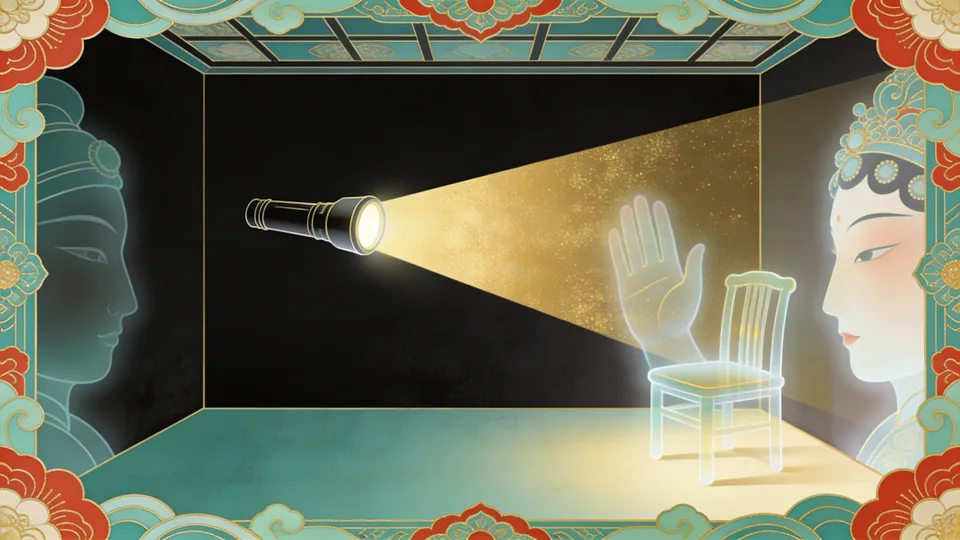
If consciousness is the ground, why can nobody find it? Looking for the self is like being in a dark room with a flashlight, shining it around to find the source of the light. All you ever find are the objects the beam lands on. Look for the subject of experience and you find ideas, images and feelings, but these are all objects of experience, so none of them can be the one experiencing. The search is made of the thing it is searching for.
This is why contemplative traditions matter epistemically. If the question is the structure of experience, the primary instrument is disciplined attention to experience. Electrodes can map correlates, but they cannot substitute for the inside view, because the inside view is what is being investigated.
That instrument works differently from how people expect. Maharishi observed that the least bit of trying, even a desire for the mind to settle down, is counterproductive: any effort promotes mental activity rather than lessening it. Trying to stop thinking is just another thought. The neuroscience of meditation points the same way, since practice works by reducing the mind’s compulsive story-generation, and effort is story-generation. The mind settles when you stop stirring it. Then attention that was always leaning outward, toward the room, the plan, the fear, can relax back toward the one to whom all of it appears. It is less a fireworks display than a plain recognition: I am here, and I have always been here.
The same leaf
Read this way, religious language such as “I am” as the name of God, the kingdom of heaven within, or the peace that passes understanding names that recognition rather than a distant supernatural object. Religions decay when the original seeing becomes secondhand. A teacher recognizes something directly, students translate it into concepts, institutions preserve the concepts, and later generations defend the concepts while losing contact with the recognition.
Enlightenment, on this account, is not seeing different things. It is seeing the same world in a different light. Nothing is added to the leaf. It is still green, still made of cells, still reflecting the same wavelengths. What changes is that you stop assuming the green was out there all along, waiting to be reported, and start noticing what it was appearing in. When someone asked Russell at a talk whether he was saying anything different from what many others were saying, he answered: “I hope not. If I am saying something markedly different, I am probably off track.” The question he leaves open is the one the flashlight cannot answer: if the light has always been on, why does noticing it take so much stopping?
References:
- Peter Russell, From Science to God
- Peter Russell, “What is Consciousness?”