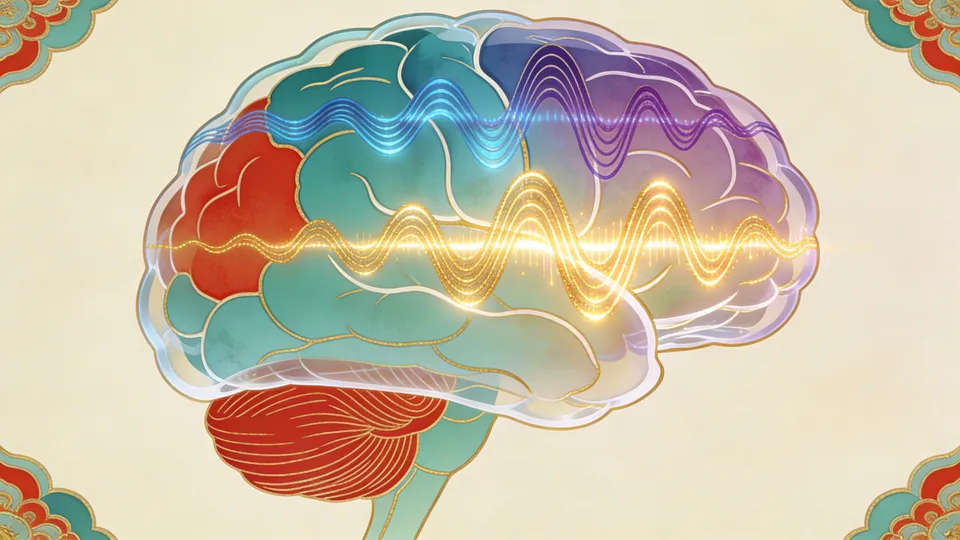
A phone number may fit in your head because seven fast beats fit inside one slow one.
Read someone a phone number and they can usually hold it long enough to dial. Read them a credit card number and it falls apart halfway through. The limit is famous: George Miller called it the “magical number seven,” plus or minus two. The usual picture is storage: short-term memory is a small shelf that holds about seven things. But why seven?
György Buzsáki’s Rhythms of the Brain, as reviewed on Astral Codex Ten, points to a different kind of answer. The brain’s electrical oscillations are not exhaust given off by thinking but the medium it is done in, and some of the mind’s limits fall out of the timing between them.
Two rhythms
Two bands matter for the phone number. Gamma (about 30-100 Hz) is the rhythm of conscious awareness. When you think about something, the neurons that represent it form a temporary assembly by synchronizing their firing at gamma frequency. Each digit you are holding is one such assembly.
Theta (about 4-8 Hz) is the rhythm of navigation and sequence. The hippocampus runs on theta, using each cycle as a discrete time step: where am I now, where was I a moment ago, where am I going. The same machinery handles events as well as places, because episodic memory appears to have evolved from the navigation system. To the hippocampus, remembering the order of the digits looks like remembering a path, a sequence of locations chunked into theta-cycle steps.
Counting beats
Now put the two together. Gamma runs at roughly seven times the frequency of theta. If the hippocampus schedules short-term memory on theta, then within each theta cycle it can call up a gamma-frequency item about seven times. Each digit gets one gamma beat, and there are only so many beats in a cycle.
This is why short-term memory holds 7±2 items. On this view the limit is arithmetic, a consequence of the frequency ratio between two oscillatory bands, which would make Miller’s magical number a hardware specification rather than a software limitation. The credit card number doesn’t fail because you weren’t concentrating. It needs more beats than one cycle holds.
The idea deserves to be held loosely. The theta-gamma account is a model, both bands span wide frequency ranges, and later estimates of working-memory capacity run closer to four items than seven, which would need a different ratio or a different story. What survives either way is the kind of explanation it offers: a cognitive limit read off the brain’s timing instead of the size of its storage. The review pushes the same logic further, speculating that meditation works partly by slowing certain rhythms until they fall into clean harmonic ratios, so that systems which were talking past each other can communicate. The brain is not a computer that happens to produce rhythms. It is a rhythmic system that happens to compute. Which leaves a question worth carrying around: how many of your other limits are beats you have been mistaking for shelves?
References:
- Book Review: Rhythms of the Brain — Astral Codex Ten, reviewing György Buzsáki