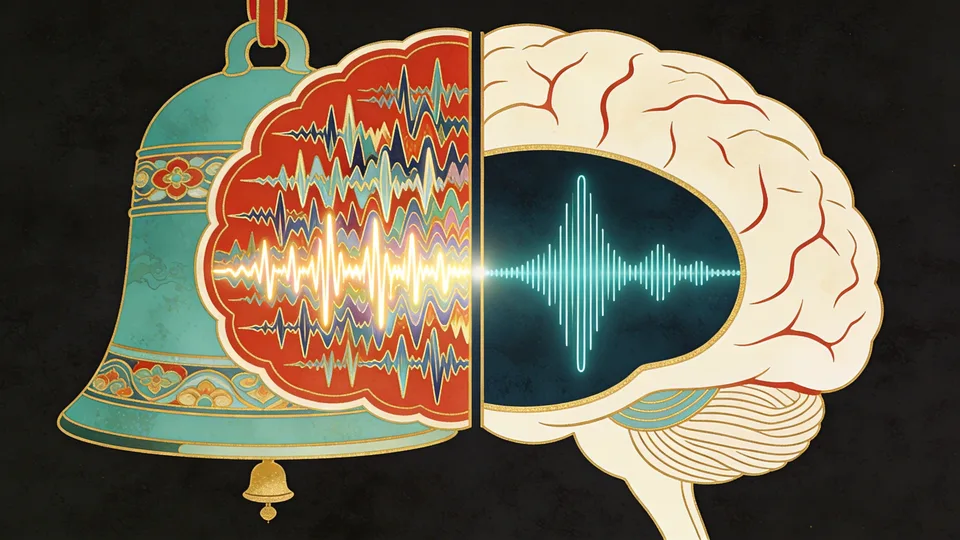
Trying to make your mind quiet gives it one more thing to talk about.
Sit down to meditate and, a minute in, a car alarm goes off down the street. Within seconds the sound has become a story: who leaves an alarm running, this always happens when I try to rest, I should move somewhere quieter. If meditation were only relaxation, the obvious fix would be to try harder to be calm. But anyone who has tried knows that makes it worse. So what is meditation actually doing to that cascade, and why would doing nothing to it help?
A QRI essay sets four models of meditation side by side, and despite their different vocabularies they describe the same sequence. The mind generates stories compulsively. Evolution biases those stories toward suffering, because wanting, loss and threat drive survival-relevant action. Meditation works by interrupting the machinery that turns a sensation into a reactive story.
Four descriptions of one cascade
In the Buddhist account, the alarm turns into suffering through craving and identification with craving. Watching closely, you notice that the sound is impermanent and that the self reacting to it is a process rather than a thing. With practice the compulsion to cling or push away weakens, and a spaciousness opens between stimulus and response.
Predictive coding explains why the story arrives at all. The brain’s core drive is to minimize surprise by building and revising stories about the world, and the more surprising a signal, the more it gets woven into the self-story. The alarm is surprising, so it gets a narrative. Maharishi’s observation explains why trying to stop this backfires: any effort to still the mind, even the wish for it to settle, is more story-generation. What meditation does instead is tag sensations early as not needing to join a stressful story. In the short term that stops one cascade. Over years it tunes down the storytelling mechanism itself, and the mind learns that not every sensation needs a narrative.
Connectome harmonics recasts this physically, as the brain damping a dissonant resonance before it spreads. Neural annealing adds the reason the change can last. Bottom-up sense data excites the brain while top-down prediction inhibits it. By diverting energy from inhibition, meditation lets enough uncommitted energy build up for structural reorganization, and the rate of cooling afterwards decides whether new patterns lock in quickly or have room to explore.
What the self was doing
Put together, the models suggest what the self is for. It manages mismatches among competing stories at different levels, which is mostly firefighting: the alarm story against the wish to rest, the wish to rest against the effort to rest. Meditation aligns the levels, so there is less conflict to manage. The self is not eliminated. It becomes less necessary, because the system it was managing is less at war with itself.
The strongest limit is the window of tolerance, the amount of activation a nervous system can hold without flipping into fight-or-flight or shutdown. Annealing needs high-energy states, and a narrow window cannot hold them. This is why meditation is hard for traumatized nervous systems: the system drops into dorsal vagal shutdown before reorganization can happen. Meditation widens the window gradually, but the prerequisite for deep practice may be enough somatic safety to hold the process at all.
Which raises the practical question. If the self is the thing meditation makes less necessary, then the self is also the thing doing the meditating, trying to get somewhere. How much of the work is learning to let the alarm be a sound?
References:
- The Neuroscience of Meditation: Four Models — QRI / OpenTheory