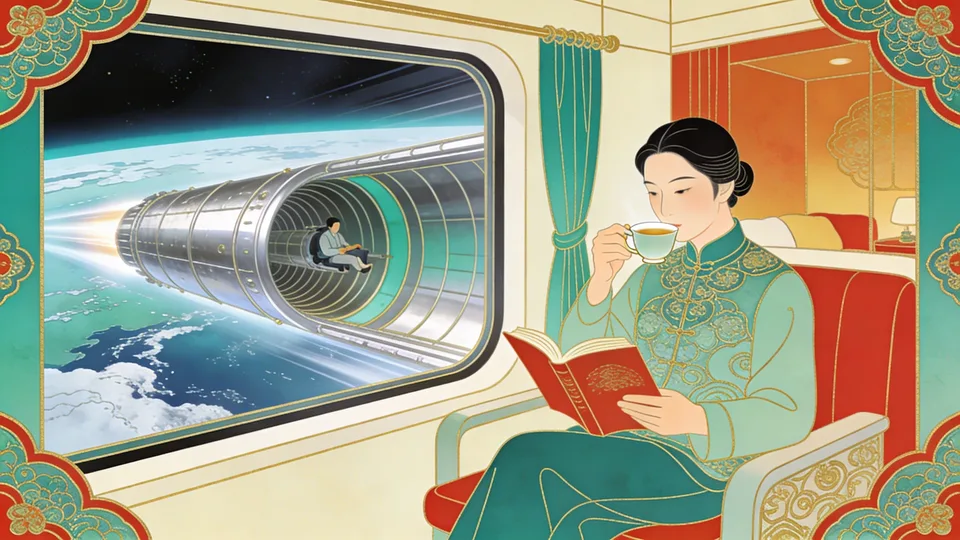
You can sit seven miles up at 500 mph and still be annoyed about the legroom.
You are sitting in an aluminum tube seven miles above the earth, moving at 500 mph, in a machine capable of zero-g acrobatics. What do you notice? The seatbelt sign, the legroom, whether the snack is pretzels. Nothing you feel, not the gentle climb or the controlled bank, exceeds what your ancestors could have felt on a fast chariot. The future of air travel arrived a hundred years ago, but it has never psychologically arrived.
If the future is supposed to arrive as a shock, why does a flight feel like a bus ride? Venkatesh Rao’s answer is that we live in a continuous state of manufactured normalcy. A mix of natural, emergent, and designed mechanisms, which he calls the Field, keeps us from recognizing that the future is already here. Life feels like a static, continuous present (it is always 4 PM, always tea-time) even as the reality underneath transforms radically.
Using without understanding
The plane shows how the trick works. Air travel grew out of bus and train conventions: you check in, wait at a gate, board in rows, stow your bag. These borrowed routines give us instrumental understanding, enough to function. What they withhold is appreciative understanding, a grasp of what the thing actually is. All we have of that are out-of-context facts about altitude and speed that we cannot feel in our gut.
We have excellent instrumental metaphors and impoverished appreciative ones. We can fly, or use Instagram, but could not explain either to someone from 3000 BC. That is not because the technology would seem like magic to them, but because we do not understand our own present in any meaningful way. We are merely able to function within it. Every new thing is received only insofar as it can be described as an old one. Facebook is warehouse-sized buildings full of etched silicon connected by radio and fiber, but “a yearbook that contains everybody” is enough to let us use it, and its familiarity stops us noticing that it explains nothing.
The Field stretches
Because new things arrive dressed as old things, the Field does not move forward to cover the future. It stretches, accommodating change through ever-expanding metaphor. That changes what we should worry about. We need not worry about acceleration, about “keeping up.” We need to worry about attenuation — the Field expanding to a breaking point and popping, like an over-inflated balloon. The danger is not that computers get faster. It is that the document metaphor breaks suddenly, leaving us unable to comprehend the internet.
Rao calls the strain Future Nausea rather than Future Shock. You are not knocked out cold. The emotional quality of the future leaks through as ambient anxiety, a constant sense of crisis held just beyond the firewall of routine. Where a newspaper once delivered a daily dose of shared Field, the feed now delivers forgotten classmates, slogan-placards, revisionist histories, incoherent glimpses of the future, and pictures of cats. The scary possibility is a permanent collapse: reality changing too fast for any Field, shared or personal, to keep up, so that instrumental metaphors survive while appreciative ones collapse entirely.
Why the Field holds
None of this makes the Field a simple error to be corrected. It is a load-bearing illusion about the present. Nobody could fly to a business meeting while feeling the full strangeness of the flight, and the normalcy is what lets millions of people board planes every day.
Rao’s update of Clarke’s law follows: any sufficiently advanced technology seems like magic to all humans at all times. Some of us merely live inside a Field that lets us function, and the gap between functioning and understanding is growing. Next time the seatbelt sign chimes off, try to feel, for a few seconds, where you actually are. Then notice how quickly the legroom wins.
References:
- Venkatesh Rao, Welcome to the Future Nauseous, Ribbonfarm