The cost of being conned is not the money. The money is almost incidental. The cost is the destruction of a self-image that can no longer be sustained. The mark who participates in the play commits himself to the proposition that he is a shrewd man. The process by which he comes to believe he cannot lose is also the process by which he drops every defense that previously protected him from defeat. When the blowoff comes, he has no rationalization left. He defined himself as possessing a certain set of qualities and then proved to himself that he is miserably lacking in them. This is a process of self-destruction of the self — and the degree of cooling required is proportional not to the dollars lost but to the distance between who the mark believed he was and who the facts now show him to be.

Social life is a confidence game in which we are all both marks and operators at different moments. We invest ourselves — identity, self-regard, sense of possibility — into roles and relationships that may eventually fail us. When they do, the social machinery requires that we accept a diminished version of ourselves and move on quietly. The person who accepts this is called mature, resilient, realistic. The person who refuses is called difficult, unstable, a problem.

Simple Picture

A con man befriends you. He introduces you to an “opportunity.” You invest — not just money, but your self-image as someone shrewd enough to spot a good deal. Then the rug pull. You lose everything. The con men scatter. But one stays behind. His job is not to return your money. His job is to talk you into accepting what happened so you do not go to the police, make a scene, or do something costly. He reframes, consoles, normalizes. He cools you out.

Now zoom out. Every career track, every marriage market, every spiritual path, every national mythology is the same structure. Aspirational scripts sold to many. Realized by few. The gap between what was promised and what arrives is where cooling happens — or fails to.

The Anatomy of a Confidence Game

The vocabulary is precise and old.

The mark is the victim. The operators are the con men. The roper is the friendly stranger who makes first contact and builds trust. The play is the entire operation from setup to exit.

The structure: the roper befriends the mark, introduces an opportunity — usually a fixed gambling venture — and lets the mark win small to build conviction. Then the mark puts in real money. Then comes the blowoff (also called the sting): a staged accident, a reversal, something that looks like bad luck. The mark loses everything. The operators scatter.

Two features make this structure revealing beyond criminology.

First, the con works through relationship, not position. The roper builds genuine-seeming friendship. Social trust itself is the weapon. This is why cons feel worse than robberies — a robber takes your wallet, a con man takes your judgment about people.

Second, the con can only work on someone who is already willing to participate in something slightly shady. The mark has to believe he is getting an inside deal, an edge, something he does not entirely deserve. He has to be a little bit of a thief to be a mark. This is why marks rarely complain afterward — to complain is to confess.

The word confidence in “confidence game” has a double meaning that is the whole point. It refers to the trust the mark places in the operator — the operator is literally a “confidence man,” someone who gains your confidence. But it also refers to the mark’s self-confidence — the belief in himself as the kind of person who can spot a good deal, who is too smart to be taken, who deserves an edge. The con does not exploit stupidity. It exploits the mark’s confidence in his own intelligence. The mechanism of destruction is self-flattery.

The Cooling Operation

Sometimes a mark wants to squawk — go to the police, chase the operators, make a scene. This is expensive. It attracts attention, spooks future marks, poisons relationships with corrupt police. So one operator stays behind: the cooler.

The cooler’s job is consolation. Not restitution — that is not on offer. The cooler walks the mark from rage and humiliation into resignation and acceptance by redefining the situation. Reframing what happened, what it means, what the mark’s realistic options are.

Goffman catalogs the specific techniques:

Offer a substitute role. The failing graduate student becomes a “practitioner with a master’s degree.” The fired employee becomes a “consultant.” The soldier being discharged “served honorably.” The role is smaller but preserves some dignity.

Gradual attrition. Do not deliver the blow all at once. Let the mark discover his situation slowly so the shock never peaks into unmanageable rage. The slow-motion layoff. The gentle phase-out. The “we’re going in a different direction.”

Appeal to his own standards. Tell him a mature, sensible person — which he is — knows how to take a loss gracefully. Make accepting the situation feel like the adult thing. Make resisting feel like childishness. This weaponizes the mark’s self-image against his impulse to fight.

Consolation via comparison. Others have suffered worse. Many people have been in your position. Failure of this kind is universal. This normalizes the loss and dissolves the mark’s feeling of particular humiliation.

Give him something to do. Action — even symbolic action — prevents dwelling. The exit interview. The farewell party. The severance package paperwork. These rituals are functional: they fill the time, structure the feeling, and create a sense of orderly process around what is actually a dispossession.

The cooler is a skilled performer of sympathy. The difference between a con man’s cooler and an HR professional, a therapist, a priest, or a good friend is largely a matter of whose interests they primarily serve — and how honest they are about it.

All of Society Is a Con

Goffman’s move — and it is the move that makes the paper a jackpot idea rather than a criminology footnote — is to propose that cooling the mark out is not a narrow pattern restricted to long cons. It is a fundamental pattern explaining all of society.

The formula:

  1. Sell people aspirational scripts that by definition only a small minority will actually realize, as a function of aptitude and luck
  2. Cool out those who fail, so they continue being productive (or at least not harmful) members of society, accepting various consolation prizes

Careers, consumption, dating, sports, spiritual attainment, military glory, academic prestige. Everything fits. Because not cooling marks out is incredibly expensive. The uncooled mark is a threat — to the institution, to the social order, to the quiet operation of the game itself.

Sustained personal disorganization is one way in which a mark can refuse to cool out. Another standard way is for the individual to raise a squawk, that is, to make a formal complaint to higher authorities obliged to take notice of such matters. — Erving Goffman, On Cooling the Mark Out

The Investor

The greed-fear-cycle is cooling failure played out in real time. The mark enters the market confident that he deserves to be right — he studied, he researched, he “did the work.” The market lets him win small. His confidence inflates. He puts in real money. Then the blowoff: a crash, a reversal, a regime change. The reflexive loop that created his gains reverses and destroys them.

The cooling infrastructure of finance is enormous. Financial advisors exist substantially to cool marks out. “Long-term perspective.” “Dollar-cost averaging.” “The market always recovers.” “You haven’t lost money until you sell.” These are cooler lines — they reframe the loss, offer a substitute identity (the patient investor instead of the shrewd one), and prevent the squawk (panic selling, lawsuits, regulatory complaints). The value investing framework is arguably the most sophisticated cooling apparatus in capitalism: it converts the humiliation of holding losers into the virtue of “discipline” and rebrands buying things that keep going down as “margin of safety.”

The mark who cannot be cooled — the one who panic-sells at the bottom, sues the broker, calls the SEC — is the market’s version of personal disorganization. Everyone in finance fears this person, not because they are wrong but because they are expensive.

The Spiritual Seeker

Spiritual communities run the same play with higher stakes, because the mark’s entire identity is on the table. The script: dedicate yourself to practice, and you will achieve enlightenment, inner peace, transcendence. The roper is the charismatic teacher, the transformative retreat, the initial taste of clarity that builds conviction. The mark invests — years of practice, money, social capital, the reorganization of an entire life around a spiritual identity.

The blowoff comes when the mark discovers that decades of practice have not produced the promised transformation. Or worse: that the teacher was a fraud, that the community was a structural fiction, that the “progress” was spiritual materialism — the ego acquiring enlightenment as another credential.

The cooling apparatus of spiritual traditions is ancient and refined. Karma — the loss is payment for past lives. Surrender — your inability to accept loss IS the lesson. “The journey is the destination.” “Enlightenment is not an achievement, it is the absence of seeking.” These reframes are structurally identical to the cooler’s technique of appealing to the mark’s own standards: a truly spiritual person would accept this gracefully. Resisting is ego. The very act of feeling cheated proves you have not learned the lesson.

The psychic economy reveals why spiritual cooling is so effective: the infinite demand source (enlightenment) can never be definitively falsified, because the goalposts are by definition unmeasurable. The seeker can always be told they have not practiced enough, not surrendered enough, not let go enough. The game never ends — which means the mark can never prove he was conned.

The Careerist

The corporate career is a confidence game with institutional coolers on salary. The script: work hard, show loyalty, climb the ladder. The roper is the recruiter, the mentor, the first promotion that builds conviction. The premium mediocre lifestyle is the visible marker that the trajectory is still plausible — the oat-milk latte as evidence of still being in transit. The Gollumized version is darker: the mark who has been cooled so completely they now cool themselves, defending the system that consumed them because the consumption has become identity.

The blowoff: the layoff, the reorg, the younger person getting the promotion, the dawning realization at 45 that the ladder leads nowhere you actually want to go. The Gervais Principle maps the cooling infrastructure precisely: the Clueless are marks who have been so thoroughly cooled they no longer know they lost — their loyalty to the organizational abstraction IS the cooling, internalized so deeply it reads as personality. The Losers know they lost and have accepted the consolation prize — watercooler solidarity, the bad economic bargain traded for stability. Only the Sociopaths understand the game well enough to operate it.

HR departments are institutional coolers. Performance improvement plans, “career transition support,” “we’re going in a different direction,” the exit interview where you are asked for feedback that will never be read — all of these are cooling techniques dressed in corporate language. The substitute role (“consultant,” “advisor,” “early retirement”) is the organizational equivalent of the con man’s partial refund.

The Romantic

The dating market sells the script of “the one” — the soulmate, the perfect match, the relationship that completes you. The roper is chemistry, the initial intoxication, the honeymoon period that builds conviction. The mark invests identity, plans, the public performance of coupledom.

The blowoff: the betrayal, the slow death of desire, the discovery that the person you married is not the person you thought. The cooling apparatus: couples therapy (the institutional cooler), the rhetoric of “growing apart” (gradual attrition), “at least you have the kids” (consolation via comparison), the divorce settlement paperwork (giving you something to do). The substitute role: “co-parent,” “someone who learned a lot about themselves.”

The American Con

The United States is something of a clueless striver culture of idealistic innocents who believe themselves to be worldly and cunning, running on a bewildering stack of mythology ranging from the personal-scale “American Dream” to the various eras of “American Exceptionalism.”

The American narrative stack is a confidence game at national scale. The scripts: anyone can make it if they work hard enough. America is the greatest country on earth. American values are universal values. The arc of history bends toward justice. The roper is the mythology itself — woven into education, media, politics, entertainment — and the initial wins are real: a rich continent, an immigrant energy, a post-war boom that made the promises plausible for a generation.

Americans are also systematically disposed to the suspicion that they are being conned by someone in everything they do — and primed to con others pre-emptively before they get conned. “Trust, but verify” is the polite version. The more accurate version: I am a good person, but everyone is out to get me, so I had better get them first. I am still a good person.

The Cooling Infrastructure

The U.S. pioneered perhaps the most unique solution to the problem of marks needing to be cooled out: litigiousness. Americans do not just threaten to sue — they invite others to sue them. “So sue me” could not have emerged anywhere else. The litigiousness goes all the way up: organizations, cities, and government agencies all sue each other or threaten lawsuits constantly.

The genius of this system is that the threat does most of the cooling work. You can always excuse failure to follow through by blaming the courts, the power of money, the venality of lawyers. The lawsuit is a ritual that channels the mark’s rage into paperwork and procedure — one of the most effective “giving him something to do” techniques ever invented. You feel like you are fighting. You are being cooled.

Relatedly, American governance is a vetocracy — many actors at many levels can stop things from happening. This both raises the stakes for cooling (persuading marks not to exercise veto rights) and offers a mechanism for it (threatening or inviting vetoes). The veto is the institutional equivalent of the cooler’s appeal to the mark’s own standards: a responsible citizen works within the system.

When the Cooling Breaks

Important chapters in American history are large-scale cooling operations. The most consequential was likely the cooling of poor southern whites post-Civil War, fed the narrative “at least we’re better off than Blacks” in the new dispensation — consolation via comparison, applied to an entire class for 150 years.

Internationally, it has been in other nations’ interest to humor American national conceits. Privately, world leaders attribute America’s success to the jackpot of a rich continent emptied by disease and built with slave labor. But for over a century, it was easy to suppress cynicism at American self-congratulation in exchange for a share of the spoils. The American narrative stack rested on the ability to bully and bribe people into nodding along.

Now the cooling is failing at every level. America is no longer generous enough for counterparties to humor its conceits. As the country relies increasingly on naked power, individual Americans face mounting stress on their identities as good people and prosocial members of humanity. The last decade’s culture wars are the sound of cooling infrastructure cracking — threats and invitations to sue and veto each other are no longer sufficient to save face as individual and collective identities start to crumble.

The derangement syndromes of the last decade — on all sides — are the beginnings of identity disorganization at scale. Marks who cannot be cooled, refusing the diminished self, insisting on the version of America that the blowoff destroyed.

The Chinese Con

China runs its own confidence game, and the cooling mechanisms are different enough to be instructive.

The Gaokao Script

The central script: study hard, pass the gaokao (高考), change your fate. The roper is the entire family system — parents, grandparents, teachers — all invested in a single aspirational narrative. “Eat bitterness now, become a person above people later” (吃得苦中苦,方为人上人). The mark invests childhood, adolescence, health, sleep, every dimension of human development sacrificed to a single examination.

The initial wins were real: for the generation that entered university in the 1980s and 90s, the gaokao genuinely transformed lives. The story was self-sustaining. But the script was sold to hundreds of millions while the slots for genuine transformation narrowed. The displacement is structural: a system that once sorted talent into opportunity now sorts anxiety into credential inflation.

The blowoff: the graduate discovers that the degree does not produce the promised life. Youth unemployment exceeds 20%. The 985-university diploma leads to a delivery driver position. The “iron rice bowl” of government work requires connections the exam was supposed to make irrelevant. The script — study hard, change your fate — has been falsified by social facts, which is precisely the wound Goffman describes.

下台: The Chinese Art of Cooling

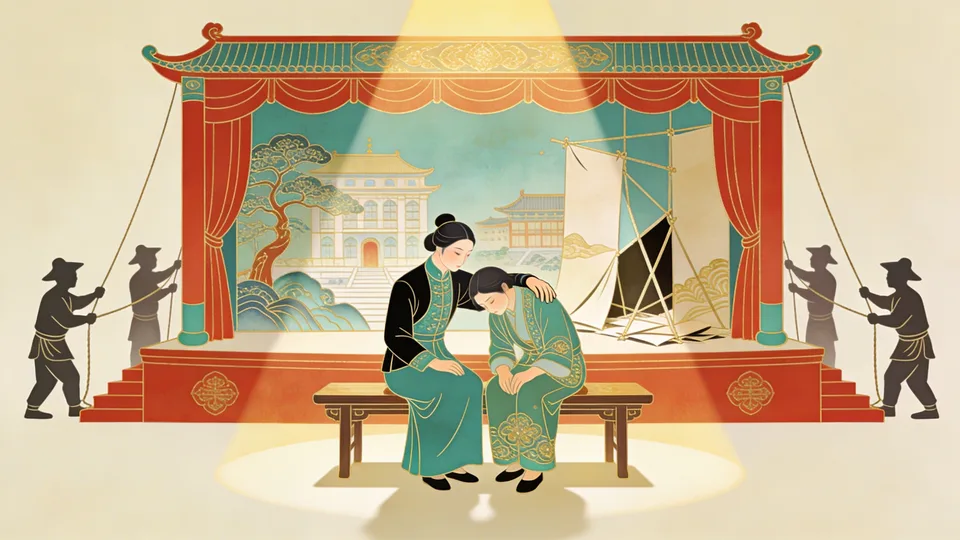
Chinese social culture has an explicit, named technology for cooling marks out: 下台 (xiàtái) — literally “stepping down from the stage.” When someone has lost face, failed publicly, or been caught in an untenable position, the people around them construct a 台阶 (táijiē, “staircase”) — a graceful exit, a face-saving reframe, a way to descend from the exposed position without the full humiliation being made visible.

This is cooling in its purest, most self-aware form. The entire social vocabulary exists: 给面子 (giving face), 留面子 (preserving face), 找台阶 (finding a staircase to step down). Where American cooling disguises itself as procedure (lawsuits, exit interviews, performance plans), Chinese cooling is openly relational. Everyone knows what is happening. The cooler is not hiding the cooling. The mark is not pretending he does not need it. The social contract is: we will construct your graceful exit, and you will take it. The violation is not losing. The violation is refusing the staircase — making everyone watch you fall.

This extends to the highest levels of power. When officials are removed, the language is carefully chosen to provide 下台: “retired for health reasons,” “reassigned to advisory roles,” “stepped down to spend time with family.” The fiction is transparent but structurally necessary — it preserves the system’s ability to remove people without creating enemies who have nothing left to lose.

The Failure to Cool: 内卷 and 躺平

When the gaokao script breaks and 下台 does not scale to an entire generation, you get two responses that map precisely onto Goffman’s framework.

内卷 (nèijuǎn, “involution”) is the mark who doubles down. The script failed, but instead of accepting the loss, the mark intensifies the same strategy — more studying, more credentials, more competition for the same shrinking prizes. This is Goffman’s “sustained personal disorganization” — the refusal to accept a diminished self, expressed not as rage but as frantic, futile effort. The 内卷 generation is running harder on a treadmill that has been disconnected from the floor.

躺平 (tǎng píng, “lying flat”) is the mark who refuses to be cooled — but refuses silently. No squawk, no lawsuit, no scene. Just withdrawal. The 躺平 generation has seen through the confidence game and decided that the only winning move is not to play. This is not the “personal disorganization” Goffman describes — it is organized, deliberate, and philosophically coherent. It is also terrifying to the system, because the entire social order depends on marks continuing to play even after they lose.

There is a third response: the Spiritual Wumao, who can neither double down nor withdraw but instead grafts his ego onto the State itself. He channels the uncooled rage outward — into digital nationalism, purity policing, xenophobic crusades — because the nation is the one identity that cannot be diminished. This is the uncooled mark who found a way to keep playing by changing what the game is about.

The character who crystallizes the Chinese cooling failure is Lu Xun’s 孔乙己 (Kong Yiji) — the failed scholar who insists on wearing his scholar’s robe long after everyone knows he will never pass the imperial exam. He cannot be cooled. He cannot accept the substitute role. He is stuck in the identity the game promised him, and the identity has become a prison. Contemporary Chinese internet uses 孔乙己 as shorthand for the educated unemployed — a generation wearing the scholar’s robe of their 985 degrees, unable to step down from a stage they were promised would be theirs.

When Cooling Fails

Cooling also maintains the Manufactured Normalcy Field at the individual level — when a piece of someone’s “present” collapses and reveals the un-normalized future underneath, cooling is the social machinery that helps them accept a diminished reality and re-enter the Field.

Goffman’s most haunting observation: a mark who cannot be cooled is a person who cannot accept a diminished self. They keep insisting on the version of themselves that the blowoff destroyed. This is what he calls “dying socially” — and a role, in Goffman’s framework, is not just a job or a status. It is one of your social lives. When a role is lost involuntarily and permanently, one of those selves dies.

The resentment that follows is not an emotion. It is a structural position. The uncooled mark builds an entire identity around having been wronged — guarding the treasure chest of grievances, investing every ounce of emotional energy in self-justification rather than adaptation. The resentment becomes load-bearing: remove it and the entire self-structure collapses, because the resentment IS the self-structure. The mark would rather be a righteous victim than a diminished survivor.

This produces hard knots — states where the mark is:

  • Too aware to accept the consolation prize (they see the cooling for what it is)
  • Too proud to accept the diminished role (the old identity is fused to the self)
  • Too angry to move on (the injustice feels like it demands a response)
  • Too invested to start over (the sunk cost is not just money but identity)

The local optimum of resentment is stable because every exit looks worse. Accepting the loss means admitting you were a mark. Starting over means admitting the years were wasted. Moving on means letting the operators win. So you stay in the knot, and the knot becomes who you are.

Goffman maps the geography of uncooled marks in mid-century America: skid rows, hobo jungles, county asylums, cheap rooming-house districts. These function as graveyards — places where the socially dead are gathered and separated from the living community. The segregation is “at once a punishment and a defense.” Punishment for failing. Defense for the rest of us — so we do not have to look at the evidence that the game can end this way. The graveyards make the failures invisible, and that invisibility is what allows everyone else to keep believing in the fairness of the game.

Dimwit / Midwit / Better Take

The dimwit take is “don’t be a sucker — learn to spot the con and you won’t get played.”

The midwit take is “this is just cynical sociology — real relationships and real achievements exist, and calling everything a con is nihilistic edgelord talk.”

The better take is that the confidence game is not a conspiracy — it is the operating system. Nobody designed it. The scripts are not lies in the sense that liars tell them. They are load-bearing fictions that hold up the social order because the alternative — telling everyone upfront that most of them will fail — would collapse the motivation that makes the system run. The pseudo-agent who sees the game clearly but cannot operate within it is not free — they are stuck in a more sophisticated version of the same trap. The person who truly understands cooling does not refuse the game. They play it with open eyes, accepting that they will sometimes be the mark and sometimes the cooler, and that the art of living is knowing when to accept a diminished self and when to refuse — and having the wisdom to tell the difference.

Main Payoff

Goffman notes that actually dealing with the pain of identity loss is the work being avoided by cooling-out processes. The cooler’s job is to make the pain manageable, not to resolve it. But pain deferred is not pain eliminated — it compounds. Individuals and nations that cool themselves out for long enough eventually face a reckoning with the accumulated weight of all the selves they quietly buried.

The most dangerous moment is not when the blowoff hits. It is when the cooling infrastructure itself becomes visible as cooling. When the therapy feels like management. When the “career transition” feels like a euphemism. When the national mythology feels like propaganda. When the 台阶 feels like a trap rather than a staircase. At that point, every cooling technique becomes evidence of the con rather than consolation for it — and the mark’s rage is no longer directed at the loss but at the entire apparatus that tried to make the loss acceptable.

We are living through such a moment, in multiple civilizations simultaneously. The scripts are breaking. The coolers are exposed. And the marks — all of us — are discovering that the hardest thing is not losing. It is admitting you were playing a rigged game and that the version of yourself who believed in it was the mark all along.

References:

  • Erving Goffman, On Cooling the Mark Out: Some Aspects of Adaptation to Failure, Psychiatry, 1952
  • Venkatesh Rao, The Cactus and the Weasel, Ribbonfarm Studio, rereading of Goffman