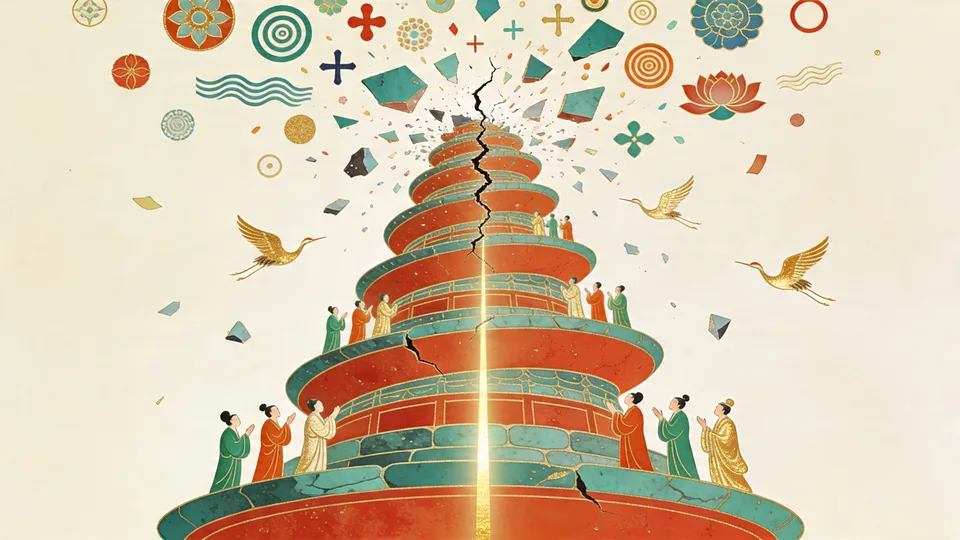
God didn’t knock the tower down. He just gave the builders different words for brick.
In Genesis, the whole earth has one language, and its people decide to build a city with a tower that reaches heaven. God comes down to look at it and then does something odd. He doesn’t strike the tower with lightning or flood the plain. He confuses their speech so they can no longer understand one another, and the building stops on its own. The builders scatter across the earth.
The usual reading is that pride got punished. But if the point were punishment, why choose language as the weapon? The story implies something stranger: a project that large was only ever held together by agreement, and removing the agreement was enough to end it. Read that way, The Tower of Babel is not a story about hubris. It is a structural description of the coordination frontier — the precise boundary where the marginal utility of centralized cooperation is eclipsed by the exponential growth of communication entropy. Past a certain scale, agreement itself becomes impossible, and any structure that required agreement comes apart beneath its own weight.
The coordination frontier
Every group that cooperates pays a cost of alignment: the overhead of checking that everyone still means the same thing. That cost grows faster than the group does. Communication links between N people grow roughly as N², while the payoff from adding one more person grows far more slowly. At some size, each new builder costs more in coordination than they add in labor.
Firms reach this point first. The team that built the product cannot ship a change a year later, because every change needs a meeting, every meeting needs a pre-read, and every pre-read needs a round of stakeholder alignment. The feedback loop that could have saved them is the first thing to break, because feedback depends on a shared vocabulary and the vocabulary has started to drift.
Empires reach it at a much larger N, with the same symptom. Rome, the Catholic Church and the Soviet Union each came apart along the lines where the periphery stopped meaning what the center meant by the same words. Latin became the Romance languages. Orthodoxy split from Catholicism. Party discipline fractured into regional nationalisms. The collapse is never announced by the end of the empire. It is announced by the moment two provincial governors cannot agree on what an imperial edict says.
Why the confusion protects
If scale itself is the problem, the confusion of tongues looks less like a curse and more like a firewall. In a world with one language, one king and one way to fail, a single bad idea can spread everywhere at once, because it never has to cross a translation layer. Many languages mean many separate copies of how to live. When one civilization builds a tower that will collapse and kill everyone inside, the others, speaking differently, are unaffected and can try again. Cultural diversity works like genetic diversity: a catalog of backup copies that preserve survival knowledge no single frame could derive. Read this way, God is a decentralist. The curse of many tongues is a hedge against a single point of failure, and Babel is a structural diagnosis, not a moral fable.
The tower also shows which kind of coordination fails. It was a mandate, a top-down decree that every builder shall follow this plan. Mandates need a protocol, protocols need enforcement, and enforcement needs communication, which is exactly what decays with scale. A Schelling point works differently. It is the outcome people converge on without being told, like the meeting spot two strangers both guess or the queue that forms with no one organizing it. Each person computes it locally from shared priors, so its cost does not grow with N. The strong gods of faith, tradition and communal bonds were focal points of this kind. The post-war project to replace them with a managerial scientific consensus substituted mandate for Schelling, and the bill for that substitution is the rootlessness and ideological susceptibility that followed.
The new tower
The internet and large language models are a new attempt at one tongue: digital translation and algorithmic consensus standing in for the shared meaning the strong gods used to supply. It is impressive, and for now it works. But the next collapse will not look like a loss of languages. What breaks is the shared object layer, the consensus reality that lets people disagree inside one world: the implicit agreement about what a piece of evidence is. Two people watch the same video and see two different events, because each has been served a different ontology by their own personalized feed. They still say “vaccine”, “election” and “war” with the same phonemes, so the talking keeps producing the feeling of coordination while their models of reality drift further apart. When the shared-reality substrate breaks, the tower is already down — the rubble just hasn’t finished falling yet.
Restoring one ontology by punishing deviation doesn’t work, because the monoculture is the fragile thing the confusion of tongues protected against. Some people have already started moving the other way: private messaging networks, in-person meetings, closed communities with high barriers to entry, compute and storage under small-group control. On the surface this looks like privacy or status. Structurally it is rebuilding the cultural silos that make civilization antifragile to the next collapse of universal consensus.
The strongest objection is that large-scale coordination plainly exists. Prices coordinate billions of strangers, and scientists on different continents agree on what a measurement means. But those are Schelling systems rather than mandates: nobody has to be ordered to understand a price. So the limit bites on coordination that has to be transmitted and enforced, which is what every universal project eventually requires. The Tower is not a warning against ambition. It is a warning against universalism — and the lesson is that every species that survived long enough to tell its story did so by fragmenting before it had to. The harder question is which of the things you assume everyone shares are real focal points, and which are only held up by builders shouting from one floor to the next.