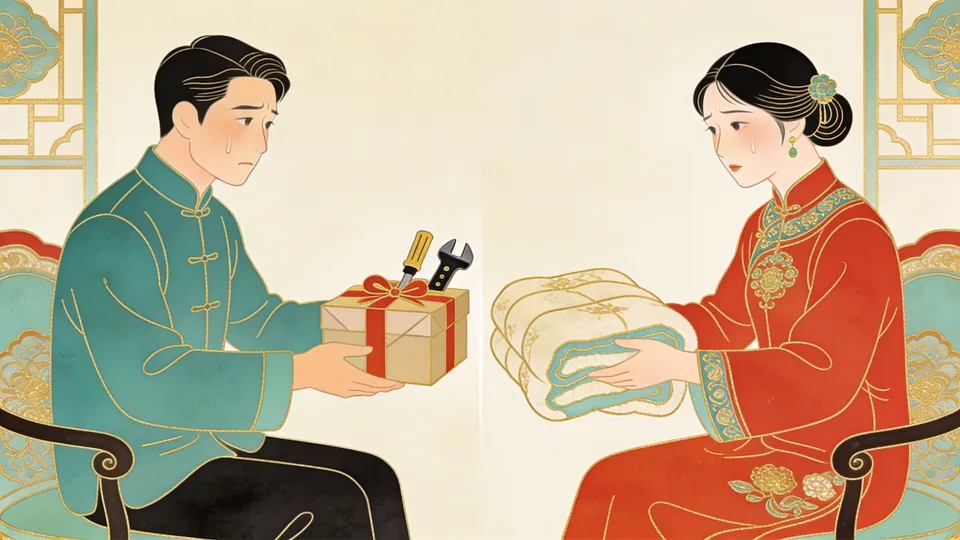
The fix he offers is a love letter she reads as a dismissal.
She comes home upset about work. She wants to be heard. He listens for thirty seconds, identifies the problem, and offers a fix. She feels dismissed, because he clearly doesn’t understand her actual pain. He feels rejected, because his best effort to help was thrown back in his face. Both walk away convinced the other doesn’t care. Neither is wrong about their own feelings. Both are wrong about the other’s intentions.
The usual diagnosis is that one of them doesn’t care enough, or that he just needs to learn to listen. But both of them were trying. So why does an evening of two people trying end with both feeling unloved?
Giving what you would want
The answer running through John Gray and Shaunti Feldhahn is that each partner instinctively gives the other what they themselves need, not what the other needs. A man’s deepest fear is that he is not good enough: incompetent, inadequate, unable to provide. A woman’s deepest fear is that she is unworthy of receiving: too needy, too much, destined to be rejected if she asks for what she actually wants. Men are motivated and empowered when they feel needed. Women are motivated and empowered when they feel cherished.
Go back to the kitchen. For her, sharing the problem is the relief, and being asked about her feelings is connection. For him, a problem is something to solve, and solving it is how he expresses love through competence. So he offers his greatest gift, and she throws it away, because what she wanted was empathy. The reverse happens when she expresses concern about how he is handling something. She thinks she’s nurturing. He feels he’s being controlled. To offer a man unsolicited advice is to presume he can’t figure it out, which registers as a direct attack on competence; what he wants is acceptance, not help. The pattern holds because both partners are doing exactly what would make them feel loved if it were done to them.
The respect-love asymmetry sharpens this: men would rather feel unloved than disrespected. Women would rather feel disrespected than unloved. Crying is often a woman’s response to feeling unloved; anger is often a man’s response to feeling disrespected. The same fight looks like two completely different injuries depending on which side you’re standing on.
The crazy cycle
Once the asymmetry starts, it feeds itself. He doesn’t give enough love in her language, so she doesn’t give enough respect in his. He feels slighted and withdraws further; she feels more unloved and becomes more critical. She thinks, “If he loved me, he would listen.” He thinks, “If she respected me, she would stop criticizing.” Back in the kitchen, he explains why she shouldn’t be upset, which tells her he doesn’t care about her feelings. She expresses frustration with how he’s responding, which tells him he is incompetent. Within five minutes they are arguing about how they are arguing. He defends his point of view while she defends herself from his sharpened expressions.
Why does a thirty-second fix produce so much heat? When we are upset, approximately 90 percent of the upset is related to our past and has nothing to do with what we think is upsetting us. Generally only about 10 percent is appropriate to the present experience. The partner who triggers a disproportionate response is not the cause; they are the key that fits a very old lock. His drive to prove competence and her drive to be worthy of love are both neediness wearing different costumes, one chasing external proof of adequacy and the other chasing external proof of worthiness.
Translating
The obvious objection is that these are stereotypes and every individual is different. Individuals do differ, and the claim is statistical: it describes two common validation systems running on different fear structures, not a rule for every couple. Where it fits, though, it changes what a fight means. A man who understands that her criticism is a cry for love, not an attack on his competence, can stop defending and start connecting. A woman who understands that his withdrawal is identity maintenance, not rejection, can stop chasing and start trusting. The translation failure is not about caring too little. It is about caring in a language the other person cannot hear.
So the fix is not giving more. It is translating. When she comes home upset, he does not need to fix it; he needs to say “I hear you.” When he pulls away, she does not need to chase; she needs to say “I trust you.” The hardest part is that the right move, in each case, feels exactly wrong. Listening without solving feels like failure to him, and waiting without pursuing feels like abandonment to her. If ninety percent of that feeling is the old wound talking, how much of tonight’s argument was ever about tonight?
References:
- John Gray, Men Are from Mars, Women Are from Venus
- Shaunti Feldhahn, For Women Only / For Men Only