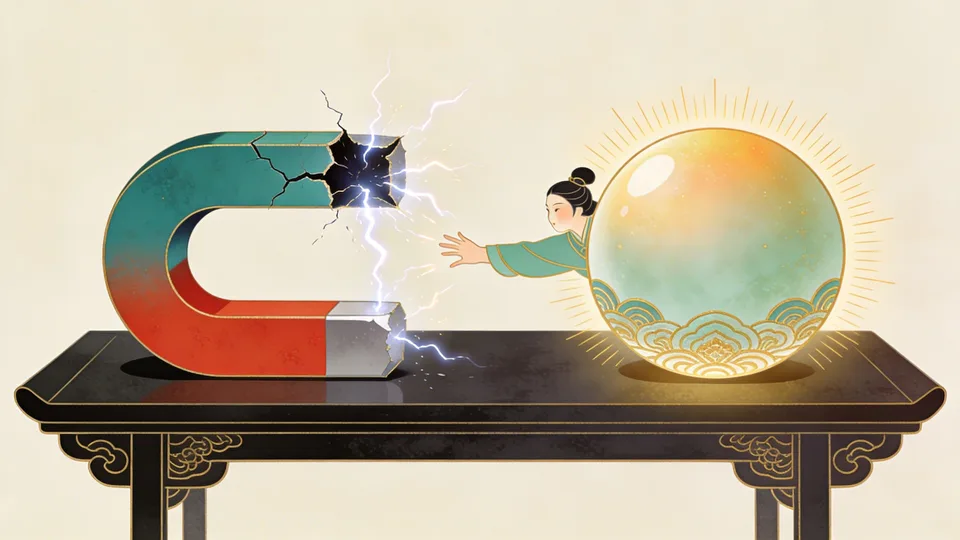
The person you desire most is usually the one who touches your deepest wound, not your deepest love. Desire is not affection, connection, or compatibility. It is a force that pulls you toward whoever mirrors your unresolved pain. And you mistake the pull for destiny.

Simple Picture

ELI5: the psyche does not chase comfort. It chases familiarity. If your childhood taught you that love means anxiety, you desire the person who destabilizes you — not because they are right for you, but because they feel like home. Not the home you deserved, but the home you survived.

Core Claim

Desire is the wound calling out to itself.

When someone touches the bruise you have been carrying since childhood — the one that says “I’m not enough, I’m not wanted, I’m not chosen” — your brain mistakes the pain for passion. The intensity feels cosmic, spiritual, destined. But destiny has nothing to do with it. The unconscious is seeking completion through repetition, not healing. Girard’s mimetic theory names the social version: you desire what others desire, mediated through models whose wanting makes the object desirable. In relationships, the model is the wound. In markets, the model is the person whose portfolio you envy. Both produce the same illusion — that the desire is autonomous when it is actually imitative.

The psyche is painfully strategic in its attractions. It chooses people not for how they treat you, but for what they represent inside you:

  • If you grew up earning love, you desire the person you cannot earn
  • If you grew up invisible, you desire the person who barely notices

The Esther Perel questions operationalize this: prompts like “what I learned about love from my parents” and “the part of my parents I’m most afraid of becoming” surface the specific imprint that desire is chasing.

  • If you grew up abandoned, you desire the one who leaves

You are not trying to love them. You are trying to rewrite your past using their hands. And they cannot reach the place the wound lives.

Why Intensity Is Not Love

The wound does not want love. It wants intensity. Intensity is the closest thing it knows to feeling alive. At the neurochemical level, this maps onto dopamine — desire is an anticipatory signal that fires hardest for unpredicted, inconsistent rewards. The inconsistent partner produces a stronger dopamine spike than the stable one, which the psyche misreads as evidence of deeper connection.

Maté names the ultimate form: the fundamental addiction is to the fleeting experience of not being addicted — a brief liberation from emptiness. The drug restores the childhood vivacity the addict suppressed long ago. Addiction is passion’s dark simulacrum — it resembles passion in urgency and promise, but unlike passion, its alchemy does not create new elements from old. This is why desire and neediness are structurally linked. The needy person organizes their entire motivational system around someone else’s approval — and the person whose approval feels most urgent is the one who withholds it in the same pattern as the original wound-giver. The desire feels like proof of love. It is proof of unresolved pain.

Real love does not cause anxiety. It does not confuse you. It does not make you beg for clarity. Real love is calm. De Mello captures the alternative in awareness: “what I really enjoy is not you; it is a kind of orchestra that plays one melody in your presence, but when you depart, the orchestra doesn’t stop.” Love that does not depend on the other person’s presence for its existence. And calmness terrifies the wounded because calmness feels like emptiness — because you have lived so long inside your wound that peace feels like something is missing. The calmness extends to speech: saying “I love you” becomes possible — not ceremonial, not high-stakes, just accurate — only when the wound has stopped trying to use the sentence as a demand for intensity.

The Repetition Problem

The unconscious repeats what it remembers, not what it needs. The puer-aeternus is the archetype of this repetition: the Don Juan who projects the image of the perfect woman onto each new partner, crashes when she turns out to be human, and moves on to project again — eternally chasing a mother-goddess no real person can embody. This is why idealization is so catastrophic for its target — the projectee is punished not for making a mistake but for breaking the fantasy, and the fantasy was the entire reason they were loved.

At the community level, this intensity-seeking produces the unreliability of romantics — people who sparkle in every room but cannot be counted on, because showing up when you don’t feel like it registers as a betrayal of authentic feeling.

This is why every relationship feels like deja vu. You are not ending up in the same situation. You are returning — returning to the moment you became disconnected from yourself. Desire always pulls backward. Love moves forward.

The generational version of the same mechanism is the urge to procreate as wound-replication: the wish for a little me, to bear the weight, to subconsciously replicate this exquisite, familiar pain. The bloodline ends names the specific refusal — choosing not to cast a child into the role the wound is trying to fill.

The person who triggers your wound cannot be the person who heals it. The same emotional pattern that created the longing will recreate the pain. You think you are chasing love, but you are chasing closure. You think you are longing for a person, but you are longing for yourself. playing-your-edge reframes the masculine side: when a man’s purpose is intact and he is living at his edge, he does not need the relationship to provide identity or validation — which means he can actually love rather than extract.

Anxiety as Fuel

The deepest trick of the wound-driven relationship is that the anxiety is not a bug — it is the entire product. The cycle of doubt, reassurance-seeking, emotional crises, and temporary repair is not something that happens inside the relationship. It is the relationship. Two people organized around managing each other’s anxiety have built a machine whose only function is to generate and resolve distress. Remove the distress and the machine has nothing to do.

The brain would rather be right and miserable than wrong and happy. A nervous system trained on chaos does not experience a calm partner as relief — it experiences them as prediction error. So it rejects the data: sabotages the peace, manufactures a fight, selects for whoever confirms the familiar signal. The anxiety is not a feeling the brain is trying to escape. It is a prediction the brain is trying to confirm.

This is why “fixing” the anxious dynamic does not save the relationship — it ends it. If the economic anxiety dissolves, if the attachment wound heals, if the external pressure lifts, what remains is two people in a room who have never actually enjoyed each other’s company. They were never choosing each other. They were choosing the relief. The partner was not a person but a delivery mechanism for the temporary absence of dread.

The needy couple who manufacture crises and rush to repair them are not failing at love. They are succeeding at the only game they know how to play. The fixer needs problems to feel valuable. The crisis-generator needs rescue to feel chosen. Both get what they want — and neither gets what they need. When one partner heals and stops generating anxiety, the other does not feel relief. They feel abandoned — because the anxiety was the only bridge between them, and now there is nothing to cross.

What Healing Changes

When the wound heals, your appetites change. The old desires die quietly. People you once longed for no longer move you. The spark that once felt irresistible starts feeling like a warning.

You stop craving intensity and start craving clarity, safety, consistency, peace. This is what feline philosophy describes as the natural state: cats do not love to divert themselves from loneliness or chase wound-matching partners. They love when the impulse takes them. If they do not enjoy the company, they leave. Your nervous system begins rejecting what it used to chase. People mistake this for losing passion. It is not loss. It is the difference between passion built on pain and passion built on wholeness.

The person you are meant for does not activate the wound. They heal it just by existing. That sounds soft, but it is the hardest thing to accept — because the wounded psyche has spent a lifetime equating boredom with safety and chaos with love.

The Thinning Crowd

Watts describes the next stage that most accounts of healing skip: you are whole, you are free, you no longer mistake hunger for love — and the crowd rather thins out. Where once the world was full of possibilities, suddenly there are only very few. It is rare to meet someone who has walked through their own shadows and come out awake on the other side. Most are still playing the old game.

This is the social cost of clarity applied to romance specifically. The gap between seeing clearly and finding anyone who can meet you at that depth is not theoretical. It is a lived experience of standing apart — not lonely in the usual sense, but holding a fullness that very few have learned to hold space for.

The wish that emerges is not for the old fever but for something quieter: love that comes clean, unmasked, unforced. Not as rescue, not as possession, but as the meeting of two whole beings who choose to share their freedom. Better the solitude of clarity than the company of illusion. Better to wait, even if it means years, than to surrender to the old hypnosis — because once the eyes have opened, peace itself is too precious to be gambled.

De Mello’s orchestra keeps playing whether the person is there or not. boundaries maintain a self that exists independent of witness. The question is no longer “who completes me?” but “who can I share this completeness with without having to dim it?”

Common Misread

The dimwit take is “follow your heart — if the desire is strong, it must be real.”

The midwit take is “just choose the safe, stable person and the passion will come.”

The better take is that desire is diagnostic information, not navigational guidance. When you feel intense longing, the right question is not “why do I want them?” but “what wound in me wakes up when they appear?” The moment you answer that question, the spell weakens. The desire was never about the person. It was about the unfinished business inside you. The diagnostic flips forward once the pattern is read: the same precision with which the wound identifies wound-activating partners also identifies the domain where your engagement is most alive — the sensitivity trained by the wound is inseparable from the capacity that domain requires, which means desire is pointing at two addresses at once and they are the same address.

Main Payoff

Desire is regression. Love is evolution.

This framework reframes the entire landscape of attachment: the push-pull cycle in borderline-personality-disorder, the needy-needy codependence described in neediness, and the defensive shutdown in depression all become variants of the same underlying pattern — a psyche organized around a wound it refuses to face directly.

The wound is not trying to hurt you. It is trying to close. But it keeps choosing the hands that reopen it, because those are the only hands it recognizes.

Barry Long names what surfaces when you stay instead of flee: the fiendess — the shadow that emerges in love only when you are too attached to walk away. A person who has not yet experienced the hatred of the fiendess has not yet experienced love. The fiendess is not cruelty. It is the demon of unmet need made visible by proximity — the shadow that only shows itself when the stakes are real. Both partners then face a choice: bluff and bluster through, eventually surrendering into half-dead compromise — or let the shadow surface and integrate it. Most relationships end in the compromise. The rare ones that survive the fiendess are the ones where both people chose the harder option.

References:

  • Alan Watts, lecture on awakening and romantic love