In 1933 you could keep your diamonds. Your gold you had to hand in.
In 1933 Roosevelt made it a criminal offense for Americans to hold gold. The government did not care who owned diamonds or fine watches. Why would it care about a soft yellow metal sitting in someone’s drawer, and then go on buying it for itself?
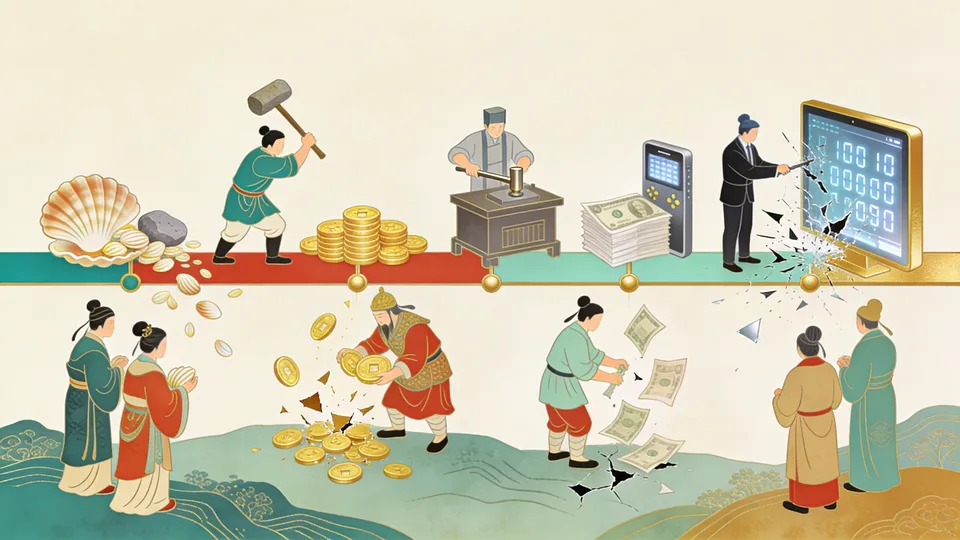
Lyn Alden’s Broken Money answers with a different picture of what money is. We tend to think of money as a thing with value, or else as paper that only works because everyone agrees to pretend. Alden treats it as a ledger: a way of remembering who owes what to whom. It began as favors remembered within a small community and, as trade reached strangers, moved into shells, beads, silver, gold, paper and finally numbers in a computer. The gold ban makes sense once you ask what each of those ledgers was protecting against.
Money works until technology breaks it
Money has to be resistant to the desire to make more of it. Each money in Alden’s history failed the same way: someone found a cheap way to produce more of it. West African trade beads were money until European glassworks could turn out lookalikes cheaply, and the people holding the old beads gave up real goods for glass that cost Europe almost nothing to make. Shells fell to drilling technology, silver to English banking and banknotes, and gold to electronic settlement. The pattern gives the book its central principle: Whoever has the most advanced technology controls the ledger because they control the scarcity.
Gold lasted longest because the world holds roughly 67 years of mine production above ground, so even a mining boom barely moves the total. That property is what made gold dangerous to a government in 1933. A ledger kept in gold cannot be quietly diluted.
Why debasement needs a fence
Diluting money is tempting because it is easier than taxing. A government that can print can fight a war without asking anyone to pay for it openly, which is why a hard currency requires the cost of war to be made explicit. Most empires debased their coins gradually over decades, and anything that can be debased eventually will be debased.
But dilution only works if people cannot step outside it. If Americans could hold gold, they would move their savings out of dollars the moment the dollars began to lose value. That is why the gold ban had to come before the devaluation, and why it was followed in 1971 by ending foreign redemption too, leaving the dollar redeemable for nothing. The debasement of a ledger can only occur when attempts to flee are blocked. Blocking capital flight is an indication of purchasing power siphoning. It is exit being closed on purpose.
What gets lost when the fence goes up is the signal. When information is compressed into a price, the process, like a hash, is destructive. You cannot extract the original information out of a price. It is compressed into pure objective signal. A high price is a call for help that draws in new supply, and a currency being diluted bends every price at once. It also bends them unevenly: those closest to new money spend it before prices rise, so the closer you are to money creation, the more you can take advantage of market ignorance. That is the Cantillon effect.
What the ledger is for
The usual arguments about money split into “it’s all a scam” and “the system works, it just needs regulation.” Alden’s view is narrower and harder to dismiss: money is a technology for coordinating human activity across time and trust boundaries, and like all technologies, it has characteristic failure modes that the operators exploit. The gold ban was not an accident or a misunderstanding. It was the operators closing an exit before using one of those failure modes. Fix the Money, Fix the World makes the Bitcoin-native version of the claim.
So the question the 1933 ban leaves behind is not whether your money holds value today. It is what your savings are kept in, who can make more of it, and whether you would be allowed to leave.
References:
- Lyn Alden, Broken Money: Why Our Financial System is Failing Us and How We Can Make It Better