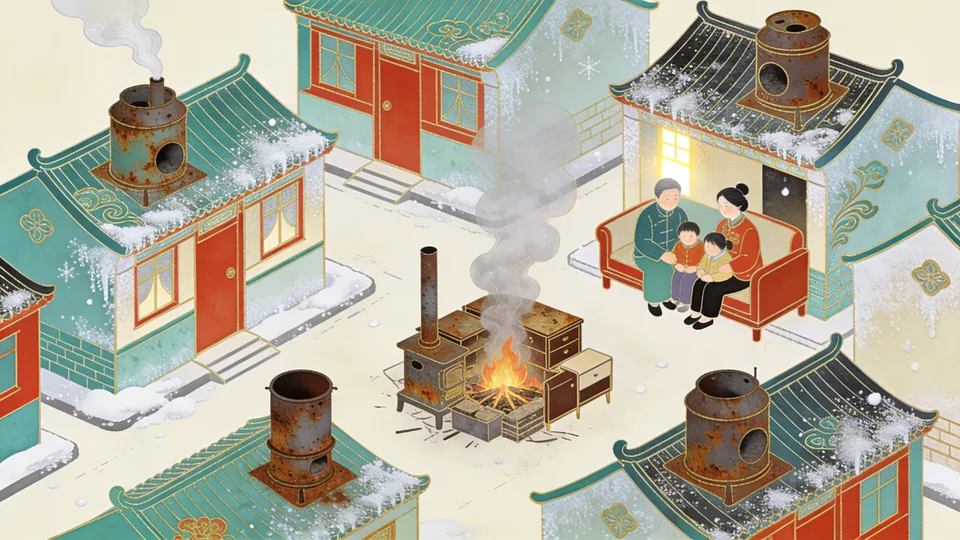
After 1945 the West treated flags, churches and families as fire hazards, and the house went cold.
Imagine a neighborhood where a furnace sets a house on fire. Afterwards the residents decide that all fire is dangerous, and they remove every furnace, every stove and every candle. The houses become fire-safe, and uninhabitably cold. R.R. Reno’s argument in Return of the Strong Gods is that the West did roughly this after the Second World War, and that we are now living in the cold houses.
In the wake of WWII, the leadership classes of America and Europe made “never again” the core of their ideational universe. But the resolution to prevent fascism, war and genocide soon became an all-consuming obsession with negation. Influential thinkers like Karl Popper and Theodor Adorno helped convince the post-war establishment that the fundamental source of authoritarianism was the “closed society,” marked by strong gods: strong beliefs and truth claims, strong moral codes, strong relational bonds, strong communal identities and connections to place and past. Ultimately, all the “objects of men’s love and devotion, the sources of the passions and loyalties that unite societies.” The cross, the flag and the national myth bind a civilization precisely because they work below thought, which is exactly why the post-war project found them terrifying.
The unifying power of the strong gods came to be seen as dangerous. Faith, family and above all the nation became suspect, temptations to fascism. Was banishing them the right lesson to draw from the fire?
What replaced the furnace
Something had to do the work the strong gods had done, and the post-war establishment dreamed of governance via scientific management: politics transformed into “a social technology whose results can be tested by social engineering” (Popper), run by a cadre of carefully selected “institutional technologists.” The result was vast permanent administrative states, run by an oligarchic elite class of technocrats schooled in social engineering, dissimulation, false compassion, the manipulation of allegedly-neutral processes, and a litigious ethos of risk-avoidance. Its pinnacle was the “rules-based liberal international order,” in which war between states would become a relic.
The technocrat does not rule; he “manages,” and the distinction lets power be exercised while denying that power is being exercised. For a while the arrangement felt like liberation, partly because the post-war order also exported its costs to a global periphery, the mechanism Spice describes.
The cold house
Instead of producing utopian peace and progress, the open society consensus and its soft, weak gods led to civilizational dissolution and despair. Hirschman’s framework explains part of the mechanism: the open society maximized exit while atrophying voice, so the people with the strongest convictions, who would have fought to improve the commons, left for private alternatives. What remained were nation-states that lack the strength to hold themselves together, let alone defend against non-open, non-delusional societies.
Despite its obsession with “openness,” the world of the post-war open society has always been, in its own way, a strictly enclosed and deeply stifling place. Human nature is treated as something dangerous to be contained or remolded into a reliable cog. Its dream of perfect freedom, equality, rationalism and passivity has always been one “in which no great heart could beat and no great soul could breathe.”
And the cold does not stay quiet. Arendt warned that totalitarian solutions would survive the fall of totalitarian regimes “in the form of strong temptations which will come up whenever it seems impossible to alleviate political, social, or economic misery in a manner worthy of man.” By dissolving the strong gods, the open society produced the rootless, lonely, conviction-less population she identified as most susceptible to ideology. The residents of the cold houses are starting to build fires again, and nobody remembers how to do it safely.
Neither furnace nor freeze
None of this means the old ways were simply better. The furnace really did burn the house down. Strauss understood that the strong gods of the closed society “are permanent truths, not atavisms, no matter how unpalatable they are to the progressive-minded,” and that a society that cannot affirm them invites catastrophe, no less than does a society that cannot question them. Put plainly, the strong gods are not good or evil — they are strong, which means they can be fearsome and dangerous, or they can protect and defend. The hard question is whether a civilization can hold strong convictions while keeping the capacity to question them, a balance history suggests is extraordinarily difficult.
Taleb’s forest-fire principle explains why suppression made things worse: systematically preventing small fires to be “safe” makes the catastrophic fire inevitable. It remains an open question whether the renewal of strength and vitality can be reintegrated harmoniously, or whether the world will again be plunged into greater strife.
References:
- R.R. Reno, Return of the Strong Gods: Nationalism, Populism, and the Future of the West
- N.S. Lyons, American Strong Gods, The Upheaval