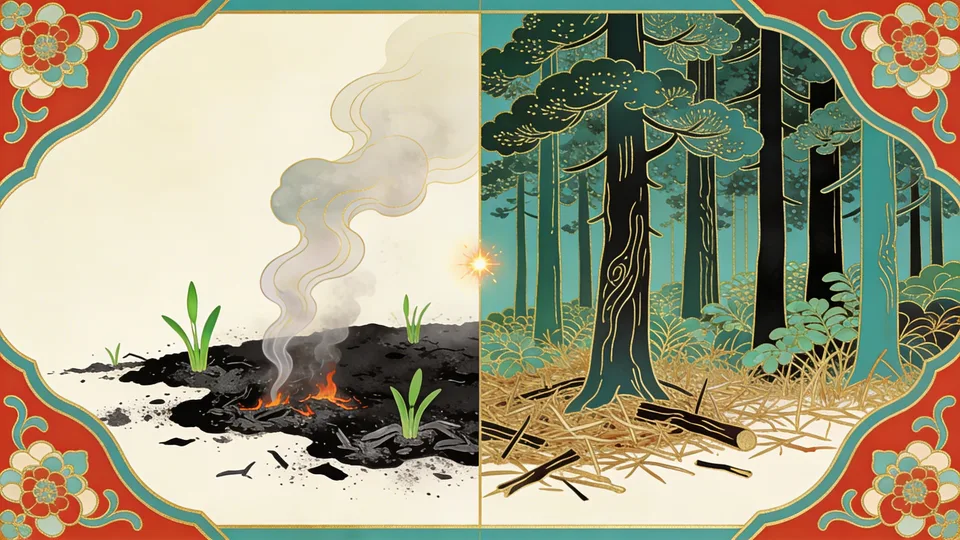
Put out every small fire to be safe, and you are building the big one.
Suppose you manage a forest and you are told to keep it safe. The obvious policy is to put out every fire as soon as it starts. For years the policy looks like a triumph: fewer fires, fewer losses. Meanwhile the dead wood and dry brush that small fires would have burned off keep piling up, until one fire finds all of it at once. Small forest fires periodically cleanse the system of the most flammable material. Preventing them “to be safe” makes the big one much worse.
How can protection produce the catastrophe it was meant to prevent? Nassim Taleb’s answer in Antifragile starts with a missing word. A wine glass is fragile: drop it and it breaks. A rubber ball is robust: drop it and nothing happens. But some things get better from being dropped. Muscles strengthen under load, immune systems improve with exposure, and a forest stays healthy through small burns. The opposite of fragile is not robust but antifragile, and the modern mistake is to treat antifragile things like wine glasses.
The fragilista
Taleb calls the person who makes this mistake the fragilista. He works in medicine, economics and social planning, and he favors policies whose benefits are small and visible while their side effects are potentially severe and invisible. As with neurotically overprotective parents, those trying to help are often hurting us the most.
The forest shows why he keeps getting hired. It’s much easier to sell “Look what I did for you” than “Look what I avoided for you.” A fire put out is visible; a catastrophe prevented by letting small fires burn is not. So intervention gets rewarded even where it causes harm. Copy editors show the reflex on a small scale: each will propose a fixed number of edits per page, and a second editor will suggest just as many, sometimes reversing the first editor’s changes. Incidentally, those who do too much somewhere do too little elsewhere.
The cure is often to do less. Procrastination is our natural defense, letting things take care of themselves and exercise their antifragility. Taleb extends this into via negativa: true wealth is largely subtractive, and if something can be removed and life improves, it was harmful.
Skin in the game
The fragilista can keep making the same mistake because he doesn’t live in the forest. When the big fire comes, the people downwind pay. Taleb treats this as the deeper corruption: power goes to those who steal a free option from society, the bankers, executives and politicians who capture the upside while distributing the downside. In traditional societies, rank tracked exposure; knights and generals stood where the danger was greatest. Never trust the words of a man who is not free. An academic has nothing at risk from his opinions, so he need not even remember them. The Intellectual Yet Idiot is the type this arrangement selects for: fluent with symbols, insulated from the error signal. Taleb’s practical test is to never ask the doctor what you should do. Ask him what he would do if he were in your place.
Not a love of chaos
The easy misreading is that disorder is good and you should seek it out. Taleb’s distinction is narrower. Stressors to discourage are artificial, man-made stressors that blunt the message from reality; the stressors to welcome are messages from nature. The point is that antifragility is not about seeking disorder but about building systems that convert small shocks into strength rather than systems that accumulate hidden fragility by suppressing all shocks. Remove the natural stressors and the antifragility threshold drops, until challenges that would have caused growth become deadly.
His way of living with this is the barbell: extreme safety at one end, so nothing can ruin you, and many small bets with unlimited upside at the other, with nothing in the fragile middle. Provide for the worst; the best can take care of itself. Someone with that payoff needs to be right far less than half the time.
The same logic explains where change comes from. Much progress comes from the young because of their relative freedom from the system and courage to take action that older people lose as they become trapped in life. The young are the small fires of a society: they fail often and cheaply, and the whole gets stronger from it. The antifragility of the system comes from the mortality of its components. The uncomfortable question Taleb leaves is how much of what we call safety is really a pile of dry brush.
References:
- Nassim Nicholas Taleb, Antifragile: Things That Gain from Disorder