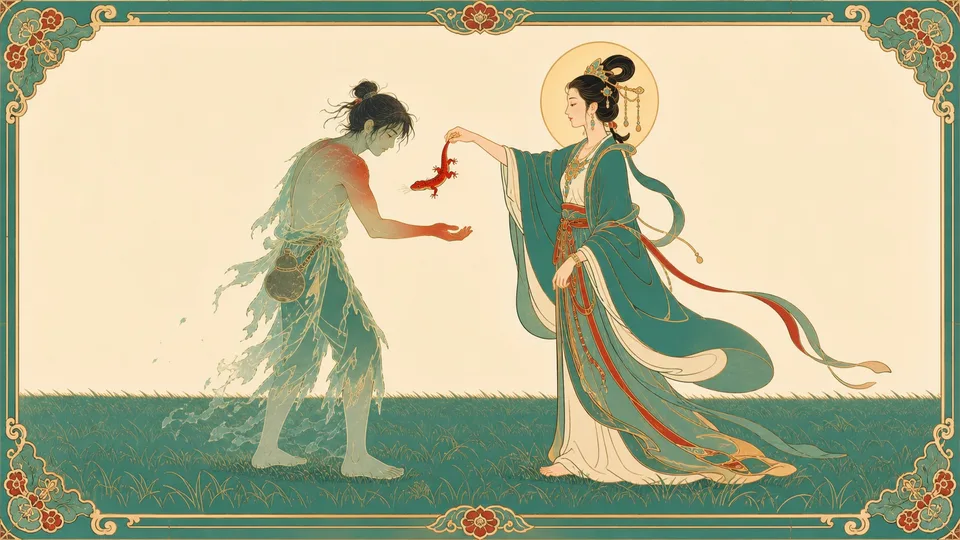
The grass in Heaven hurts the ghosts’ feet. The grass is not the problem.
A red lizard whispers from a ghost’s shoulder. An angel offers to kill it. The ghost wants relief, but not at that price: perhaps the lizard will quiet down later; perhaps the operation can be postponed; perhaps losing it will kill him too. Only when he finally consents does the lizard die, and return as a stallion strong enough to carry him toward the mountains.
Why hesitate, when the angel offers exactly what he says he wants? Most of us picture Hell as a punishment handed down. C. S. Lewis’s The Great Divorce answers the ghost’s hesitation differently: Hell is not usually chosen as misery. It is chosen as the right to remain the person for whom misery has become necessary.
The grass hurts because the ghost is thin
Lewis sends a busload of ghosts from a gray, sprawling town to the outskirts of Heaven. Instead of clouds, they find grass sharp enough to hurt their feet and raindrops heavy enough to pass through them. Heaven is not vaporous. They are.
In Lewis’s picture Hell is the vague, weightless place, and Heaven is density: things have consequences, persons remain separate, and truth does not negotiate with the stories that kept a ghost comfortable. The pain of Heaven is reality making contact with a self organized around avoiding contact.
That is why the ghosts do not need better information. Each one is met by someone who sees the trap and offers help. What they lack is consent to become someone for whom the information can matter.
Every ghost wants Heaven as an accessory
The ghosts are willing to visit Heaven. What they refuse is Heaven’s authority to alter the visitor. One wants intellectual exchange about truth, but not truth. One wants art to secure a reputation, but not beauty large enough to make reputation irrelevant. One wants justice as a permanent moral advantage, but not forgiveness, because forgiveness would end the case on which the self was built.
The hardest case is a grieving mother who demands reunion with her dead son. Her demand sounds like the purest love in the book, yet she treats Heaven as a clerk withholding her property. Lewis is not demoting parental love; he is showing a finite love claiming the right to overrule every other good, including the son’s. The test is not how intense the love is but whether the son is permitted to remain a person once he stops performing the function she assigned him.
Each ghost wants the atmosphere around goodness while keeping a veto over goodness itself, like a new room on a house whose foundation cannot support it. Accepting Heaven on its own terms would make the grievance, the reputation or the claim on the son pointless. The false self does not fear suffering as much as it fears becoming unnecessary. This is the terminal form of wanting to be right more than wanting to be free: at first a person carries a grievance, and eventually the grievance carries the person.
The lizard dies; desire gets its body back
So what does Heaven ask of the ghost with the lizard? Not negotiation: the angel must kill it. But what dies is not the underlying vitality. Released from its cramped form, the same energy becomes a stallion.
Lewis avoids two symmetrical mistakes. Indulgence obeys the lizard as authentic; repression treats desire itself as shameful. Lewis says the corrupted form must actually end so the trapped energy can find larger work. Vice, on this reading, is often not too much desire but desire reduced to a repetitive channel: lust reduces eros to stimulus, vanity reduces the wish to be seen to scoreboard management. Redemption does not erase the force. The force changes employment.
The ghost hears the offer as humiliation: become less yourself. Heaven is offering the opposite, but the offer arrives through the one doorway the defense exists to barricade. And grace cannot manufacture his consent without destroying the freedom it means to restore.
The strongest objection is that the scene is too dramatic to be useful: almost nobody gets an angel offering to kill their vice. Character hardens instead through ordinary repetitions whose stakes look trivial. A complaint becomes a style, the style becomes a reputation, the reputation becomes a social circle, and the circle becomes a world in which letting go would cost everything.
But that is Lewis’s point, not a flaw in it. The final separation is already happening inside small refusals, each time dignity outranks apology or possession outranks love. Hell is the cumulative achievement of protecting the self that cannot enter Heaven. The great divorce does not begin at death. It begins whenever reality offers a larger life and the smaller self calls the offer annihilation.
Which leaves the ghost’s question for anyone who doesn’t share Lewis’s geography: what good thing would feel intolerable to you unless it arrived on your terms?
References
- C. S. Lewis, The Great Divorce