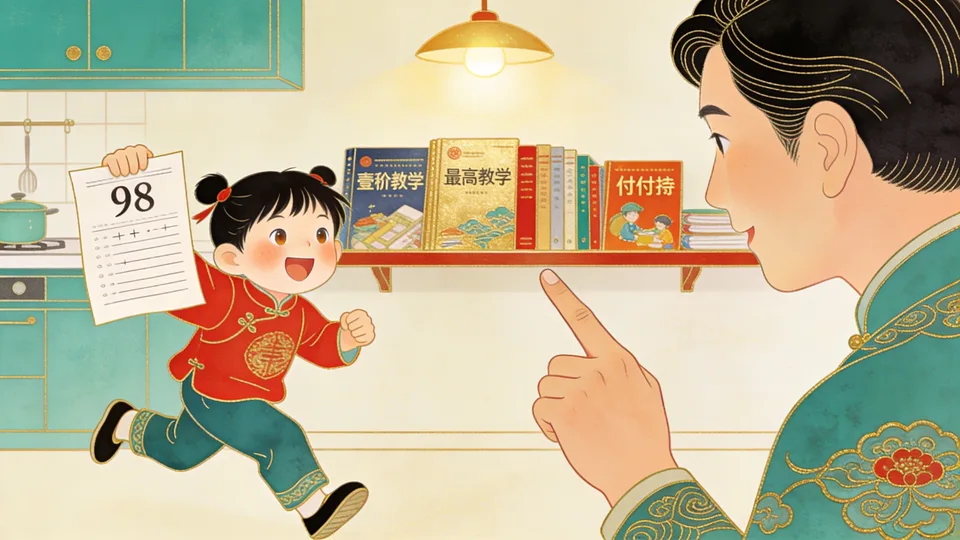
Ask a child why it wasn’t 100 and you’ll stop hearing about the 98s.
A child gets 98 on a test and runs home excited. The parent says: “Why not 100?” A face full of pride becomes a face full of defeat. Most parents who say this are not careless. They pay for tutors, enrichment programs and good schools, and they asked about the missing two points because they care how the child does. So why does one sentence do so much damage, and why can’t all that spending repair it?
Because the score was never the point. The child was offering a gift of achievement, and the parent evaluated the gift and found it insufficient. What the child learned was not that 100 beats 98. It was that their effort, and the feeling attached to it, does not matter much to the people who matter most to them. That is the complaint running through 尹建莉’s 《好妈妈胜过好老师》 (A Good Mother Is Better Than a Good Teacher): Too many parents are willing to spend money on children but not time, energy, or thought. Money can buy the tutor, but it cannot buy the moment of being seen.
Small things are big things
Adults miss this because they measure children’s feelings with adult value systems. A 98 or a lost toy looks trivial beside a lost job, but to the child it is the largest thing happening, and a child who is told their loss does not matter learns that their inner world does not count.
Nor are children too young to notice. 很多东西没必要给孩子简化 — there is no need to simplify things for children. A child without the word for hypocrisy still sees it, and children see through their parents’ hypocrisy faster than anyone else. They learn from the behavior, not the words. If a child is always required to say things they do not believe, speaking against their own heart becomes habit and their judgment gets confused. You cannot punish a child for telling the truth without teaching them to lie.
So the deepest thing a parent can give is not instruction, resources, or structure — it is the quality of attention that communicates “your inner world matters to me.” The parent who sits and listens to what sounds like a trivial problem is doing more developmental work than the parent who spends thousands on enrichment programs.
Attention is not supervision
Presence can be confused with watching. The parent who hovers over homework, corrects every mistake in real time and takes over when the child struggles is present in body, but steals the child’s power process: the loop of goal, effort and attainment through which a person learns that their own agency counts. 指令和监管不是教育 — commands and surveillance are not education. Children already have self-respect and a drive to improve, so the parent’s job is less to install these qualities than to avoid destroying them.
The parent who asked “why not 100?” was paying close attention to the score and none to the child. A child who fears that verdict will work for it, but 恐惧不是尊重 — fear is not respect — and 一个人没法同时讨厌一个东西和用心: a person cannot dislike something and put their heart into it at the same time. Interest can’t be commanded. It can only be invited by someone who respects the child’s autonomy and trusts that the drive to grow is already there.
Presence is not rescue
The strongest objection is that all this sounds like coddling. The book rejects that too. 哄骗不如培养孩子的勇气和忍耐能力 — building courage and endurance is better than soothing with deception. As long as a child feels understood and then gets an honest explanation, their capacity for endurance is astonishing. 首先是勇气,然后才是技术问题 — first comes courage, then the technical problem. The parent who removes every obstacle before the child meets it produces a child who has never discovered they can handle difficulty. Being present means staying with the child through the hard thing, not clearing it away.
So the 98 didn’t need inflated praise. It needed someone to notice the pride first and ask about the missing two points later, if at all. Parents who say they have no time for that rarely lack the minutes. 想做一个事总有理由,不想做个事尽是借口 — when you want to do something, there are always reasons; when you don’t, there are only excuses. What is usually missing is the belief that being with the child is the important part.
References:
- 尹建莉, 《好妈妈胜过好老师》