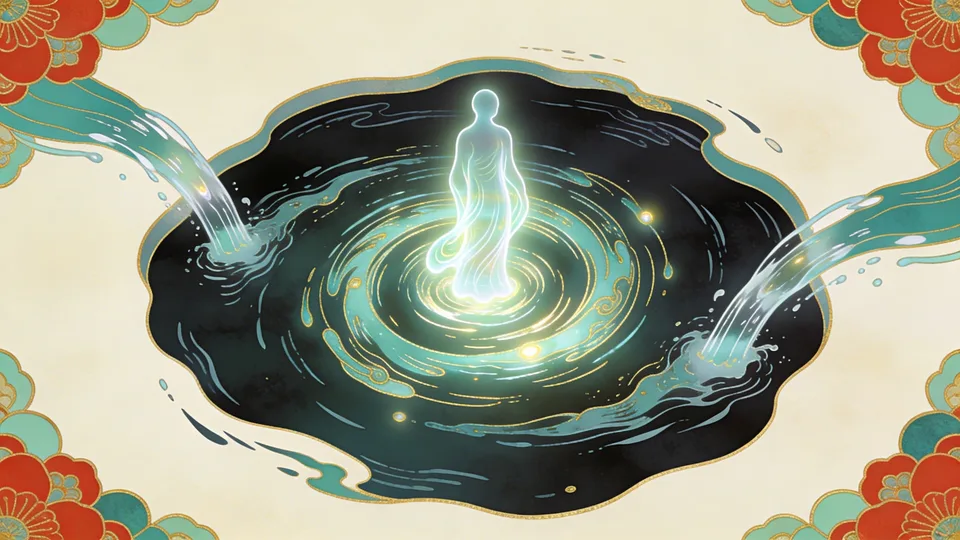
A whirlpool keeps its shape all afternoon without keeping a single drop of its water.
Buckminster Fuller once returned to Dartmouth to speak. The hall where he had first lectured there had burned down, and seventeen years had passed, long enough, he said, for every cell in his body to be replaced. Neither the building nor the speaker was physically the same. So in what sense had he come back?
The biology is looser than Fuller’s line: most cells turn over, but many neurons and the lens of the eye last a lifetime. The point survives the correction. Think of a whirlpool in a river. It is real, with shape, force and behavior, but it is not made of any particular water. Water flows through it constantly and the pattern persists. You are the same kind of entity. Food, air and water pass through you, and what persists is the organization, which Fuller called a pattern integrity: a persistent pattern sliding along strands that came from all around the universe, momentarily woven together, and eventually coming apart again. The flowing is the organizing, the same logic that runs through the soul as oscillation.
That sounds like a point about identity, but Fuller drew from it a point about how to build, and about how we think.
Bones that float
Nature builds with discontinuous compression and continuous tension. The bones in your body do not stack like bricks. They float in a web of muscles, tendons and ligaments that hold them in tension, and if you removed that web the bones would collapse into a pile. The structure’s integrity lives in the tension, not in the compressed parts. Fuller’s name for this was tensegrity, tensional integrity: compressed elements as islands in a sea of tension. It is lighter and more resilient than a stack, and it can span distances a stack cannot.
Humans mostly build the other way, brick on brick, and Fuller thought we also think with no other logic, stacking ideas, hierarchies and institutions. A stack has a built-in ceiling. A Greek stone column could rise about 18 diameters before buckling, and every compression structure has some height at which it collapses under its own weight. The usual response to that limit is more material: thicker walls, more concrete, more mass.
Fuller’s alternative also changes what counts as an effect. Precession is the effect of bodies in motion on other bodies in motion, and it acts at 90 degrees to the direction of travel. A stone falls vertically into water and the ripples spread horizontally. A bee flies from flower to flower for nectar, and the sideways effect, pollination, sustains life on earth without ever being the bee’s purpose.
Put the three ideas together and you get his central claim: the deepest efficiency is structural, not material — building with tension rather than compression, using pattern integrity rather than brute mass, and recognizing that the most important effects of any action are the precessional ones happening at 90 degrees to your intention. His whole body of work argues that humanity is doing more with less at an accelerating rate, and that the end of this trajectory is the discovery that there is enough to go around for everybody. The $200 billion spent each year on military preparedness, in his figure, rested on the assumption that there is never enough, and he saw that assumption as an artifact of compression thinking. The constraint is design, not resources.
Why the stack persists
If tension is so much better, why do we keep stacking? Fuller’s answer was fear, and not mainly for ourselves. Human beings are really very brave, he said; what they fear is for the people they love and who depend on them. That fear drives hoarding, lying and the compression-on-compression architecture of societies that assume scarcity is permanent.
This is also the strongest objection to his optimism. Fear of scarcity is not stupid when scarcity has been real for most of history, and a parent stacking reserves is behaving sensibly on the evidence they have. Fuller’s reply was that the evidence keeps changing. Every generation is born into a new “natural” that was “unnatural” to the one before. When Fuller was seven, engineering societies tried to prove the Wright brothers’ flight was a hoax because it was “absolutely impossible.” The most important things that happen are impossible right up to the moment they happen.
Whether “enough for everybody” is one of those things is still open. But the man at Dartmouth, made of little of the matter that had first stood there, was already evidence that what persists is the pattern. The question is which patterns we are willing to stop stacking.
References:
- R. Buckminster Fuller, Everything I Know, Buckminster Fuller Institute