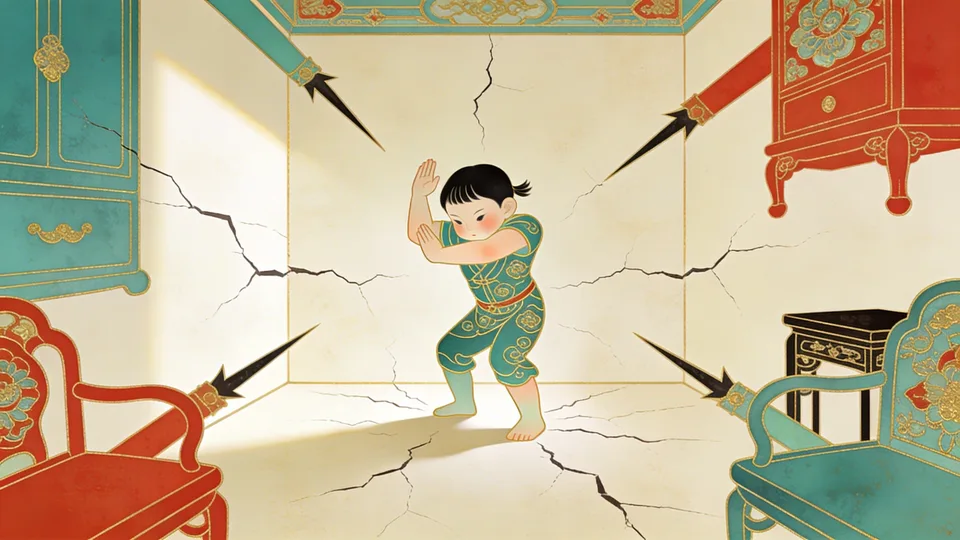
A child who lies to you has usually learned something true about you.
A seven-year-old breaks a glass and says the cat did it. The usual reading is that the child has a lying problem, to be punished out of them. But try a different question: what did the child learn that made lying the smart move? Often the answer is that, in this house, mistakes provoke an overreaction. The lie is less a defect in the child than a sensible response to the cost of telling the truth.
That is the idea behind the “bad parenting signs” lists that circulate online: Children do not malfunction. They adapt. A behavior adults label a problem is often the child’s best available response to an environment that is failing to meet a specific need. The behavior is the symptom, and the diagnosis points back at the environment.
Reading the behavior backwards
Run the same logic through other behaviors and the pattern repeats. A child who gets angry quickly found that misbehaving was the only reliable way to get attention. A child who is a coward was rescued too quickly, every obstacle removed before they could discover they could handle it.
Each is a Locally Optimal strategy: the child is solving a real problem with the only tools a developing nervous system has. The adhd note makes the same argument about tuning out, the best available response when paying attention is painful, and puts the conclusion precisely: the very first failure was a failure of the environment, not the child.
So the list is most useful read backwards. If you want to know what a child needs, look at what they are doing wrong. For the child with the glass, punishing the lie harder teaches the same lesson again, that mistakes are dangerous here. Meeting the broken glass calmly is what makes the truth safe to tell next time.
The adult version
The adaptation doesn’t stay in childhood. The child who learned that mistakes were catastrophes can become the adult who hides every error at work.
A child taught to still the voice of her innermost feelings assumes automatically that there is something shameful about them, and therefore about her very self. — Gabor Maté, Scattered Minds
None of this makes parents villains, or genes irrelevant. Temperament shapes which adaptation a child reaches for, and the mappings above are tendencies, not diagnoses. Parents are rarely malicious; more often they are stressed, or repeating the patterns they received. The cruelty is usually not in intent but in ignorance — and ignorance propagates across generations until someone breaks the chain.
That leaves a question for any adult reading this. Your own patterns may be the answer to a question you were asked before you had words for it: what do I have to become to survive this place?
References:
- 12 Signs of Bad Parenting — CureJoy
- Gabor Maté, Scattered Minds