Tai Lung wasn’t failing his teacher’s method. He was its best result.
In Kung Fu Panda, Shifu finds an abandoned snow leopard cub, raises him, and tells him he is destined for greatness, that the Dragon Scroll might one day be his. He means every word. Tai Lung trains harder than anyone at the Jade Palace, masters in years what took other warriors decades, and earns every word of praise Shifu gives him. Then Oogway looks at Tai Lung and refuses him the scroll, and the student Shifu loved most becomes the villain of the film.
Most viewers draw the obvious lesson: Oogway is the wise teacher, Shifu is the strict one, so be more like Oogway. But the films are more interesting than that. One teacher saw you clearly before you’d done anything to deserve it. The other had to learn to see you at all — at real cost, across a very long time — and did it anyway. Most of the teachers in your life won’t be Oogway. They will be somewhere in Shifu’s arc, capable of real harm and real growth, often in the same year.
A method that worked
Shifu’s love for Tai Lung was real, but it came with conditions: become the Dragon Warrior, earn the scroll, be what Shifu had already decided you would be. Conditional love was the only way he understood how to build someone.
The part that’s easy to miss is that Tai Lung wasn’t failing. He was succeeding. The system worked perfectly right up until the scroll went to someone else, and then everything he had been told was his destiny turned out to depend on a decision neither of them controlled. He had been raised as the phantom child of Shifu’s ambition, so when the promise broke he lost the only identity he had, not just a title. The destruction that followed was a self collapsing after losing its single external anchor.
Oogway saw what Shifu couldn’t: someone whose identity had fused with an outcome. His “no” was the most compassionate act in the film, and the one that looked least like compassion. Shifu learned nothing from it at the time. Tigress trained at the same palace for years afterward, became its strongest warrior, and still couldn’t get Shifu to say he was proud of her. The conditional love found a new person to leave hollow.
Two rooms
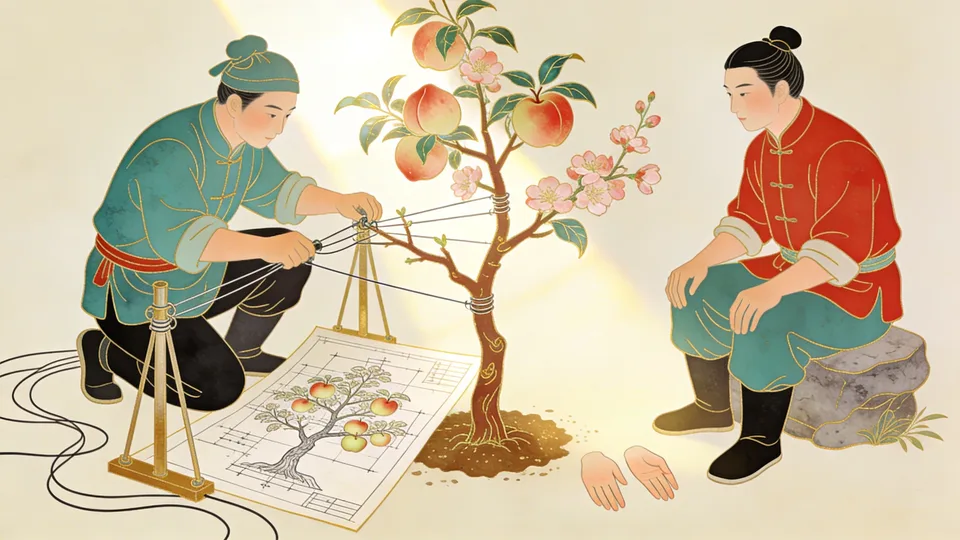
Twenty years later Tai Lung escapes, and Shifu comes to Oogway in full crisis, wanting a plan. Oogway plants a peach pit. No matter what you do, he says, the seed will grow into a peach tree:
You may wish for an apple or an orange, but you will get a peach. — Oogway
The point lands squarely on Shifu’s whole method: Your need to control the outcome is the problem. His face shows that he heard it and understood it. But understanding something while being completely unable to act on it are two different rooms, and Shifu is standing in the first one. What’s being asked of him isn’t a technique. It is a reorganization of how he has understood love and teaching all his life. Control isn’t his bad habit; it is the only self he knows. Oogway dies soon after with the lesson unfinished, and he doesn’t stay to force it.
Oogway’s calm is easy to mistake for temperament, but the third film shows it was bought. He and Kai were once conquerors, until Oogway was wounded and healed in a panda village by power used for something other than taking. He chose to stay, Kai chose to take, and Oogway gave up his oldest friendship and everything he had built. His peace was a decision made once at the highest possible cost.
The kitchen
Po arrives soft, untrained and clumsy, everything Shifu believes a warrior can’t be, and Shifu’s first instinct is to prove it won’t work. Then he finds Po in the kitchen late at night, doing feats of balance to reach the food. The kung fu was hiding inside the thing everyone dismissed about him. For the first time in his career, Shifu follows a student instead of leading one, finding where Po’s nature already has grace and building from there. It works because he stops deciding what the student is supposed to become.
One breakthrough doesn’t undo decades of wiring. In the third film Shifu is still trying to master chi, the thing Oogway had and he never reached, through pure discipline, as if he could muscle transcendence into existence. What finally loosens his grip is watching Po, the panda he tried to break, become someone who doesn’t need to be managed. The lesson Oogway delivered in one afternoon under a tree took Shifu three films to mean.
The voice in your head
Shifu’s voice sounds familiar because most of us grew up hearing some version of it. It came from the parent at the kitchen table checking homework because your grades were their report card, or the coach who said “I’m hard on you because I see potential” and meant it. The love was real, which is what makes it hard. The voice that started outside your head moved inside so gradually that you can no longer tell which part is yours. The smooth child is what that voice sounds like once it no longer needs to speak: the student anticipates the correction and suppresses the question, and the teacher takes the silence as proof that teaching worked.
The harder question runs the other way. Did someone once look at you when you were unfinished and clearly not ready, and decide to believe in you anyway? Maybe they did, and you were so trained by the conditional model that you couldn’t hear it. Unconditional felt suspicious — like there had to be a catch somewhere — because everything you’d ever been given had one. Po is in the same position under Oogway’s tree, still in transaction mode, barely able to receive what is offered.
Moving
So the story isn’t comparing two teaching methods. It’s showing you two different relationships to your own damage. Oogway faced his capacity for harm early, chose to change, and taught from settled peace. Shifu didn’t see his until he had broken a student, then spent twenty years carrying it while he dismantled everything he thought great teaching looked like. Oogway’s path is the one we admire. Shifu’s is the one most of us are on, and he can show Po something Oogway never could: what it looks like to be broken by your own teaching and rebuild yourself anyway.
That is why the adults a generation is waiting for aren’t the ones who were always whole. It’s easy to be wise when you start that way. Harder to become it after you’ve already done damage. The question for any teacher, or parent, is never which of the two you are. It is whether you are moving.
References:
- Two Kinds of Teachers in Kung Fu Panda — YouTube video essay
- Kung Fu Panda (2008), DreamWorks Animation
- Kung Fu Panda 3 (2016), DreamWorks Animation