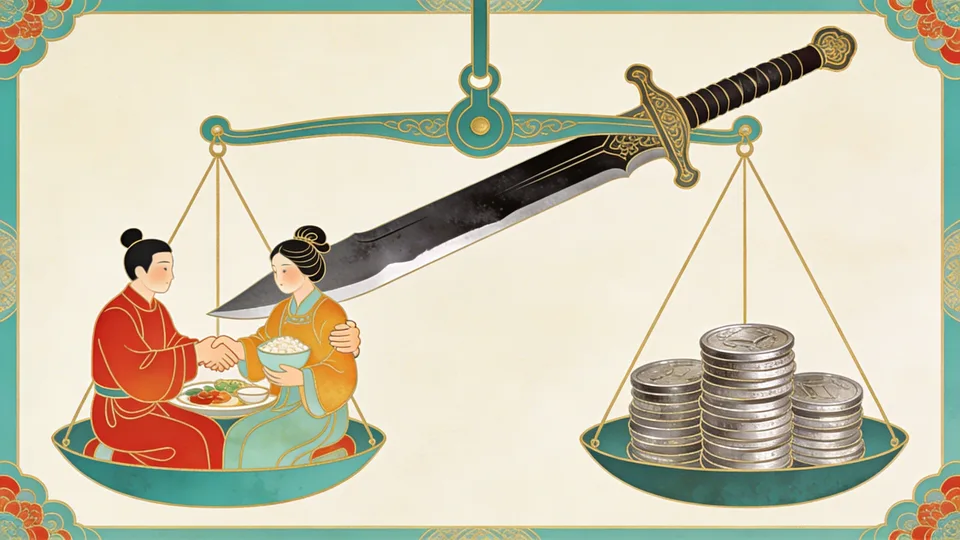
The coin in your pocket began as a way to feed an army.
Every economics textbook tells the same origin story. People once bartered, barter was inconvenient, so we invented money, and then came banking and credit. Adam Smith codified it, and it sounds like common sense.
The problem, as David Graeber argues in Debt: The First 5,000 Years, is that there is no evidence for it, and lots of evidence that it did not happen this way. People in the past did not barter with their kin, because they were bonded by ties of hospitality and kinship. You do not haggle with your brother. You give, and you trust that the community will give back. Elaborate barter systems do crop up, but only where money has become unreliable, like cigarettes in prisons, among people who grew up using money and are recreating what they lost.
So if money did not grow out of barter, where did it come from?
The king’s army
Picture a king who extracts gold, stamps his face on it, circulates it among his subjects, then demands they give it back as taxes. Under the barter story this is bizarre. It makes perfect sense once you notice that the king needs to feed an army of 50,000 men.
He could provision them directly, requisitioning grain from every farmer and organizing logistics across the kingdom. Or he can pay the soldiers in coins and decree that taxes must be paid in those coins. Now every subject must acquire coins, which means producing something soldiers want to buy, and a market forms around the army. It emerges not from human nature but from the state’s need to mobilize resources at scale. Markets do not emerge spontaneously; states create them, and money is a technology of state power.
The order of events flips too. Obligation, trust and reciprocity came first, and money was layered on top by states that needed to convert diffuse social trust into concentrated, taxable, transferable units. A debt is the obligation to pay a certain sum, which makes it simple, cold, impersonal, and therefore transferable. That transferability is what turns an interpersonal obligation into an economic system.
An IOU nobody pays
You can watch the conversion at small scale. You write an IOU to your neighbor for a bag of grain. Your neighbor uses it to pay the baker, because the baker trusts that you’re good for it, and the baker uses it to pay the blacksmith. The IOU now circulates as money, and it keeps circulating only as long as you don’t actually pay your debt, because paying would void it and remove it from circulation. This is, quite literally, how the Bank of England was founded. The value of a unit of currency is really a measure of one’s trust in other human beings.
Violence and arithmetic
Go back to the king. His coins circulate because taxes are owed in them, and taxes are owed because he can punish anyone who refuses.
Violence, or the threat of violence, turns human relations into mathematics. It’s the ultimate source of the moral confusion surrounding the topic of debt.
Look closely and violence and quantification are almost never found apart. The slave becomes a price only through the violence of capture and the threat of continued violence. The debtor becomes a number only because the creditor has recourse to enforcement. Strip away the enforcement and the debt is just a request. That is the danger in putting a number on a relationship. Money has the capacity to turn morality into a matter of impersonal arithmetic — and by doing so, to justify things that would otherwise seem outrageous or obscene.
The popular modern view, that money is a shared fiction and any sufficiently trusted token could serve, is too gentle. A sharper statement is that money is a technology of violence that converts diffuse social obligations into transferable, quantifiable units — and the conversion is never neutral. Money is a shared fiction backed by the capacity to destroy anyone who rejects it.
The debt that holds us together
The oldest written reflections on debt, in the Vedas and Brahmanas, treat it as synonymous with guilt and sin, and across several ancient languages the words for debt and sin overlap.
Our debt to the gods was always, really, a debt to the society that made us what we are.
The social contract is an unpayable debt, and that is what makes it work. Like the Bank of England’s founding IOU, the system works because the debt is never fully discharged. Paying it off would void the currency of obligation that holds the community together.
None of this makes money a mistake. Converting relationships into arithmetic scaled cooperation beyond the tribe. But Smith’s assumption, that people left to themselves will start swapping and comparing things, is the deepest load-bearing illusion in economics, because it makes markets natural, capitalism inevitable and alternatives utopian. If obligation and trust came first, money is an interruption of natural human relations rather than their expression. The interruption was useful, but arithmetic does not care about the people inside the numbers. How much of what we owe each other should it be allowed to count?
References:
- David Graeber, Debt: The First 5,000 Years
- Joseph Wang, Central Banking 101