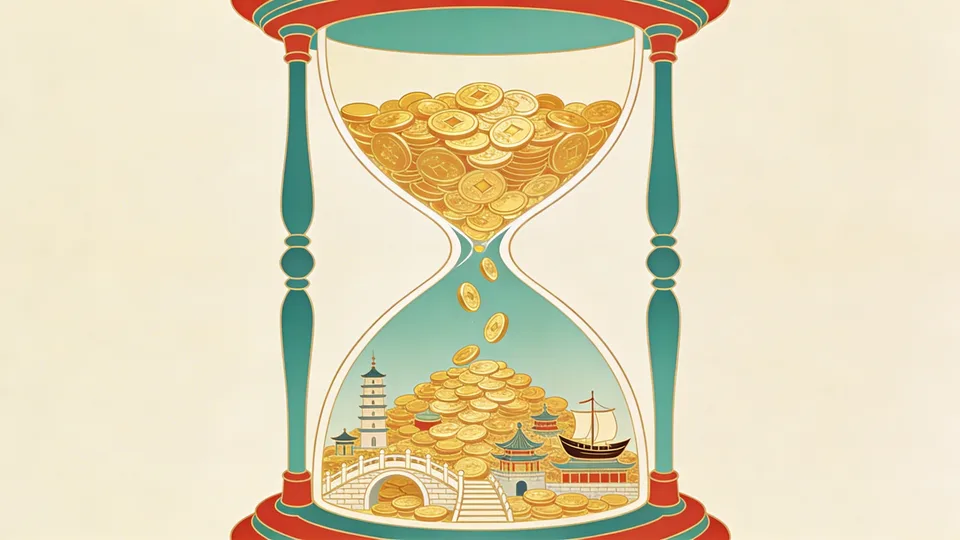
Every cathedral was paid for by someone who didn’t eat all the grain.
Hoarding has a bad name. The hoarder takes value out of circulation while everyone else does the spending, so spending looks generous and saving looks selfish. But what could a society that never stored anything build?
An animal eats every calorie it finds as soon as it finds it, and so it can never build anything. A human who stores grain through winter has done something different. The stored grain is capital: calories deferred from present consumption to fund future survival. Stored grain feeds a farmer who grows more grain, which feeds a builder who raises a granary, which supports a city that can afford scholars who invent mathematics. Each layer is funded by the surplus of the layer below. Civilization is a stack of deferred consumption.
Seen this way, capital is self-replicating leverage over reality: any stored resource that can be deployed to produce more resources. Bridges, cathedrals, space programs and research all sit on surplus that someone declined to eat. Without hoarding, everything is consumption. Capital is civilization’s battery system.
Coordination without consensus
The granary also does a job nobody planned. When many people independently hoard the same scarce asset, each betting that value will persist and that society will honor its ledgers, their private choices create global signals. Price appreciation reveals scarcity, and movement into and out of hoarding reveals confidence. Nobody has to agree on a plan for these signals to coordinate behavior, which is why a globally trusted, scarce unit of value makes the economy legible from below and allows coordination without consensus.
Longer horizons
To hoard is to remove value from circulation today in exchange for control over the future, and that stretches time horizons. Short horizons produce consumption, conflict and zero-sum games; long horizons produce investment, cooperation and positive-sum ones.
Because the battery holds stored time, it can also be drained. Credit pulls future capital into the present, and if that spending builds no productive capacity, the stored time of savers is quietly confiscated to fund debtors’ consumption. Hyperinflation is the limit case: holding money becomes a guaranteed loss, nobody saves or lends, and the whole stack of deferred consumption collapses. That is why sound money is not a technical issue but a civilizational one.
When the battery stops being spent
The battery also fails from the inside, through the people holding the charge.
Power that no longer needs to listen will eventually choose not to.
When the stewards of capital no longer need civilization to grow, only to persist, they prefer stasis over risk. The granary keepers stop funding new builders, because new builders threaten what has already been stored. The Dead Sea Effect then works on elites: the best leave, the residue entrenches, and the entrenchment blocks the renewal that would mean risking what has been accumulated.
So the case for saving carries its own warning. The surplus that lifts a society can freeze it once its owners stop reinvesting. Civilization is the controlled detonation of a positive feedback loop. Its apex is determined by the inequality threshold before systemic fracture. Where that threshold sits, and whether anyone can see it before the fracture does, is the question the granary leaves open.
References:
- Original notes on gold, scarce assets, and capital formation