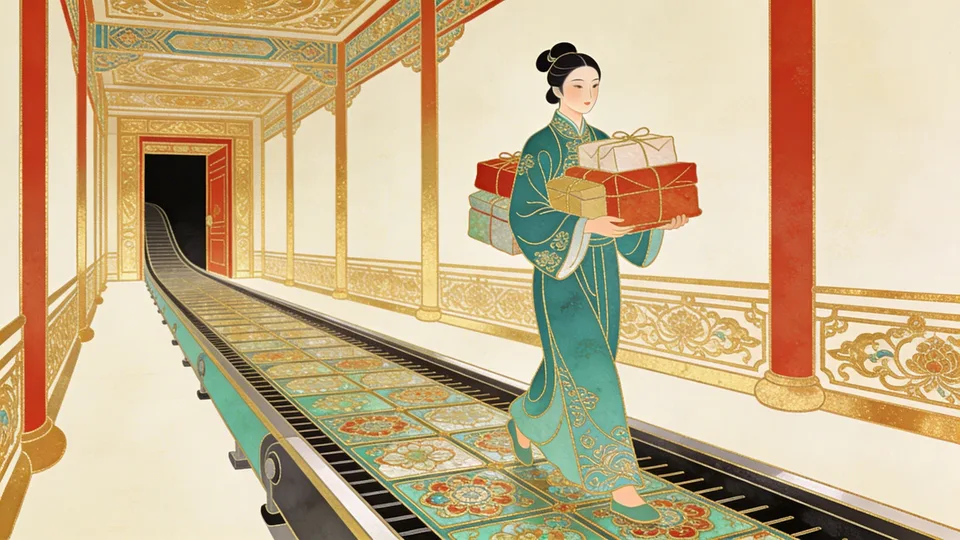
“I do this to eat” is the most honest answer about a job, and almost nobody gives it.
Ask people why they work and almost nobody says “to stay alive.” They mention the work itself, their colleagues, a full life. Hu Anyan, whose memoir I Deliver Parcels in Beijing moves through a run of low-wage jobs including the courier work in its title, doubts these answers, because we could pursue our interests, keep our friends, and live fully without working. So why does work still sit at the center of a life, and why does it feel shameful to admit we do it to eat? His starting point is blunt:
完全为了谋生而工作,就和坐牢一样可悲。
Working purely for a living is as pitiable as sitting in prison. That is why so few people claim it; the interest, the colleagues, and the full life are ways of not appearing as a prisoner in one’s own description.
The older generation’s honesty
Hu thinks the older generation was more honest. They asked a simpler question, how will you feed yourself without working, and many took pride in blind industry. Their honesty came with a hidden advantage. Hunger told them what to do with their days, so they rarely had to face the problem Maugham described: not everyone, once freed from providing for basic needs, still knows what they should do. Necessity was cruel, but it was also clear. Once it loosens, a person has to decide what a life is for, and most people have never been asked.
The new prison
Hu’s claim is that the freedom which replaced necessity did not stay empty. Consumerism moved in and became a new ideology, so the imprisonment remains — we only seem more free. The mechanism is the important part:
Compared to restricting everything you want to do, installing in you what you “need” and giving you the means to achieve it is a far more durable method of maintaining social stability. But this is still enslavement.
A restriction can be resented, because the person feels the wall. An installed need feels like one’s own desire, so there is nothing to push against. A courier who works long shifts to afford a new phone experiences the phone as something he wants rather than something he was taught to want, and the shifts that pay for it look like his own choice. The new cage has no visible bars, which is why it is stronger. It also makes the plain admission “I do this to eat” sound like failure, though Hu insists that work is a means of survival, not the purpose of life.
Standing up to the barbarian
So what attitude is left? Hu’s answer is neither revolt nor cheerful acceptance:
现实就像一个力大无穷、整天在胡说八道的野蛮人,不过最后他总能证明自己是对的。
Reality is like an infinitely strong barbarian who babbles nonsense all day, but in the end always proves himself right. Those who say they “accept reality” are actually finding ways to make reality accept them. What he offers in place of a theory is a posture, and it is funny:
如果我被石头绊了一跤,就爬起来自己再摔一跤。
If I trip on a stone, I get up and trip myself again. Then I dust myself off and walk on. This makes the stone look foolish. Eventually it will attain Buddhahood and learn to treat the world kindly.
The joke does real work. A courier cannot argue with traffic, a quota, or a parcel that must arrive by noon, and complaining about them only confirms who is in charge. Tripping on purpose takes the fall back. The stone keeps its power to knock him down but loses its power to humiliate him, which is about as much freedom as the barbarian allows.
Evenings
In Hu’s telling, all joy seems to gather in the evenings: you walk to the square by the water, children set off fireworks, everything ugly feels distant, and a little wine back home deepens the feeling.
But fireworks and wine are things for the evening. During the day, we had better face reality.
That pairing answers the question the defenses at the start were avoiding. The day’s work is not dressed up as a passion, and the evening’s happiness is not mistaken for a cure. Keeping the two apart is how a person can work for a living without letting the work, or the things it buys, decide what the living is for.
References:
- 胡安焉 (Hu An Yan), 我在北京送快递 (I Deliver Parcels in Beijing)