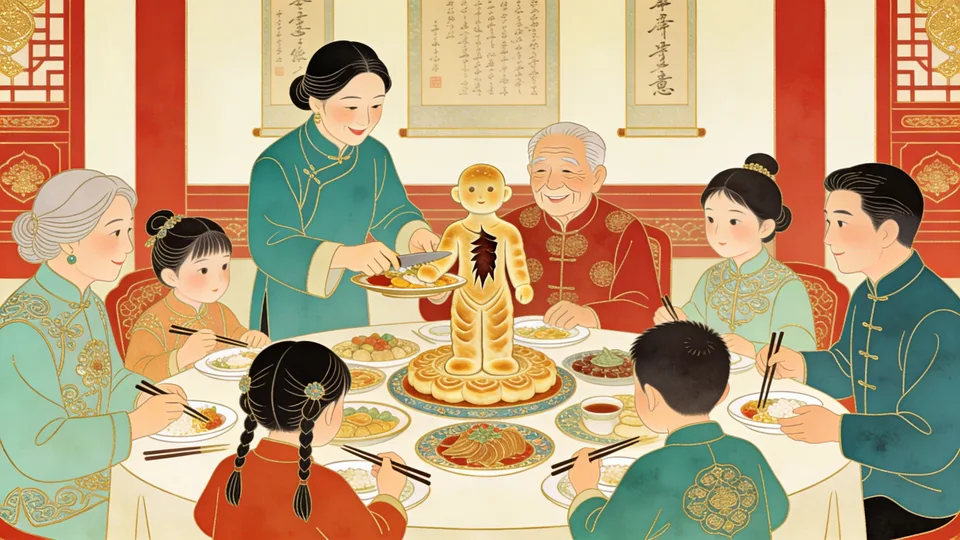
A family can feed a child every day for twenty years and never once see her.
Lu Xun’s madman opened the history books and found, between the lines of “benevolence, righteousness, and morality,” two words repeated on every page: eat people (吃人). That was 1918. Why would anyone still recognize the charge a century later, when the families in question are fond of their children and sacrifice enormously for them?
A satire circulating on the Chinese internet, the “New Harmony Ritual Code” (新和谐礼记), gives one answer. Its ten commandments are written as parody, but many Chinese readers recognize them as autobiography.
The ten commandments of harmony
- Your body belongs to the family. 身体发肤,受之父母. You exist for the family’s face, glory and retirement.
- Eat bitterness. 吃得苦中苦,方为人上人. Endure now; it pays later. When it doesn’t, and the gaokao graduate ends up delivering packages, the mark lies flat (躺平).
- Continue the bloodline. 不孝有三,无后为大. Marriage and children are obligations, not choices.
- Gratitude as guilt. Your parents gave everything. How can you bear to disappoint them? (Lu Xun answered this a century ago: reproduction is a biological impulse, not a favor, and the child owes nothing.)
- The universe ends at a government post. Skip art and entrepreneurship. Get an iron rice bowl. Stability is the highest filial piety.
- Buy property with six wallets. Empty the savings of parents and both sets of grandparents for an apartment. The mortgage is “motivation.”
- Conform or perish. 木秀于林,风必摧之. The tree that stands above the forest is broken by the wind.
- Women depreciate. Don’t be picky. Past a certain age, your value drops. Love can be cultivated later.
- Parents are never wrong. 天下无不是的父母. Even when they are wrong, it was for your own good.
- The individual serves the collective. 大河有水小河满. Without the nation, where is the family? Without the family, where are you?
Why nobody fixes it
Read one at a time, every commandment is Locally Optimal. Each solves a real problem: financial security, family cohesion, elder care, social stability. Six wallets really do buy an apartment that one salary can’t. The system works, for the system. The cost is borne entirely by the individual who is consumed.
What keeps the cost from being corrected is the way two commandments work together. Hirschman’s exit and voice are how any organization learns it is failing: people leave, or people complain. The family code closes both. Exit is branded as betrayal (abandoning your parents), and voice is silenced by the ninth commandment (parents are never wrong). With both feedback channels shut, the system cannot correct itself. It can only demand more sacrifice.
The cannibalism
So Lu Xun’s insight was not that Chinese culture is uniquely cruel. It is that the system consumes people while calling the consumption virtue, and the consumed learn to call it virtue too. The person who has internalized the ten commandments does not feel oppressed. They feel responsible and grateful, and guilty whenever they want something for themselves, which is exactly how the system reproduces itself.
The parents are not absent. They are hyper-present, but their presence is organized around the family’s needs rather than the child’s. The child is fed, housed, educated, and unseen, because feelings are not the point; performance is. In the one-child household this sharpens into the phantom child trap, where parental sacrifice becomes an invoice nobody can dispute. The result is adults who are competent, dutiful and empty, and who experience their suppressed desire as maturity. The code even ships with its own defense: questioning is selfishness, and selfishness is the one unforgivable sin.
Is this just China, then? The easy reading is “Chinese culture is oppressive; Western individualism is better.” The satire doesn’t support that. It is about any system that consumes individuals while calling the consumption love. The Western version swaps filial piety for productivity and family honor for career achievement, and can produce the same emptiness by different means. The commandments are local; the mechanism isn’t.
Save the children
The madman’s diary ends on one hope: “Save the children.” Perhaps some children have not yet been taught to eat people. The system passes itself on through every generation that internalizes the commandments, and it breaks when someone sees the consumption for what it is and refuses to consume or be consumed, even at the cost of being called selfish, ungrateful and unfilial.
The refusal is not the hardest part. The grief that follows is: the recognition that the love was real and the harm was real, and they were the same thing.
References:
- Lu Xun, A Madman’s Diary (狂人日记), 1918
- Satirical “新和谐礼记” (New Harmony Ritual Code), contemporary Chinese internet