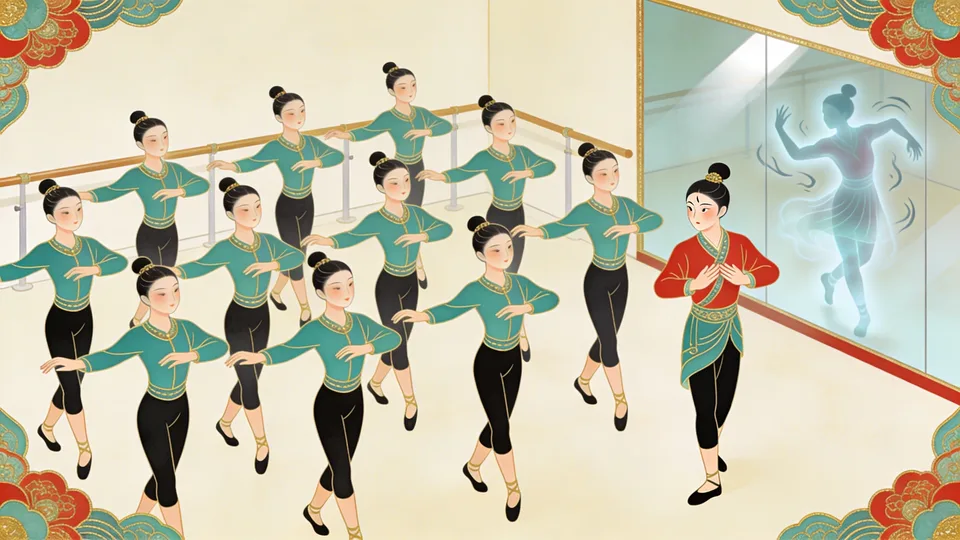
Daily practice is the easiest place to hide from what you’re bad at.
In an interview about Chinese dance culture, Xiao Hai (小海) describes a familiar scene. Dancers walk into the rehearsal room, put on music, and dance without stopping. They do this every day, and year after year their progress gets slower. If effort were what mattered, they would be improving faster than anyone. So what is going wrong?
进到排练厅就放音乐就不停地跳舞,他还是不想自己什么不好,我要练什么,我要教什么,改变什么。
所以大家发现这几年他们虽然进步越来越慢,就是因为他们每天重复地再重复练习自己来本来就会的东西。
His answer is that they are repeating what they already know. They never ask what they are bad at, what they should change, or what they need to learn.
Where people stop
Xiao Hai describes mastery as five stages, linked by four steps:
- 不会到会: from not knowing to knowing
- 会到会用: from knowing to using
- 用到用好: from using to using well
- 用好到用成自己的: from using well to making it your own
不会到会,会到会用,用到用好,用好到用成自己的。
这是缺一不可的。
None of them can be skipped. Yet most people stop at the second stage: 会了就认为自己牛了, once they “know it,” they think they’ve made it, and they stop everything after that. The dancers in the rehearsal room can already do the moves, so practice becomes a place to perform what they can do rather than to find out what they can’t.
Why copying caps you
Why would a whole scene stall at the same stage? Xiao Hai’s diagnosis is blunt:
中国人谁厉害谁学谁。这个人来了,哇好厉害,大家学他;这个人来了,大家学他。
从来没有受过我要当自己。
Chinese people copy whoever is impressive. This person shows up and everyone learns from them; that person shows up and everyone learns from them. There has never been the training of “I want to be myself.” Copying is a good way to climb the first stages, but it fixes the destination at someone else’s style, so it cannot carry you to the last one.
想法决定一切。你的想法初衷就定了我要去模仿他,我要学他,太喜欢他了,就没办法了。
他可能也想过当自己,他就当不成。
想法决定一切: your initial intention determines everything. If the starting point is “I want to imitate him, I admire him too much,” you cannot arrive at originality, however perfectly you imitate. He may have wanted to be himself. He just couldn’t.
The hardest thing
最难的不是冠军,是有自己的style,有自己的特色是最好的。当自己是最难的。
The hardest thing is not being champion. It is having your own style, your own character. Being yourself is the hardest thing. A championship rewards whoever best fits the current standard, and a culture of imitation produces plenty of people who fit it. A style of your own means asking what only you can do, which is the question the rehearsal room never asks. Xiao Hai ties it to 初心 (chūxīn), the original intention behind dancing, which he finds rarer the longer he looks at the scene in China.
It would be easy to read all this as “Chinese culture kills individuality,” but imitation is how everyone learns, everywhere. The better reading is that the five stages are universal, but the cultural pressure to stop at stage two varies enormously. Where standing out is punished, stopping at “knowing” is less laziness than rational fear, and the courage to be disliked costs more when being disliked means losing the only community you have.
So the dancers in the rehearsal room are not short of discipline. They are short of permission to be bad at something new in front of other people, and the last stage asks for exactly that: to stop polishing a borrowed style and step into the gap between what others have shown you and what only you can find.
References:
- 小海 (Xiao Hai), interview on Chinese dance culture and individuality