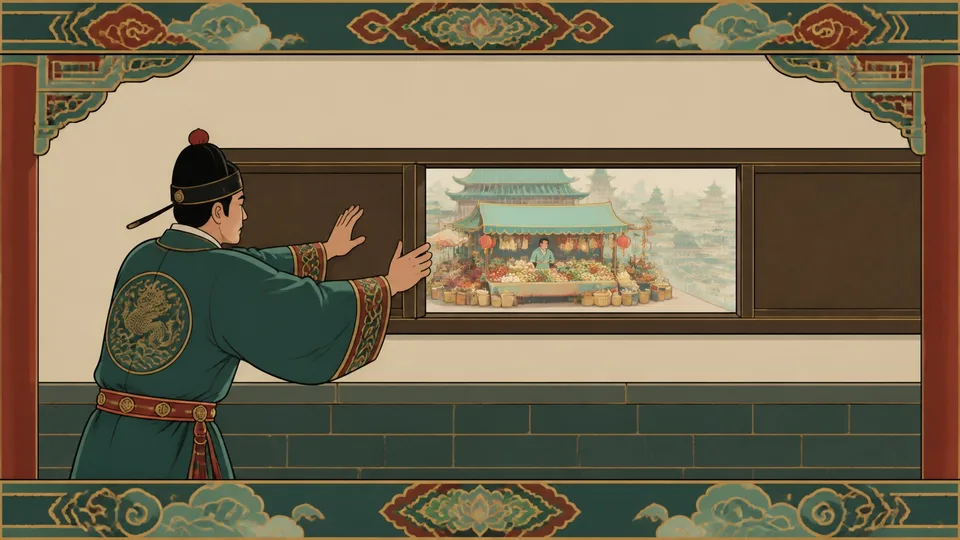
A city contains failing pipes, promising inventions, private griefs, minor crimes, new businesses, neglected neighborhoods, and arguments that could change how it is governed. Most of these things are real. Only a few can become what the city is about.
The canonical window is that small field of public reality: the people, events, problems, and possibilities a group can recognize as consequential at a given time. What enters the window can receive money, imitation, outrage, protection, and institutional response. What remains outside may be equally true, but it cannot easily recruit coordinated action.
A fact becomes socially powerful when it enters a story that institutions know how to continue.
Attention is not enough
The window is narrower than everything people happen to notice. A strange video may attract millions of views and disappear the next day. A technical failure may be known for years without changing a budget. These objects received attention, but they did not become canonical because nothing durable knew what to do with them.
Entry requires three things.
First, an object needs a recognizable role in a shared story. It must be legible as evidence of progress, decline, injustice, danger, genius, betrayal, or some other movement people already understand. Raw novelty is hard to retain. A familiar role gives it a place in memory.
Second, the object needs a path to consequence. Journalists can repeat it, officials can classify it, investors can fund it, platforms can distribute it, or communities can reward and punish around it. Consensus reality becomes operational through exactly these routes: shared tokens matter because behavior and enforcement redeem them.
Third, the object needs enough continuity to survive replacement by the next object. A coherent story preserves attention across time. Without that continuity, public attention is only a flash; with it, each new event becomes another episode in the same world.
This is why the canonical window is not simply “the discourse” or a list of trending topics. It is the portion of reality for which collective attention, narrative memory, and institutional action have become aligned.
The window makes its own evidence
Once something enters the window, attention begins changing the thing it observes. A company treated as the future attracts employees, customers, and cheap capital. A neighborhood described as dangerous loses investment and becomes harder to inhabit. A technology declared strategically necessary receives contracts, talent, and regulatory protection.
The result is reflexivity: the story helps create the evidence later used to prove that the story was correct. This does not mean the object was empty before attention arrived. It means selection changes its developmental path. Two equally capable people or products can diverge sharply because one receives opportunities that compound while the other must keep proving itself from the outside.
Positioning describes the commercial version. The product that owns a category in the customer’s mind does not merely enjoy better publicity; it becomes the reference point against which later products are understood. Its early visibility produces distribution, and distribution produces the familiarity that looks like natural leadership.
The same process canonizes people. A historical system is compressed into a hero, then the hero’s visible traits become the explanation for an outcome produced by many hidden conditions. The winner’s character may be real, but the window has removed most of the surrounding machinery. What remains is not a lie so much as a story trimmed to fit public memory.
Power can move the frame
Most people compete for recognition inside an existing window. They try to make their work fit a category the audience already values. Alpha earns within this arrangement by seeing or doing something better than other players.
Power begins where someone can alter the arrangement itself. A platform changes its ranking system. A government declares a new national priority. A celebrity introduces an ordinary product to an audience that already treats their choices as consequential. An institution changes which credentials authorize speech. These actors do not merely improve an object within the frame. They move the frame around an object.
This does not require a central editor. Modern windows are often produced by loosely aligned institutions whose incentives and professional languages cause them to select similar objects. The Cathedral is one account of this decentralized synchronization. No meeting is necessary when credentialing, media, bureaucracy, and philanthropy already reward compatible judgments.
Nor is there one canonical window for an entire society. Families, professions, markets, nations, and online subcultures maintain overlapping windows. An idea can be canonical in physics and invisible in politics, famous on one platform and nonexistent on another. Power depends partly on the ability to translate between these fields: to move an object from a small window into one backed by broader money, legitimacy, or force.
The boundaries are therefore contested. Every claim that “nobody is talking about this” is an attempt to bring an excluded object into view. Every accusation that an issue is a distraction is an attempt to push it back out. Both may be sincere. Since the window has limited bandwidth, inclusion always displaces something else.
What stays outside
Reality outside the window does not vanish. It accumulates without a public role.
Some excluded things are harmless background. Others are unresolved causes waiting for a story that can admit them. A neglected infrastructure problem remains boring until a bridge collapses. A strange research result remains an anomaly until a new theory makes it diagnostic. A private injury remains isolated until a movement supplies language, comparison, and a path to remedy.
The Chekhov’s gun analogy clarifies the problem. A gun onstage matters because the audience expects the story to use it. The same gun in a locked prop room has no narrative force, even though it is physically identical. Objects outside the canonical window are props without an active production. Bringing them in means more than pointing at them; someone must revise the story so their presence creates an expectation of consequence.
That revision can be valuable or destructive. Expanding the window may reveal a neglected reality and let institutions respond. It may also turn a marginal event into a moral panic, directing resources toward what is vivid rather than what is important. Shared stories carry structural weight, so abruptly changing the canon can damage the coordination those stories supported.
The practical question is not merely “is this true?” Truth is necessary when the claim concerns reality, but it does not explain whether the claim can move people. Ask instead: What role could this fact occupy? Which institution can act on it? What existing story would have to change? What will leave the window if this enters?
Those questions reveal the distance between discovering something and making it consequential. The first is an encounter with reality. The second is an intervention in the world that decides which realities count.