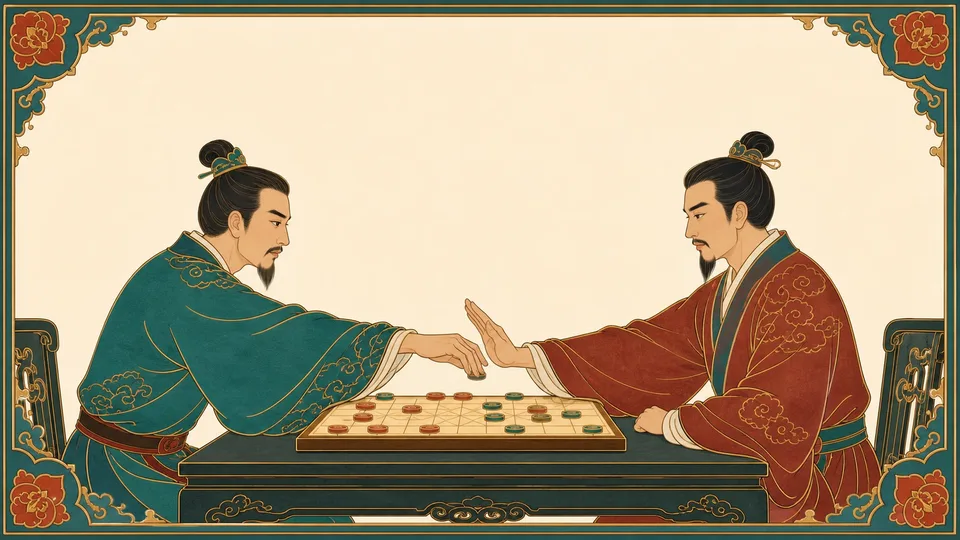
Two strategists sit across a xiangqi board. One studies his opponent, predicts the next move, then reaches across the table to move the opponent’s piece himself. When the opponent stops his hand, the strategist records the resistance as evidence of hostility.
He has not assumed that his opponent is stupid. He may believe the opponent is brilliant, disciplined, and dangerous. What he has denied is the other player’s interiority: the private field in which fear, pride, memory, loyalty, humiliation, argument, and judgment turn circumstances into a choice. The opponent is allowed to calculate but not to author.
Denied interiority is the asymmetry that grants other people capability while withholding authorship: we have reasons; they have causes.
The Model Can Predict Moves but Cannot Represent a Mind
A storm has causes. A chess engine has an objective function. A person has causes too, but also interprets them. She can feel cornered, mistrust the offered bargain, argue with her own faction, sacrifice an advantage for dignity, or change her mind after deciding what another person’s action means.
Denied interiority compresses this middle layer out of the picture. The target becomes weather with skills. Parents produced her preferences. School installed her habits. Culture supplied her values. Propaganda explains her beliefs. Incentives determine her conduct. None of these explanations is necessarily false. The error is treating their sum as exhaustive while leaving the observer’s own authorship intact.
The asymmetry is easy to hear:
- I withdrew because the situation became unsafe; you withdrew because you are avoidant.
- Our country armed itself in response to events; their country armed itself because expansion is its nature.
- I changed my mind after reflection; you repeated what your culture taught you.
- My group contains factions, reluctant compromises, and institutional failures; your group expresses one underlying will.
- My account of my motives is evidence; yours is camouflage.
The ingroup acts. The outgroup is caused.
This is stronger than an insult. Calling someone foolish still leaves a fool who perceives, chooses, and can surprise you. Denied interiority can praise the target’s intelligence while making the target less human. The imagined optimizer is frightening precisely because it has no embarrassment to absorb, no constituency to persuade, no relationship it hopes to preserve, and no meaning beyond getting more.
Rationality Can Turn Compression Into Innocence
Consider a policy analyst estimating a rival’s technological power. Talent plus access to advanced chips produces capability; restricting chips therefore subtracts capability. At one level this is clean and useful. At another, the analyst has modeled the rival as a production function and the restriction as an external parameter.
But the restriction is also an event inside the rival’s political world. It can shift prestige toward security factions, make dependence feel intolerable, coordinate firms that once competed, justify expensive domestic substitutes, or convert commercial competition into a sovereignty struggle. The same policy can reduce present capability while changing the path along which future capability develops. Whether that trade is wise is an empirical question. A model that cannot represent the second effect cannot answer it.
The failure is not insufficient sympathy. It is missing endogeneity: my move changes the other player’s beliefs, coalitions, and objective, which changes the game I thought I was measuring. A static threat model becomes a causal input into the threat.
The surgeon’s hubris extends this problem to alignment itself: a researcher can carefully model an intelligence’s response to incentives while leaving out the incentives created by the researcher’s own monitoring and interventions.
This is a characteristic rationalist blind spot. Formal models must compress, and compression is often their virtue. Trouble begins when the model’s exclusions disappear from view. American policymakers remain people moving through elections, institutions, commercial interests, fear, and incomplete information. “China” becomes a unitary agent maximizing power under every possible American policy. America reacts to circumstances; China reveals its essence.
The language looks bloodless, which makes the asymmetry feel neutral. It is not. Selective reductionism is prejudice with a cleaner user interface. A fully deterministic model could reduce everyone to causes. A fully agentic model could grant everyone interpretation and choice. The rigged model gives causal complexity to one side and an optimization function to the other.
This does not imply that sanctions are wrong, rivalry is imaginary, or an adversary will respond benevolently to trust. It means that several equilibria can be structurally possible: bounded competition, commercial interdependence, hardened autarky, arms racing, or war. Policy partly selects among them. A rival can be dangerous and still react conditionally; indeed, conditional reaction is often what makes accurate statecraft possible.
The garden’s image of China as Solaris names the cost of looking at a vast system and seeing one’s own theory reflected back. Denied interiority identifies one way that reflection is manufactured: internal disagreement, historical memory, and interpretation are deleted until a civilization becomes a single legible appetite.
The Asian American Is Credited With Capacity and Denied Authorship
The same structure operates at human scale. The model-minority stereotype appears flattering because it credits Asian Americans with discipline, technical skill, and achievement. Yet each strength is narrated as an output of something else: strict parents, exam culture, conformity, sacrifice, or ethnic coordination. Success demonstrates capacity without establishing authorship.
The national-security stereotype reverses the valence but preserves the model. The capable student becomes a carrier of another country’s interests; the engineer becomes a possible conduit; the citizen’s face becomes a geopolitical classification. Praise and suspicion meet in the same sentence: highly competent, therefore instrumentally useful to someone else.
This is why ancestry can function as a supposedly deeper truth than self-description. A white American is ordinarily permitted a private mixture of loyalties, resentments, historical ignorance, political judgment, and irony. A Chinese American who explains the same mixture risks being told, in effect, that the explanation is only surface data. The causal truth lies in the parents, race, or motherland. “Where are you really from?” asks not for a birthplace but for the hidden author presumed to stand behind you.
There is a real substrate that makes the stereotype sticky. Dead reading rewards the correct answer over the originating judgment. An anxious family can produce the smooth child by sanding down preference, anger, experiment, and refusal. A person trained this way may struggle to narrate desire, disagree in public, or state a costly belief. Expressed interiority can be underdeveloped.
Then the category error arrives. Limited expression becomes limited inner life. Conformity under incentives becomes essential conformity. A contingent adaptation becomes a racial property. The child is first taught not to display authorship and then judged by outsiders as if no author exists.
American culture imposes its own price of personhood. It recognizes interiority through a familiar performance: spontaneous opinions, public disclosure, distinctive taste, rebellion against parents, and a narrated personal destiny. The Asian American can therefore become over-legible as a type while remaining illegible as a person. Legibility does not merely fail to see her. It sees her so quickly that her own account becomes redundant.
The double bind closes every exit. Conventional behavior confirms conformity. Eccentric behavior makes her exceptional—“not really Asian.” Defending China makes loyalty suspect. Criticizing China makes her useful as a native informant. In every case, the person is evaluated less as the source of a judgment than as evidence about a category.
A Threat Model Changes the Person It Claims Merely to Describe
At home, the mechanism is less grand and no less destructive. One partner expects abandonment, so she checks, tests, pursues, and demands reassurance. The other expects control, so he conceals, delays, and withdraws. Each experiences his own move as a response and the other’s response as a trait:
I pursue because you withdraw. You withdraw because you are cold.
I withdraw because you pursue. You pursue because you are controlling.
The loop preserves each person’s interiority only from the inside. My action carries a history and a reason; yours reveals what you are. Each threat model then helps produce the behavior it predicted. The prior eats its own evidence, but here it also reaches across the table and moves a piece.
Restoring interiority means asking how the other person interpreted the last move, what options seemed available, and what would let the pattern change. It does not mean assigning equal blame. One partner may lie, one state may invade, one parent may terrorize a child. Causal participation and moral responsibility are different ledgers. To describe an equilibrium is not to declare everyone equally responsible for it.
Nor does humanization require reconciliation. The point of treating people as people is not that every relationship must continue. A person with interiority can choose harm, refuse repair, and make exit necessary. Understanding restores the possibility of repair when repair is real—and the accuracy to leave when it is not.
The Interiority Test
A model has made room for another mind when it can answer questions like these:
- Can the target update? What experience could change its judgment rather than merely expose its hidden nature?
- Can my move change its move? Does the model represent the target’s interpretation of my action?
- Does the category contain disagreement? Which factions, loyalties, or internal arguments does the group label conceal?
- Can self-description count as evidence? What would make the person’s account informative rather than automatically false consciousness or propaganda?
- Would I explain the same behavior symmetrically? If my side did this, would I invoke context where I now invoke character?
- Can the relationship reach another equilibrium? If every possible gesture proves the target eternally hostile, the conclusion entered before the evidence.
These questions do not demand belief. They demand model capacity. An appreciative model tries to see the world the actor is responding to; a manipulative model reduces the actor to the few variables needed for intervention. Governments, managers, and negotiators need manipulative models. They fail when they forget that the compression is a tool and begin treating it as a complete portrait.
Dimwit, Midwit, Better
Dimwit: The outgroup is robotic, conformist, or naturally hostile. Its behavior flows directly from what it is.
Midwit: Everyone is equally complex, conflict is always co-created, and attributing stable traits or unequal responsibility is dehumanizing. This restores sentimentality, not interiority. Some people do build durable character; some institutions do reward aggression; some actors are more responsible than others.
Better: Behavior is both caused and authored. Traits matter, incentives matter, history matters, and the other actor still interprets all three. Model those interpretations, allow for several possible responses, and keep responsibility separate from causal participation.
The worse-is-better reality is that no institution can carry every person’s full interior world into every decision. A border officer, intelligence service, hiring manager, or frightened spouse must use categories. Fast action requires compression. The practical advance is not abolishing categories but keeping them revisable, applying causal charity symmetrically, and creating moments in which the person’s own account can alter the model.
The Hidden Reward Is Moral Innocence
Denied interiority offers more than cognitive ease. It protects innocence. If the adversary’s hostility is intrinsic, my pressure did not intensify it. If my partner’s anger is simply her personality, my contempt did not enter the scene. If the student is a product of culture, I do not have to encounter the judgment behind the accent. If the enemy is an optimizer, there is nothing to recognize—only a system to contain.
That is the Straussian reading of the abstraction. The model does not merely simplify the other person. It erases the place where my action could have landed.
The corrective is not a warmer story. It is a more dangerous one, because it restores reciprocal causation. The other side can misunderstand me, exploit me, or choose badly; it can also respond to what I do. I lose the comfort of being the only subject in a world of objects.
Denied interiority is what happens when we explain other people so completely that we no longer have to meet them.