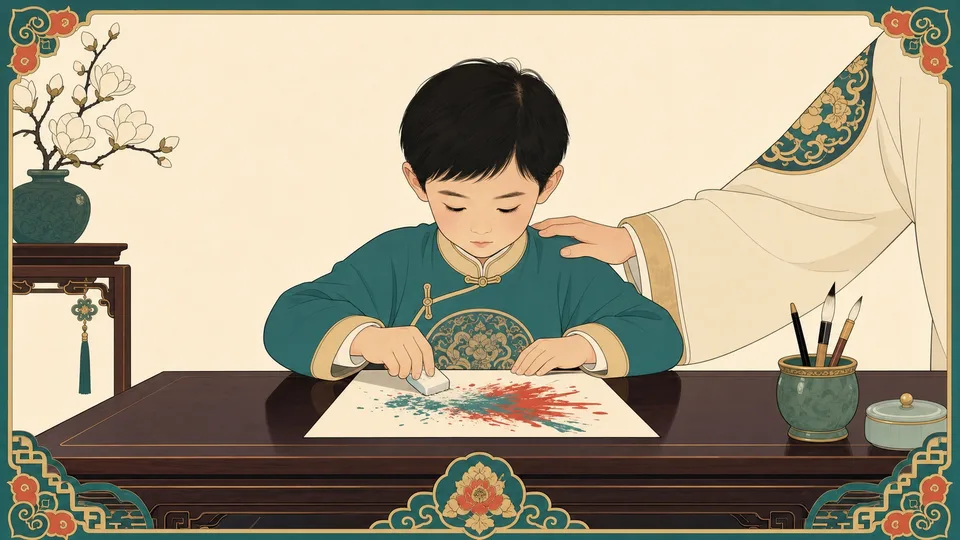
A teacher tells the parents that their son never interrupts, never argues, finishes every assignment, and causes no trouble. At dinner, an aunt asks what he wants to eat. “Anything is fine,” he says. The adults exchange the relieved smile reserved for a child who is 乖 (obedient), 懂事 (sensible), and 省心 (requiring no worry).
The room calls him good. Put the goodness on an autopsy table and a different fact appears: nobody can find his pulse.
The roughness adults remove to make a child “good” is the exact texture from which a self would have grown. In the anxious Chinese home and exam-centered school, goodness often means low friction. The child becomes beautiful to the system by ceasing to push back against it.
The Body Is Immaculate
Begin with the external examination.
The uniform is clean. The grades are high. The piano piece is polished. The child greets relatives correctly, accepts the extra class, thanks the adults, and carries hardship without complaint. No shouting. No unfinished homework. No embarrassing public scene. No dangerous appetite pointing toward an illegible future.
The achievement is not fake. The child may possess real discipline, memory, technical ability, patience, and consideration. That is why the damage hides so well. A visibly broken child invites concern. A smoothly functioning child invites admiration.
But performance cannot tell us who is performing. A marionette can execute difficult choreography. The grace of the movement does not prove that it chose the dance.
The phantom child is standing beside the real one throughout the examination: the future doctor, engineer, civil servant, overseas graduate, dutiful spouse, or stable provider whose success will redeem the family’s sacrifice. Adults compare the living child with this projection and call every reduction in distance “growth.” They do not notice when the child reaches the projection by disappearing.
First Incision: Preference
Ask the child what he wants.
“Anything is fine.”
Ask what subject he likes, what game he wants to play, where he wants to go, what he wants to eat, what he wants to become.
“I don’t know.” “Whatever you think.” “It doesn’t matter.”
Adults hear flexibility. The autopsy hears a missing organ.
A preference is a tiny act of authorship. Chocolate rather than vanilla, drawing rather than piano, this friend rather than that one: each choice says that the world lands unevenly inside me. I am not a neutral surface. I have a shape.
That unevenness creates work for adults. A child with preferences must be negotiated with. He may dislike the expensive activity his parents selected, love something with no respectable career path, or refuse the plan that makes the family legible at dinner. The smooth child saves everyone this labor. He anticipates the adults’ anxiety and deletes the preference before they have to override it.
This is more than obedience. The inability to trust joy begins when the child learns that the inner signal itself has no standing. The lesson is not merely “you cannot have what you want.” It is “wanting is unreliable evidence.” Eventually the child stops reporting desire because he no longer experiences himself as an authorized source.
Second Incision: Anger
The good child does not become angry when an adult crosses a boundary. He understands.
He understands that his parents are tired, that the teacher has fifty students, that the family spent money on him, that the exam is important, that everybody suffers, that now is not the time. Every explanation may be true. Together they teach him that another person’s burden always outranks his own signal.
Anger is the nervous system saying: something that matters to me is being crossed. Remove the “me,” and anger becomes unintelligible. The child learns to convert it into guilt, anxiety, stomach pain, private contempt, or perfect politeness.
This is why 懂事 can carry a dark double meaning. In its healthy form, it means social understanding. In its corrupted form, it means that the child has become exquisitely skilled at pre-paying the emotional costs adults refuse to bear. He reads the room, notices the parent’s face, predicts the complaint, and abandons himself early enough that no conflict becomes visible.
The child looks emotionally mature because the adults never see the emotions he had to kill to protect their composure.
Third Incision: Curiosity
Passion is inconvenient because passion does not stay inside the assigned question.
The interested student asks why the formula works, whether the textbook is wrong, what happens outside the test distribution, and whether the exercise matters. These questions consume time and may expose that the teacher only knows the approved procedure. The indifferent student is easier: show him the rubric and he will reproduce it.
An approval ecology therefore selects a specific classroom virtue. The good student is not the one most captured by the subject. He is the one most accurate about what the evaluator wants. He becomes excellent at dead reading because dead knowledge stays where it is put. Living knowledge wanders.
The same filter acts on teachers. Schools cannot directly measure the ability to awaken another mind, so they select for credentials, exam results, classroom order, parent satisfaction, curricular obedience, and tolerance for institutional politics. A teacher who reveals the hidden structure of a subject gives the student something dangerous: the ability to reconstruct the answer without authority.
Real teaching ends with, “Now I can see it myself.” Institutional teaching often ends with, “Now I know what to write.”
The difference is not softness versus rigor. It is agency versus compliance. The teacher who sees the actual student follows the living intelligence already present. The controlling teacher follows the prewritten destination and treats the student’s nature as resistance.
Fourth Incision: Judgment
After preference, anger, and curiosity go quiet, judgment follows.
Judgment is not knowing the approved ranking. It is sensing that one explanation is clearer, one movement more faithful, one argument dishonest, one life more alive—even before an authority supplies the answer. It develops through repeated contact between an inner response and consequences in the world.
The smooth child is denied that contact. Someone else chooses the goal, the path, the standard, and the interpretation of failure. He can become astonishingly capable while remaining unable to decide what capability should serve.
This is why copying the winner becomes safer than developing a style. Being yourself is hardest because a style is accumulated judgment made visible. It contains preferences that cannot be defended by saying everyone else chose the same thing.
The system does not need to destroy intelligence. It only needs to sever intelligence from an independent evaluator. The person may still reason brilliantly, but the final question remains outsourced: what answer can the person above me safely approve?
Cause of Death: Friction Was Mistaken for Defect
The organs failed together because they shared one blood supply: the child’s authority to register that reality matters to him in a particular way.
Passion is not a hobby, a career slogan, or constant excitement. It is biased attention. Something matters more than something else. The passionate child returns to one question, resists one demand, protects one strange fascination, and becomes bored by what everyone insists is important. Passion produces an asymmetrical person.
Asymmetry produces friction.
Parents must tolerate a child whose path makes relatives nervous. Teachers must answer questions that disrupt the lesson plan. Managers must deal with employees who care about the work enough to reject stupid instructions. Institutions must absorb people whose judgment sometimes competes with hierarchy.
So the system redescribes friction as immaturity. The child who objects is selfish. The student who questions is undisciplined. The worker who finishes early and leaves is disloyal. The independent teacher is difficult. What cannot be smoothly extracted is treated as defective character.
Legibility makes the substitution look reasonable. Grades, hours, obedience, certificates, and sacrifice are visible. Understanding, judgment, taste, and transformation are not. In a low-trust environment, adults choose the signals they can audit. The signals gradually replace the person.
The official story is hard work. The hidden test is submission: can the institution make your body and time visibly obey? The child rehearses this test long before entering the labor market. “Sit still, stop asking, finish what was assigned, do not make us worry” becomes “stay late, answer immediately, endure arbitrary demands, do not make the boss uncertain.”
The good child is the prototype of the extractable worker.
Why the Parents Keep Polishing
Calling this cruelty does not explain why loving people do it.
The parents see real danger. Exams allocate scarce opportunities. Employers use crude filters. Housing, elder care, hukou, marriage, and status punish failure. The child may be the family’s only credible mobility strategy and old-age hedge. When the child carries the family balance sheet, an unusual preference does not look charming. It looks like risk.
The parents are trying to reduce variance. A smooth child is easier to move through a narrow gate. He studies what is assigned, enters a legible profession, does not create scandal, and does not gamble the family’s sacrifice on a private conviction.
The strategy works often enough to become sacred. It produces credentials, incomes, orderly classrooms, family peace, and impressive technical execution. The survivors display the polish. The cost arrives later, after the gates have been passed, when nobody is left to assign the next answer.
Then the successful adult confronts questions no exam prepared him to answer:
- What do you want when nobody is grading you?
- What work would still matter without a title?
- What do you believe when agreement carries no reward?
- Whom do you love when the match cannot be defended as optimal?
- What are you willing to disappoint people for?
The striver often responds by finding another gate. The next credential, promotion, apartment, portfolio target, or approved partner restores motion without restoring direction. The machine can keep a person moving for decades after it has destroyed the capacity to choose where to go.
The Corpse Photographs Beautifully
This is the aesthetic trap. The smooth child does not look brutalized. He looks finished.
There are no rough drafts on the wall, no failed experiments on the floor, no vulgar enthusiasms, no embarrassing loyalties, no loud refusal. The room is tidy. The résumé is coherent. The family can narrate the life in one clean line.
But coherence can be purchased by removing everything that does not fit the story. The mask becomes exquisitely proportioned while the daemon—the child’s unsanctioned life—loses every legal channel into the world.
The outward beauty is not evidence against the violence. It is the form the violence takes.
An embalmed body is calm, clean, and easy to pose. No appetite disturbs its face. No anger interrupts the ceremony. No curiosity leaves the room. Nothing inside it demands a different future.
The corpse photographs beautifully because death is perfectly well-behaved.
Dimwit / Midwit / Better Take
The dimwit take is that Chinese parents are strict, Chinese schools kill creativity, and Western children are free.
That turns a structural mechanism into ethnic caricature and ignores every Western family, school, and company that also rewards manageability over life.
The midwit take is that discipline and passion require a reasonable balance. Some conformity is necessary; too much becomes harmful.
That is true but bloodless. It treats the damage as an excess of pressure when the decisive injury is a transfer of authorship. The child stops being the subject who uses discipline and becomes the object discipline is used upon.
The transfer continues when an outsider meets the polished adult and treats smoothness as proof that no author was ever there. Denied interiority turns a cultivated adaptation into an essence: the family first trains the child not to express independent judgment, then the wider culture explains his silence as racial incapacity for it.
The better take is that anxious systems define goodness from the evaluator’s point of view. A good child creates little uncertainty for parents. A good student creates little disruption for teachers. A good worker creates little resistance for managers. The traits are praised as virtues because they reduce the burden on whoever holds power.
The worse-is-better reality is that smoothness wins many finite games. It passes exams, avoids conflict, reassures relatives, and survives bureaucracy. The bill appears in the infinite game: the person becomes highly qualified to live a life no one chose.
Resuscitation Begins With an Inconvenient Signal
Do not begin by asking the smooth adult to “find your passion.” That turns passion into another assignment and creates another opportunity to give the correct answer.
Begin smaller.
What bores you even though it is prestigious? What annoys you before you explain the annoyance away? Which question do you keep returning to without permission? What do you do badly but voluntarily? Which person makes you more specific rather than more agreeable? What would you still practice if nobody could convert it into a credential?
These are weak signals from the buried evaluator. They need consequence, not affirmation. Choose something. Touch reality. Discover that the choice was partly wrong. Revise it. Preference becomes trustworthy by steering, not by being praised.
Good teaching supports this resuscitation. It takes something opaque and reveals the structure that lets the learner act without the teacher. It does not make the learner smooth. It makes the learner harder to control and easier to trust.
The institution called education does not own that act. It can happen in a classroom, a workshop, a small seminar, a practice court, a piece of explanatory writing, or a tool whose use teaches the user how to see. The essential condition is that reality—not the authority—gets the final vote.
The first sign of life may not be joy. It may be an objection. “I don’t understand.” “I don’t agree.” “I don’t want that.” “Let me try it another way.”
Adults who want a good child hear danger in those sentences. A teacher hears the return of the student.
The child was never raw material to be polished. The roughness was the person.