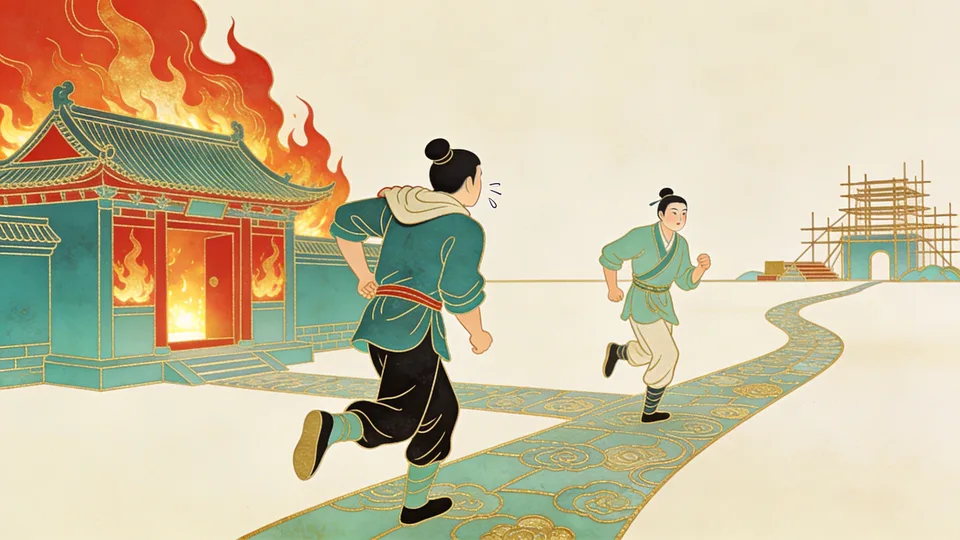
Two people can work the same hours at the same desk, and only one of them is building anything.
Picture two people doing the same job well. One works hard so as not to be fired. The other works hard because the work matters to them. Their managers can’t tell them apart: same hours, same output, same reviews. Does the difference in motive matter if the behavior is identical?
Ayn Rand’s Atlas Shrugged says it matters more than anything else about them. The claim arrives in John Galt’s long speech near the end of the novel:
You who are worshippers of the zero — achieving life is not the equivalent of avoiding death. Joy is not “the absence of pain,” intelligence is not “the absence of stupidity,” light is not “the absence of darkness,” an entity is not “the absence of a nonentity.” Building is not done by abstaining from demolition.
Toward and away
You seek escape from pain. We seek the achievement of happiness. You exist for the sake of avoiding punishment. We exist for the sake of earning rewards. Threats will not make us function; fear is not our incentive. It is not death that we wish to avoid, but life that we wish to live.
The two workers diverge over time, because a goal of “not failing” is satisfied the moment the threat recedes. The person working to keep the job eases off once the job feels safe. The person working toward something has no such stopping point, since there is always a further version of the thing to build. The orientation determines the trajectory long after the initial motivation fades.
The The Power Process explains why the avoider pays for this inside as well. People need real goals they can reach through their own effort, and those goals have to be positive. Both workers spend effort, but only the one building something gets the experience of agency from it. The other gets the quiet desperation Rand calls a living death.
Where does the “away from” orientation come from? Galt’s speech traces it to childhood:
“Don’t ask so many questions, children should be seen and not heard!” — “Who are you to think? It’s so, because I say so!” — “Don’t argue, obey!” — “Don’t try to understand, believe!” — “Don’t rebel, adjust!” — “Don’t stand out, belong!”
Each instruction teaches the child to suppress one more part of their own engagement with reality. The adult who comes out the other end has a motivational system made almost entirely of “don’t.”
Aiming below your best
All work is creative work if done by a thinking mind, and no work is creative if done by a blank who repeats in uncritical stupor a routine he has learned from others.
To settle into a job that requires less than your mind’s full capacity is to cut your motor and sentence yourself to decay. To cheat your way into a job bigger than your mind can handle is to become a fear-corroded ape on borrowed motions and borrowed time. The worker who stays only to avoid being fired is usually making the first error. The edge lies between the two: the work demands everything you have without exceeding it.
Rand pushes this to its harshest form. There’s no surer way to destroy a man than to force him into a spot where he has to aim at not doing his best, where he has to struggle to do a bad job, day after day.
Diagnosis, not program
The usual arguments about the book are political. Admirers read it as proof that taxation is theft and the rich are heroes; critics read it as sociopathic individualism that ignores structural inequality. Both miss what holds up, which is the diagnosis. People who organize toward goals do live different lives from people who organize against threats, even in identical circumstances, and you can trace the path from a child’s crushed curiosity to an adult’s empty compliance. Whether Rand’s proposed solutions are correct is less important than the precision of her diagnosis.
That leaves the uncomfortable part with the reader rather than with Rand. Destruction is not achievement, and avoidance is not living. Of the two people at the same desk, which one are you? The only question that matters is: what are you building?
References:
- Ayn Rand, Atlas Shrugged