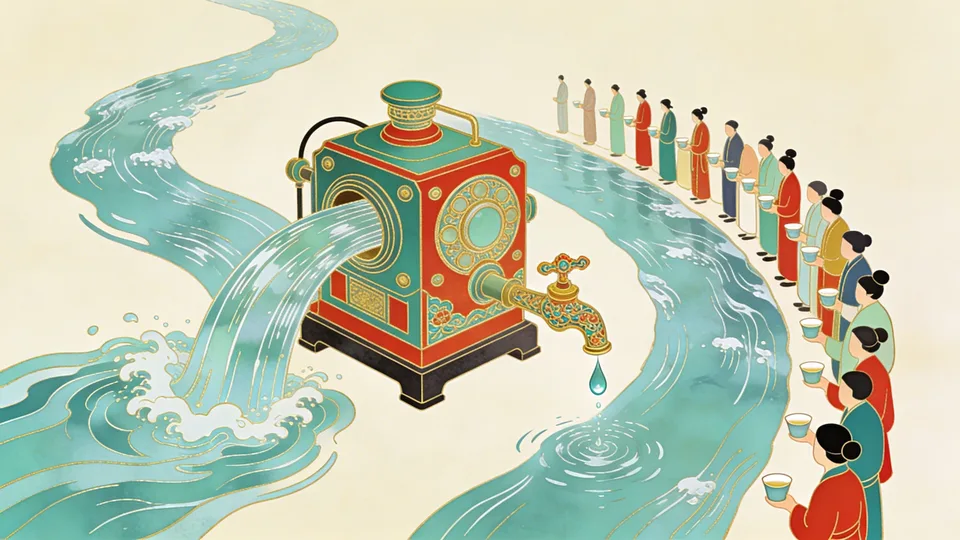
The bottled-water company never had to poison the tap. It only had to make sure nobody defended it.
Economics textbooks begin with scarcity. Human wants are unlimited, resources are not, and so we need markets, prices, and institutions to decide who gets what. On that picture scarcity is a fact of nature and the economic system is our best tool for managing it. Yet the richest societies in history are full of people who feel short of almost everything: money, time, rest, attention, affection. If the system is so good at managing scarcity, why does there never seem to be enough?
Darren Allen’s 33 Myths of the System answers by reversing the textbook. The system cannot function unless there is never enough. On his account scarcity is the system’s operating requirement. It is produced, not discovered, so that the system that manages scarcity remains necessary. The claim sounds like paranoia until you watch a small version of it run.
How a shortage gets made
Imagine a town with clean tap water. A company that sells bottled water first convinces people the tap might be unsafe. Then it sells them the solution. Then it lobbies against spending on the water infrastructure, which nobody defends very hard because fewer people drink from the tap. Eventually the tap water really does become unsafe. At no point did the company discover a problem. It manufactured the conditions that made itself necessary, and by the end its product is a genuine answer to a genuine shortage.
Allen thinks the loop is not confined to particular products, and its primary instrument is money, which converts the quality of life into quantity that can be measured, stored, and stolen. Once that conversion is in place, more of what we do takes on the alienating character of work. That produces more unhappiness and stress, each of which opens a new market and therefore creates more work. So the loop feeds itself: the system produces the dissatisfaction that creates demand for the system’s products.
None of this requires a conspiracy. The bottled-water company does not need a secret plan, only an incentive that rewards whatever makes the tap look worse. In Freedom Unemploys, scarcity is manufactured with no central actor at all: each person’s sense of self depends on everyone else staying in their role, and the supply of freedom shrinks through mutual enforcement rather than command.
Merit and choice
A system that manufactures scarcity has to explain why some people end up with plenty, and its explanation is merit. Allen’s objection is that the system rewards conformity, ambition, abstract “intelligence,” and insensitivity, so the executive who designed the campaign against the tap is promoted for exactly what the structure wants. The few who rise from the bottom do not refute this. Allen calls them tokenism: the town’s one local kid who became a regional manager at the water company is exactly the person the company will put in its brochure.
The system also has to seem free, and here Allen’s claim is that the system permits meaningless choice. You can do what you want, as long as it doesn’t really matter. The supermarket now stocks forty brands of bottled water, still, sparkling, mineral, alkaline, in glass or plastic. Nobody can choose a working tap. And a household that tries to opt out anyway, in a town whose tap is unsafe, gets sick, so its failure becomes an argument for bottled water.
Natural or naturalized
There are two easy responses to all this. One is “the system is rigged, so tear it all down.” The other is that these are the natural consequences of complex coordination and that complaints are naive. The second deserves a real hearing. Some scarcity is not manufactured. Land, time, and attention are genuinely finite, and market economies did produce historic abundance in food, medicine, and goods. Allen’s account is totalizing, and a reader can reject its strongest form.
But a narrower version survives the objection. Wherever an institution profits from managing a shortage, it has an incentive to keep the shortage going, and over time the managed shortage starts to look like the way things are. That is why the system’s most powerful trick is not oppression but naturalization — making its manufactured conditions look like the way things inherently are. The structural problem is that the system is self-justifying: each of its outputs becomes the input that justifies its existence.
Return to the town a generation later. Its children have never drunk from a tap. They know the brands, have opinions about alkaline water, and some of them work at the bottling plant. Nobody has forbidden them to want clean public water. They simply cannot picture it. The system’s final product is not a prisoner but a person who cannot imagine what freedom would look like. A prisoner at least remembers the outside. The town’s children would have to be told, and the system has made sure the person telling them sounds utopian.
References:
- Darren Allen, 33 Myths of the System