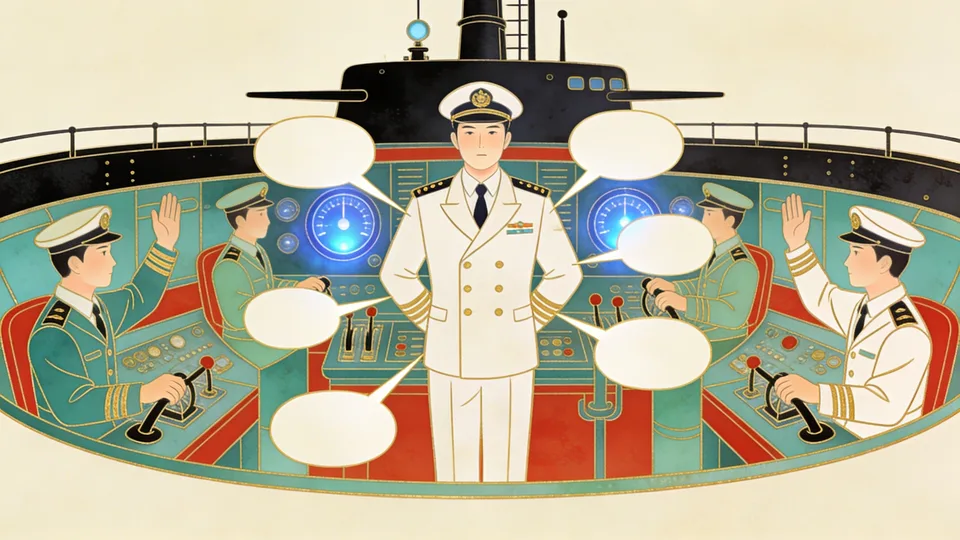
A captain who makes every decision has a crew that can’t.
When L. David Marquet took command of the USS Santa Fe, it was one of the worst-performing submarines in the US fleet. It carried 135 crew, and by his count only five brains were engaged: the captain and four department heads. Everyone else followed checklists, waited for orders, and tried not to make mistakes. Every decision routed through the captain, so the captain barely slept, and the ship was only as good as his judgment at three in the morning.
The obvious fix is an empowerment program: tell the crew they own their work, invite initiative, delegate more. Marquet’s argument in Turn the Ship Around! is that this fix contradicts itself. The message is “you have power.” The method is it takes me to empower you, and the method wins, because a crew learns from what the captain does more than from what he says. You cannot invoke leader-follower rules to direct a shift from leader-follower to leader-leader. So if empowerment cannot be handed down, where does it come from?
What was taking it away
Marquet’s answer starts by changing the question. The question is not “how do I empower 130 people?” — it is “what am I doing that is disempowering them?” The crew had not arrived passive. They had been trained into passivity by a system whose prime driver was avoiding mistakes, where the only reward was not being punished. Under that rule the safest move is to decide nothing, and the missing initiative produces the sloppy practices, errors, and low morale that make the next layer of supervision look necessary.
Supervision fed the spiral instead of breaking it. Efforts to improve the process made the organization more efficient. Efforts to monitor the process made the organization less efficient. Inspectors catalogue what went wrong without making anything better, and every extra check teaches the people being checked that judgment belongs to someone else. Even speech bent toward the same rule. Officers reported only fully certified information, with no room for hunches or probabilities, because in order to make the fewest mistakes when reporting, people say as little as possible.
”I intend to”
The mechanism that broke the pattern was small. Instead of asking permission, officers stated their intentions: “I intend to submerge the ship” rather than “request permission to submerge.” The captain could still say no, so no safety was given up. But to say “I intend to,” the officer of the deck has to have already done the captain’s thinking: is it safe, is it time, what does the mission need? By stating intentions, people act their way into the next higher level of command. As Marquet put it, we had no need of leadership development programs. The way we ran the ship was the leadership development program.
The captain changed how he talked as well. Formal naval communication treats “I think…” as sloppy, but thinking out loud hands subordinates the context they need for the decisions now being pushed down to them, and shows that uncertainty is safe to admit. Lack of certainty is strength. Certainty is arrogance.
Underneath both changes, the ship’s orientation shifted from avoiding errors to achieving excellence, and the shift showed most clearly in how the crew treated inspections. A crew trying not to fail sees an inspector as a threat to survive; a crew trying to achieve something asks what other ships have figured out that it hasn’t. The self-reinforcing downward spiral breaks only when the orientation flips from avoiding punishment to achieving something genuinely worth achieving.
Why “just delegate” fails
Read quickly, this sounds like “trust your people,” which would fail on a submarine. Marquet named two prerequisites. The first is technical competence: as authority moves down, the people holding it need the knowledge to use it, and control without competence is chaos. The second is organizational clarity: people must understand what the ship is trying to accomplish, not just which tasks to perform, or they will produce well-meaning but erroneous translations of intent.
So the cautious manager who says authority must be earned is partly right. He goes wrong in treating control as the way to get there, when control is what stops competence and clarity from growing. The real issue sits elsewhere: the question is not whether to control or empower but what systems are currently disempowering people — and whether competence and clarity are sufficient for distributed authority to work. Marquet’s approach was to build competence and clarity fast enough that control could keep being released.
The cost of skipping this shows up when a leader leaves. People who are treated as followers treat others as followers when it’s their turn to lead. An officer who made himself indispensable leaves behind a ship that falters, and the faltering is taken as proof of how good he was.
Which returns us to the captain who barely slept. On a ship run that way, his exhaustion looks like dedication, the crew’s dependence looks like his competence, and the ship stays safe only until something happens that he failed to foresee. You don’t want to be accidentally safe. The harder test of a captain is whether the ship runs well while he is asleep, and whether it still does after he has gone.
References:
- L. David Marquet, Turn the Ship Around!: A True Story of Turning Followers into Leaders