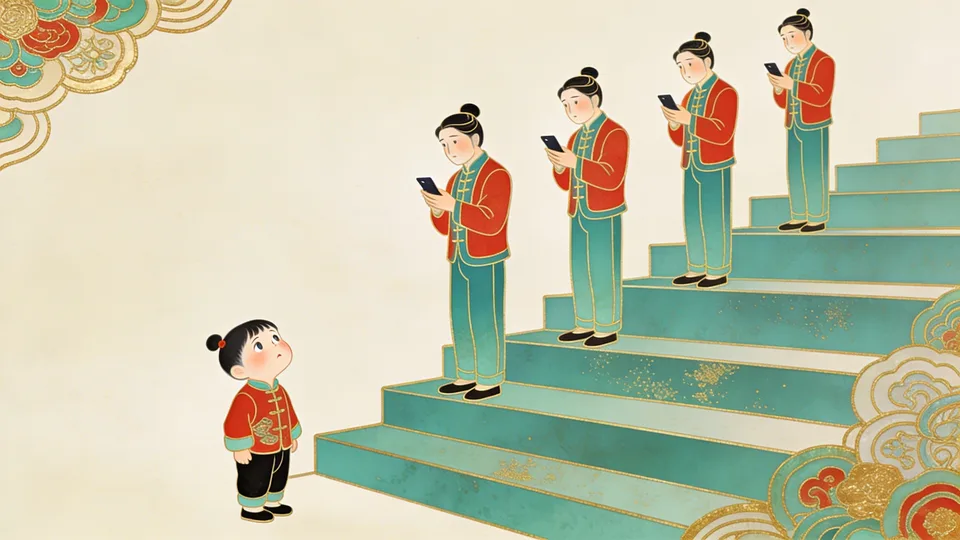
Many parents today are overprotective but strangely permissive. They hesitate to give advice or get involved, afraid of seeming controlling or outdated. They obsess over protecting children physically but have little interest in guiding them morally. They care more about their children’s safety than their character. Johnstone’s impro sees this from the other side: education itself is often the destructive process — teachers who try to get students to conceal fear rather than dissipate it produce adults who are armored, superficial, and calculating.
Simple Picture
ELI5: imagine being a child and looking up at the adults for a demonstration of what you will become. And every adult you see is just as anxious, just as insecure, just as uncertain as you are. There is no next stage. There is no “it gets better.” There is just more of the same. Why would you bother growing up?
The Empty Handoff
the-right-story names the organizational version: story is the operating system of collective action, and the leader’s job is to get the story to where it needs to be. When there is no story at all, efforts feel futile. The parent without convictions is the leader without a story — and both produce the same result: people who do not know why they are trying.
To hand something down, adults would have to believe in something first. When everything is subjective, when all is debunked, when all is a social construct — how can you pass it down? If nothing is real or solid, how can you hold onto it? Their hands are empty.
Arendt gave this its darkest frame: adults with no convictions, belonging nowhere, are precisely the population susceptible to totalitarian solutions. The void of meaning does not stay empty — ideology is always waiting. Never before in history have so many adults been wedded to nothing, vowed to nobody, belonged to nowhere, had nothing to live or die for. They have political positions but not principles. Sides in the culture war but not convictions. Adults were taught to weaken their convictions, soften their beliefs, that it was almost offensive to believe in anything deeply. There is no imparting wisdom anymore — only imposing worldviews.
This is pain as organizing principle at the generational level. If conviction risks the pain of being wrong, the locally-optimal move is to hold no convictions. If moral guidance risks the pain of seeming authoritarian, the locally optimal move is permissiveness. The adults avoided discomfort and left children to navigate moral reality alone.
Authority and Admiration
When you cast out authority you take with it admiration. You lose recognition from fathers that you are capable, that you can reach your potential. You lose reassurance from mothers that you are worth more than you realize.
shouldering-the-gate names the Chinese version with devastating precision: Lu Xun’s awakened parent shoulders the weight of tradition to let the children through to the light — understanding their world, guiding without commanding, then liberating completely. The parent who cannot do this reproduces the gate instead of opening it.
When we killed authority we also killed ideals and inspiration. Instead of adults who are gentle, kind, and aspirational, we ended up with adults who are weak, who lack conviction, who command no respect — who cannot even praise their children for acting right because that would require admitting to a right and wrong.
This is why Adler’s framework matters here. The courage to be disliked is the courage to hold convictions. Freedom is being disliked by some people — but modern adults have optimized so aggressively for not being disliked that they have forfeited the capacity to guide. They want to be liked by their children, not respected. assertiveness names this precisely: submission is the attempt to purchase approval by forfeiting yourself. An entire generation of parents submitted to their children’s comfort, and the children got safety without direction.
The Rebellion Against Freedom
We are not revolting because we were restricted by too many rules. We are revolting against too much freedom. When everything is permitted, the only rebellion left is to give up on it all.
This is an antifragility problem: children need the small stresses of boundaries, consequences, and moral friction to develop character. Remove these and you get safety without strength — fragility pretending to be protection. This is the cage inverted. Singer describes people who build walls to block pain and then decorate the cage. Here, the cage was never built — and the result is not freedom but vertigo. Children who had to come up with their own moral codes, who made major mistakes early in life, who were taken care of but left completely unprepared. We have a generation dependent on therapists and “experts” because they did not have adults.
The puer-aeternus archetype is the individual version of this cultural pattern — the eternal boy who refuses to commit because there is nothing to commit to, no adult world worth joining. Why grow up when adulthood seems no different from adolescence? Why take on burdens when nobody around you seems to grow out of anything? Show us it gets better. Show us the next stage. Show us someone who shoulders their burdens and becomes better for it. Show us how. The Shifu arc is the only honest answer — not an adult who was always wise, but one who caused real damage and spent three acts rebuilding himself in front of you. The Machine compounds this: the adults who should be modeling genuine presence are themselves swiping, editing, performing liberation — and their children have no reference point for what it looks like to be human without a screen.
Girls Without Guidance
The failure hits girls with particular force. Girls need to be taught something beyond being nice and non-judgmental so they can say no. Without that, they are left vulnerable — unable to resist pressure, unprepared for adulthood, looking loved and coddled but beneath it all, completely unprotected.
Now teenagers cannot play in the park but can get into relationships with nothing to guide them. Boys cannot risk breaking their arms but can break hearts without consequence. We got too afraid to lecture and moralize, forgetting we used to call that wisdom, forgetting that is part of protection.
This is the boundaries crisis made concrete. A boundary requires the capacity to say no — which requires knowing what you stand for. If nobody taught you what is worth standing for, the “no” has no ground to stand on. The assertiveness spectrum applies: without models of assertiveness, children default to either submission (people-pleasing, inability to resist pressure) or aggression (delinquency, acting out for attention). Both are strategies for a world where no adult demonstrated the third option.
What Is Actually Needed
We need adults to take back their dignity. To stand firm for what is right. To care less about being liked and more about being respected. To abandon this adolescent way of thinking. Adults who are authoritative not because they want children to fear them but because they have faith in them — in who they could become.
This is the infinite game of parenting: not parenting to a destination but parenting for growth. But it requires adults who believe growth leads somewhere — who have a vision that education continues an unfinished past into the future, rather than training that repeats a completed one.
Common Misread
The dimwit take is “kids these days are soft — they need tougher parents.”
The midwit take is “this is conservative nostalgia for authoritarian parenting that never worked.”
The better take is that the crisis is not overprotection or underprotection but the absence of adults who model what it means to hold convictions, shoulder burdens, and become better for it. Children do not need stricter rules or looser ones. They need adults who believe in something enough to transmit it — and who are willing to be disliked in the process.
Main Payoff
Why is Gen Z not growing up? Because who around them did? The anxiety of a generation is not a medical condition to be treated by professionals. It is the rational response to looking around and seeing no one who demonstrates that growing up is worth it. The self-acceptance path requires someone to model what an accepted self looks like in motion — not performing ease but genuinely bearing weight. Without that demonstration, self-acceptance remains an abstract concept, and therapy becomes a paid substitute for the adults who should have been there for free.
References:
- Freya India, The Need for Adults