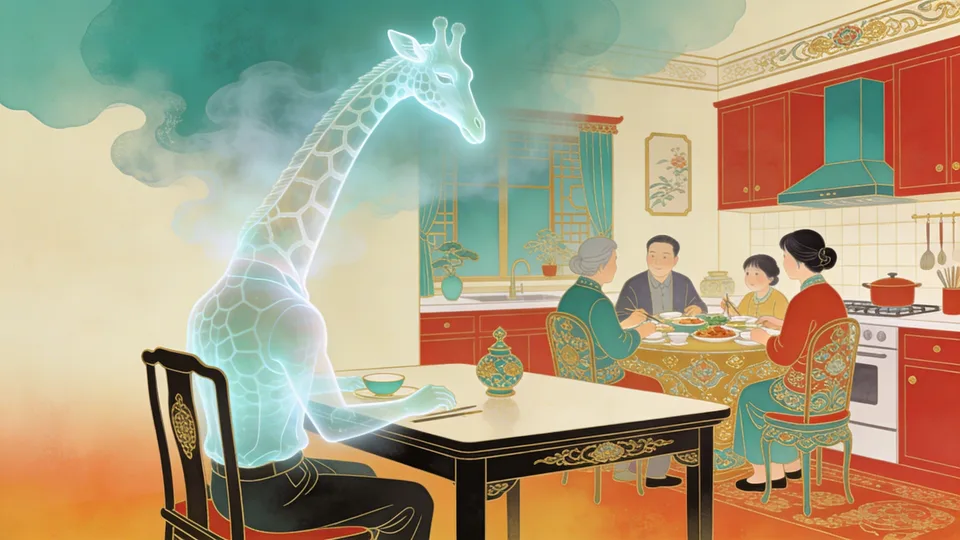
Maté’s full framework reveals ADHD as sensitivity + inadequate emotional attunement in infancy — simultaneously a wound and a gift. The hallmark of ADHD is an automatic, unwilled tuning out — a frustrating non-presence of mind. People suddenly find that they have heard nothing of what they were listening to, saw nothing of what they were looking at. There is a sense of being cut off from reality, an almost disembodied separation from the physical present. “I feel like a human giraffe — as if my head is floating in a different world, way above my body.”
This is not laziness, and it is not a choice. It is an automatic brain activity that originated during rapid brain development in infancy, when there was emotional hurt combined with helplessness.
Simple Picture
ELI5: the child’s brain learned to turn off the channel when the signal was too painful to receive. The channel stayed off. Now it turns off by itself whenever the system detects stress, boredom, or emotional intensity — even when the adult desperately wants to pay attention.
Telling an ADHD child to “pay attention” completely misunderstands both the nature of the child and the nature of attention. The newborn can no more focus his attention than he can focus his vision. Attention is a capacity that develops in the context of safe attunement — and when attunement is disrupted, the capacity develops unevenly.
How It Feels From Inside
The outside presentation is recognizable: downcast or averted eyes, tense posture, tapping feet, fidgeting hands, nervous self-deprecating humor, and a rapid meandering flow of speech that seems almost oblivious of the listener. But the inner experience is not “I do not care.” It is more like:
I am here, but not quite in the room.
There is often an almost active not-noticing — as if the mind goes out of its way to miss what is right in front of it. Directions are the comic miniature of the whole condition: someone explains how to get somewhere, the ADHD person loses the thread halfway through the first sentence, nods with practiced competence, then walks away entrusted to luck. The shame is not only that attention failed; it is that one has become skilled at impersonating someone who understood.
This produces a strange social texture. The person misses information, misplaces things, loses conversational threads, interrupts, overexplains, and then apologizes. John Ratey’s line is brutal because it is true: “I’m sorry” becomes the most common phrase in the ADHD vocabulary. Not because the person is uniquely inconsiderate, but because ordinary presence has become unreliable.
Motivation and Time
ADHD is not a lack of motivation in general. It is a motivation system that requires immediacy. The threat of failure or the promise of reward has to be near enough for the engine to turn on. This is why crisis can produce sudden competence while ordinary maintenance feels impossible.
Maté’s blunt formulation is that ADHD needs a much higher level of motivation than other people. The desired thing has to feel urgent, vivid, interesting, dangerous, relationally charged, or immediately rewarding. Otherwise the task remains conceptually important but motivationally unreal.
Time gets distorted in the same way. If the appointment is at 9:00, then until it is 9:00 the system feels as if there is still time. One is either dashing around in impossible urgency or living under the illusion of eternity. There is little middle register where future time feels real enough to coordinate present action.
That is why rest can feel contaminated. One rarely relaxes without the troubling sense that something else should be happening. The system is either underactivated and searching for stimulation or overactivated and haunted by everything it has not done.
The Developmental Root
The association between low self-esteem and ADHD is not that the first arises from the second. They both arise from the same sources: stress on the parenting environment and disrupted attunement and attachment.
The child experiences a subliminal knowledge that there are things in the world much more important to the parent than the child — that he is not worthy of the parent’s full attention. This is not necessarily dramatic neglect. The parents may be stressed, overwhelmed, depressed, or simply unable to provide the attunement contact the child’s sensitive nervous system requires.
A child taught to still the voice of her innermost feelings assumes automatically that there is something shameful about them, and therefore about her very self. This is why expressing emotions feels universally uncomfortable for ADHD adults — not because they lack emotions, but because they learned early that their emotions were unwelcome.
Hypersensitivity as Temperament
People with ADHD are hypersensitive. That is not a fault or a weakness — it is how they were born. It is their inborn temperament. Telling them to stop being “so touchy” is like advising a child with hay fever to stop being “so allergic.”
The sensitivity means the disrupted attunement hits harder. Infants whose caregivers were too stressed to give them necessary attunement contact grow up with a chronic sense that no one can share how they feel, that no one can understand. This connects to the outlier-genius pattern: the same heightened sensitivity that enables unusual perception also makes the wound deeper and the compensatory architecture more elaborate.
The child experiences abandonment not necessarily as a dramatic event but as a background fact: there are things in the world more important to the parent than the child’s inner state. The sensitive nervous system does not merely notice this. It organizes around it.
Social Outside-Ness
The social wound is not secondary. ADHD interferes with the recognition of interpersonal boundaries and social timing. Children may approach others with naive, unguarded openness, miss cues, overrun the available space, and receive rejection before they understand what happened.
In adulthood this becomes the familiar outsider feeling: always on the outside looking in, somehow missing the point, gravitating to the edge of the room while wanting to belong. The compulsive joking, rapid-fire speech, topic-hopping, and exhausting overexplanation are often attempts to bridge a gap the person cannot quite locate.
This is the social version of tuning out: not a lack of desire for contact, but a failure of automatic social compression. The person cares intensely and still cannot reliably read where the other person begins.
Counterwill
Counterwill is an automatic resistance put up by a person with an incompletely developed sense of self — a reflexive going against the will of the other. It is not stubbornness or defiance. It is a natural but immature resistance arising from the fear of being controlled.
The child erects a wall of “no’s” behind which they can gradually discover their own likes, dislikes, and preferences without being overwhelmed by the parent’s far more powerful will. This is primitive boundaries — the only form available to a developing self that has not yet learned to hold its ground without total refusal.
Any pressure, no matter how well-intentioned, is experienced by the ADHD child to a magnified degree and generates counterwill of heightened intensity. The epithets “stubborn” and “willful” denote not a strong will but the lack of one — the wall exists precisely because the will inside it is too undeveloped to function without protection.
This also explains why praise can be uncomfortable. Praise is attention, and attention from a powerful other can feel like control. If approval has been used to shape the child into compliance, then even warmth carries a hook. The child craves attention and resists it at the same time.
Depression is when counterwill falls silent. When the system stops resisting, it has given up.
The Intimacy Paradox
Fear of intimacy coexists with a desperate craving for affection and a dread of rejection. The person with ADHD may be in a relationship lasting decades without ever feeling completely committed to it — one foot always near the door, the same provisional quality of never fully landing.
The paradox is structural: the system craves the connection it learned was dangerous. A strange drowsiness may come over them during emotionally charged situations — the same dorsal vagal shutdown that the tuning-out response was originally built from, now triggered by the intimacy the system simultaneously seeks and fears.
This maps onto the desire-vs-love pattern and the fearful-avoidant attachment style in personality-tensions: high avoidance and high anxiety simultaneously, reaching out and recoiling in the same motion.
The Self-Esteem Trap
ADHD adults are convinced their low self-esteem is a fair reflection of how poorly they have done in life — only because they do not understand that their very first failure was not their failure at all. This is the general principle behind children-as-mirrors: every “behavior problem” is a child’s best available adaptation to what the environment failed to provide. The inability to win the full and unconditional acceptance of the adult world was a failure of the environment, not the child.
Many traits thought to be caused by ADHD are actually expressions of low self-esteem: workaholism, drivenness, inability to say no. The adult with ADHD is buried under yes’s that are not true yes’s at all, only no’s they dared not say. This is self-acceptance in reverse: layers of self-rejection so old they feel like identity.
The deeper wound is that the child learned to distrust the voice of inner feeling. A child taught to still her innermost feelings assumes there is something shameful about them, and therefore about herself. The adult does not merely have poor self-esteem. The adult has learned to treat spontaneous selfhood as evidence against the self.
This is why many ADHD adults become driven, useful, funny, accommodating, brilliant, or hyper-responsible while still feeling fraudulent. They are trying to earn the unconditional acceptance that should not have needed to be earned.
Common Misread
The dimwit take is “ADHD is just being lazy and undisciplined.”
The midwit take is “ADHD is a brain chemistry imbalance — take stimulants and it’s fixed.”
The better take is that ADHD is a developmental pattern where an inborn temperament (high sensitivity) met an environment that could not adequately attune to it. The attention problems, time blindness, social awkwardness, counterwill, emotional dysregulation, and self-esteem collapse all share the same root. Medication may help the attention, but it does not heal the wound underneath — which is why many medicated ADHD adults still feel fundamentally disconnected from themselves and others.
Main Payoff
The most important reframe: ADHD is not a deficit of attention. It is a locally-optimal defensive response that was built when paying attention was too painful. The system learned to turn off, and it never learned to turn back on voluntarily. The tuning-out protected the child. It handicaps the adult. But it was never a malfunction — it was the best solution the developing brain could find.
The practical implication is not “try harder to pay attention.” It is to rebuild the conditions under which attention becomes safe: attuned relationships, reduced shame, embodied regulation, immediate structure, honest boundaries, and contact with genuine preference. No one can forcibly install motivation from the outside. Motivation emerges when the self no longer has to spend all its energy defending against intrusion.
References:
- Gabor Maté, Scattered Minds: The Origins and Healing of Attention Deficit Disorder