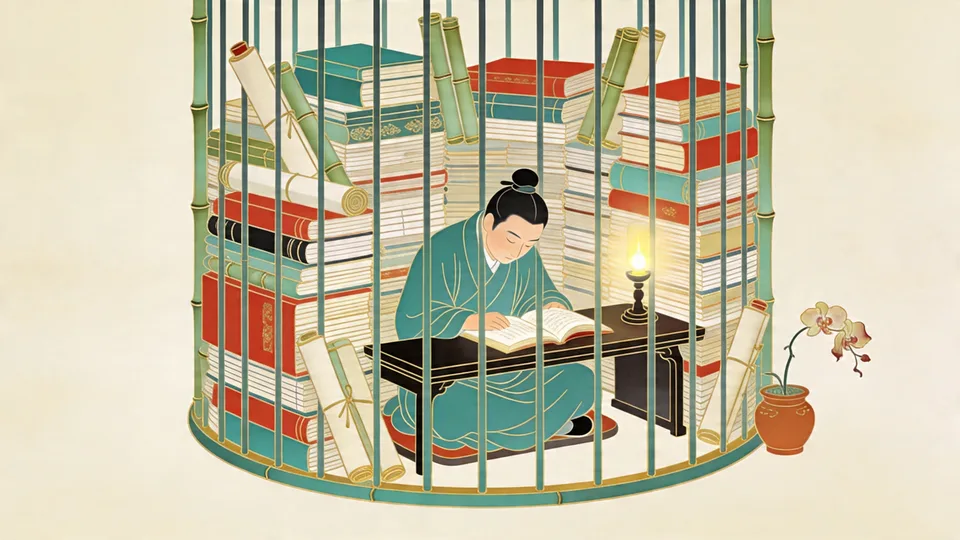
The student who memorized every recipe still can’t tell you why the cake came out dry.
Two people read the same cake recipe. The first bakes the cake, notices it came out dry, and realizes flour absorbs moisture, so next time she uses less. She has extracted a rule the recipe never stated. The second memorizes the recipe verbatim: 200g flour, 2 eggs, 45 minutes at 180°C. Hand him the same ingredients and a hotter oven and he will still bake for exactly 45 minutes, pull out a cinder, and blame the oven, because the book said 45 minutes.
Chinese has a name for the second reader: 死读书 (sǐ dú shū), literally “dead reading books.” It is usually said with contempt for a particular kind of student, the one who reads sixteen hours a day, gets straight A’s and is useless at his first job. Why would someone capable of that much work end up knowing so little? And is it really his fault?
A lookup table with no rules
The second baker read the words, but his knowledge is dead because it cannot react to reality. It is overfitting in human form: a high-dimensional lookup table built without ever writing a compression algorithm. Each fact sits in memory as an isolated node, with no edges to the others and nothing that says when it applies. The living reader builds those edges by asking: if this is true, what else must be true? Under what conditions does the rule break? The same gap shows up in Knowing the Name: a label filed where an explanation should be. The dead reader never asks, so he passes every test drawn from the recipe book and fails at the first oven it didn’t describe.
Worse, the failure stays invisible until then. He performs flawlessly on familiar material, so everyone, including him, assumes he is highly capable. The fragility shows only under an out-of-distribution shock: a real crisis, an unfamiliar problem, a question phrased in a way the textbook did not anticipate.
Not the student’s fault
The usual moralism, “he just memorizes, he doesn’t think,” locates the failure in the student. The better take is that 死读书 is the rational equilibrium for an agent inside an environment with a zero-variance evaluation metric. If the exam rewards exact textual replication and punishes novel synthesis, a student sensibly spends no effort building rules, because the lookup table genuinely works for the exam, and every move away from it — confusion, search, the willingness to look stupid — looks like getting worse. This is Goodhart’s law in the cognitive register: once recall becomes the metric, recall stops measuring understanding.
So telling students to “think critically” cannot fix it. Living knowledge needs both a great deal of input and the punishing feedback of reality, the burnt cake, to forge the connections. You get out of 死读书 by entering an environment where memorization stops paying, and most exam systems and credentialed careers make sure it keeps paying.
There is a real limit to the critique, though: most modern bureaucratic infrastructure depends on humans performing 死读书 perfectly. You do not want the compliance officer creatively grokking the spirit of the law. You want the checklist executed without improvisation, and the legal system, the airline industry and the hospital floor are all load-bearing on the human lookup table. The pathology and the function are the same behavior. The question is which environment you are deployed in.
When the lookup table is free
For a long time that environment paid well. People who could act as flawless lookup tables, such as accountants, paralegals, junior diagnosticians, standard programmers and mid-level analysts, commanded high salaries because precise recall was scarce, and a credential certified storage capacity. As LLMs offer lookup at near-zero marginal cost and superhuman fidelity, the value of uncompressed, static knowledge collapses to zero. The second baker’s skill is now free. What remains scarce is the first baker’s habit: burning the cake, noticing that the flour was the problem, and building the rule herself.
That leaves an uncomfortable question for every exam culture. What happens to the students who spent a decade of childhood becoming the second baker, just as the recipe became free?