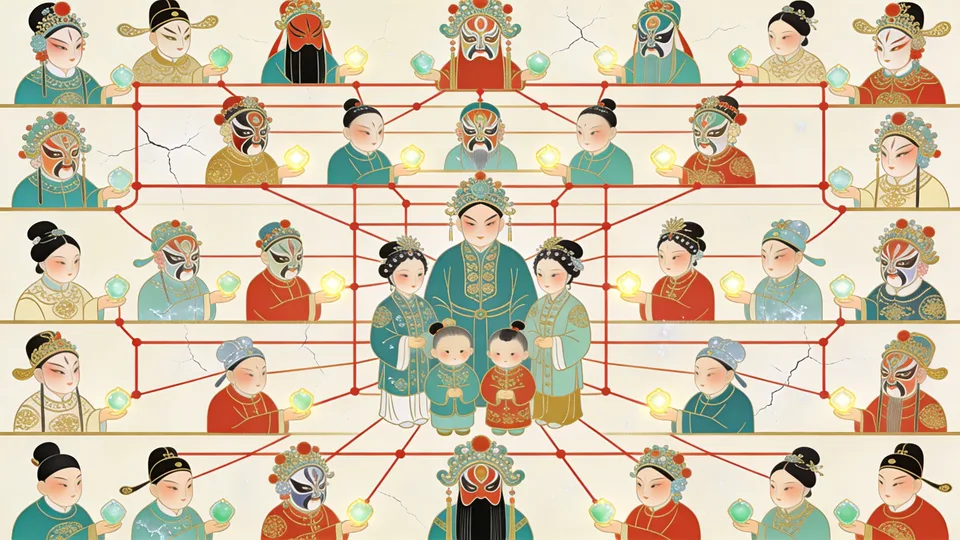
At the New Year banquet, the daughter who became a chef is still studying medicine.
A daughter in a Chinese family quits medical school to become a chef. At the New Year banquet, an aunt asks how her studies are going, and before the daughter can answer, her mother says she is doing very well, the exams are hard but she is managing. Later the mother is not apologetic. She is furious that her daughter made her lose face.
Outsiders tend to read this as pride, or a cultural quirk about politeness, as though the mother could simply decide to care less. But she is behaving the way someone behaves when a debt has been called in. To see why, it helps to treat mianzi (面子) less as a feeling and more as a distributed consensus algorithm: a social economy whose currency is perceived status, in which almost everyone is operating with enormous leverage.
A ledger everyone keeps
Face works like consensus reality under low-trust, high-density pressure. Everyone at the banquet keeps the same ledger of whose children are impressive and who owes whom. Because survival has long run through that ledger, the shared picture becomes more behaviorally real than any one person’s experience. The mother is not lying about her daughter because she is vain. She is protecting the family’s stake in the ledger, and the family’s stake is the only position she has.
The algorithm has a history. Survival on the North China Plain required large-scale coordination, flood control and irrigation above all, and individualism was a threat to it: if you broke rank, the river flooded and everyone starved. The culture built an operating system, Confucianism, that treated the social hierarchy as objective reality. In that system the individual is not allowed to exist as a primary node. You exist as a fractional share in a family’s social corporation, and your own desires and aptitudes are a volatile asset to be suppressed when they threaten the family’s face. Hence the core diagnosis: The trauma engine of the modern diaspora is that they are running this Iron Age survival software on 21st-century hardware.
What it costs
The cost falls hardest on warmth. To hold their position, people trade real connection and honesty for status inside the shared picture, and a common way to gain status is 贬低 (biǎndī), belittling others. Each small win of arrogance at the banquet table builds a wall, and the garden’s image for where that leads is the frozen hell: everyone clutching their inflated face inside a freezer, paranoid and alone.
The ledger runs through every relationship. The daughter’s career choice registers with her mother as an assault on the family’s stake, not as an inconvenience. The mother, meanwhile, is herself trapped, paying for expensive banquets and performing obedience to keep her own parents’ face intact, and she passes that debt down. Among friends, vulnerability means exposing a lack of face, so friendship drifts toward alliance. At work, admitting a mistake costs face, so failures stay hidden until they explode.
Why therapy alone won’t fix it
The tempting response is to call the whole culture toxic and prescribe Western boundary-setting until everyone can be their authentic self. That misreads what face is for. The better take is that mianzi is a Proof-of-Stake consensus algorithm designed for low-trust, high-density agrarian environments. It kept families and communities intact across millennia, and it did so by pushing the psychological cost onto the individual. You cannot dismantle it with therapy any more than you can patch a mainframe with a smartphone app.
What can change is the recognition that the survival problem it was designed to solve no longer exists. The mother at the banquet is still defending against a flood that will not come. The algorithm is working exactly as designed. The question is whether the family can afford what it costs, now that the river no longer floods.