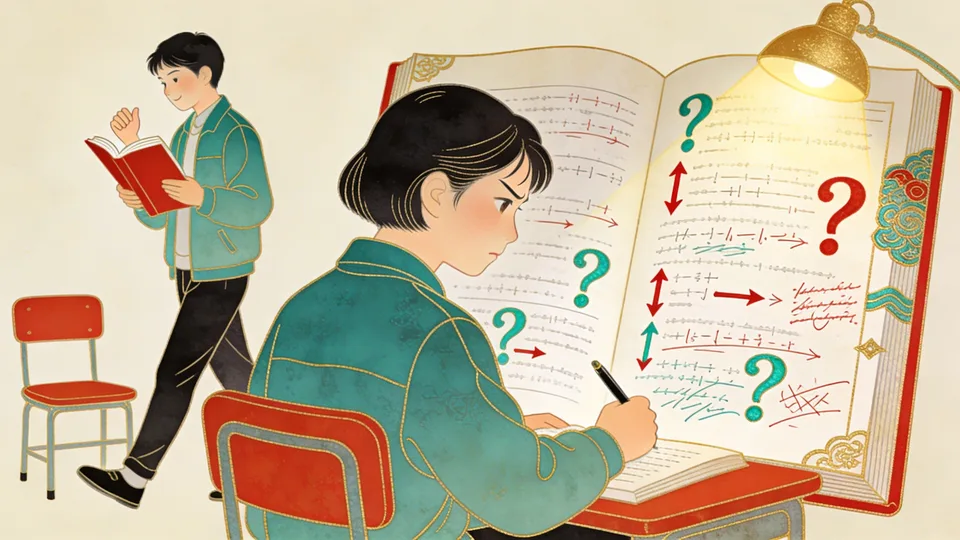
The student who asks what “energy” means looks slower than the one who writes it down.
A science textbook asks what makes a wind-up toy move. The accepted answer is “energy.” Richard Feynman pointed out that this explains exactly as much as “Wakalixes makes it go,” but only one of those answers passes the exam. Picture two students in that class. One writes “energy,” gets the mark and moves on. The other is stuck: energy of what, stored where, and how does it turn into motion? The second student falls behind, looks slow, and is often the only one in the room who is actually thinking.
We usually treat intelligence as hardware, a matter of processing speed and working memory, and on that model the first student is the smarter one. Nabeel Qureshi’s essay on understanding argues the opposite. Intelligence is not the ability to solve problems quickly but the compulsive refusal to accept an answer one does not truly understand. It is a high threshold for satisfaction in one’s own comprehension. If that is right, intelligence is closer to a set of learnable virtues, chiefly integrity and bravery, than to a gift.
Integrity: not fooling yourself
Feynman’s rule was “You must not fool yourself, and you are the easiest person to fool.” The student who writes “energy” has fooled himself without noticing. He holds a cached thought, an explanation borrowed from someone else, stored and replayed when prompted, never metabolized into understanding. Knowing the name is the specific mechanism: a label that sounds like an explanation fills the space where the explanation should be.
Cached thoughts persist because real understanding is energetically expensive. Every honest “why” opens more rabbit holes. Most people stop when they have an answer that “sounds” right, to conserve energy. The cached answer is a local optimum: it passes the exam, wins the argument and satisfies the boss, so moving past it means descending into confusion before you can climb to anything better. Grokking in neural networks gives this a mechanistic shape. The jump from memorized pattern to compressed rule arrives long after the training loss has flattened, so every visible signal says stop just before the generalization would have come. The human version is the same: the feeling that “I’ve got this” and the feeling that “nothing is happening anymore” both fire loudest just before things would have clicked.
Bravery: looking stupid
The stuck student also pays a social price. Figures like Faraday or Gladwell’s father show a willingness to look stupid by asking “dumb” questions until the semantic gap is bridged. That willingness is a filter against the illusion of competence, and it costs more for some people than others. For a high-status person, “I don’t know” is an adventure. For a low-status one it reads as a confession. A meritocracy that rewards people for accepting black-box explanations and moving up the ladder efficiently ends up inadvertently selecting against true innovators who get stuck asking “why” at the bottom rung.
School sharpens the selection. By penalizing slowness and rewarding symbol manipulation without grounding, schools systematically kill the “will to understand.” The student who insists on understanding before moving on is marked down for being slow, and the student who memorizes the answer is rewarded. Chinese has a name for the result: 死读书, the dead reader, who can recite the curriculum perfectly and synthesize nothing outside it. Over time the will to understand atrophies from disuse, and the credentialed people at the top, fluent in cached thoughts, are often the least able to tell understanding from its performance.
What does the stuck student do instead? He goes back to simple things and stays with them. The Agassiz parable has a student made to stare at a fish until he actually sees it rather than recites its classification. Even the equals sign has more depth than most people ever find. The expert is not someone who knows complex things, but someone who understands simple things with terrifying depth.
The limit and the charge
The virtue has limits. Joseph Henrich shows that for most of history, insisting on understanding before acting could kill you. A manioc processor who refused the traditional two-day wait until someone explained why it mattered would get cyanide poisoning. The will to think works where cause and effect are visible; tradition preserves knowledge where they are not.
Inside its domain, though, the charge stands. mediocrity is a moral failing — a lack of courage to face confusion. That is a hard sentence, and it is meant less as contempt for people who stop than as a claim about where the barrier sits. Most intellectual failure is not a failure of capacity but a reluctance to sit with not understanding, to ask the question that makes you look stupid, to prefer the grinding work over the plausible answer. If that is right, intelligence in this sense is available to anyone willing to pay the price, which is being confused, publicly and for a long time.
Which brings us back to the wind-up toy. The student who wrote “energy” got the mark. The one who couldn’t stop asking is slower, more awkward and frequently stuck, and is building something the fast student will never have. The question is which of the two your school, your job and your own impatience are training you to be.
References:
- Nabeel Qureshi, Understanding
- Richard Feynman, on intellectual integrity
- Louis Agassiz, the fish parable