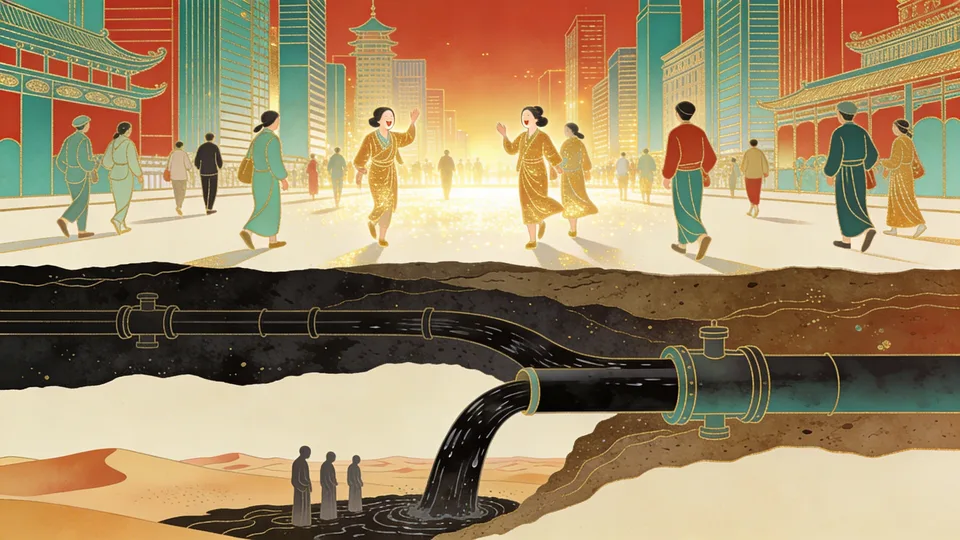
A country gets to be loud when someone, somewhere else, is made to stay quiet.
You land in a country and feel it immediately. People are loud, brash, unafraid. They take up space. They argue with cops and tip extravagantly and believe, with a sincerity that borders on delusion, that anything is possible. You call it culture, national character, vibe.
But why should one nation feel like that and another feel crushingly polite? The better explanation is that the vitality is not a trait at all. It is Spice, and like the melange of Arrakis, it is harvested from the desert at someone else’s expense.
Where the pressure goes
Civilization demands suppression. You cannot kill, steal, or act on every impulse and still have a functioning society, and holding all that back generates psychic pressure that has to be absorbed somewhere. The pressure is conserved. It does not vanish. It only moves.
A society can turn it inward, making its own citizens absorb the full weight of compliance, as Japan and South Korea do. They become exquisitely polite, hyper-functional and slowly crushed: the capitalist distillation where shame without community produces a population that can build global supply chains and cannot sustain a birth rate. Such a society does not fail gradually; it fails at the weakest point, in the salaryman who works himself to death.
Or it can turn the pressure outward, routing the aggression onto a periphery: a colony, a vassal state, a desert full of people whose suffering does not register on the evening news. The domestic population gets to feel free and vital, because someone else pays the psychological cost. That is the electricity you felt on landing. On this reading, the post-war West dissolved its strong gods of conviction and could afford to, because a military architecture was exporting the resulting pressure.
Exporting the pressure has its own price. A population that relies on peripheral scapegoats to absorb its shadow lets its muscles of self-regulation atrophy, so as multipolar shifts erode the ability to project force effortlessly, the pressure backs up into the domestic system. The empire does not lose to an external enemy. It loses to its own returning shadow: the accumulated aggression that has nowhere to go but home.
Who gets to be the sink
The obvious objection is that this is Freudian handwaving. Psychic pressure is not a measurable quantity, and nations are not steam engines. That is fair: “conservation” here is a metaphor, and it cannot predict which empire turns on itself. What the metaphor does get right is the question it forces: societal order demands an entropy sink, and the political question of every era is who gets to be the sink. Condemning the arrangement is easy; the harder implication is that universal equality may be impossible if the weight always has to land somewhere.
Perhaps AI or virtual worlds will one day absorb dominance drives without anyone on the other end being hurt. Until then, the next time you feel that electric, unbounded freedom in the air of a great power, ask who is harvesting it, and what it is costing them to hold still while you take it.