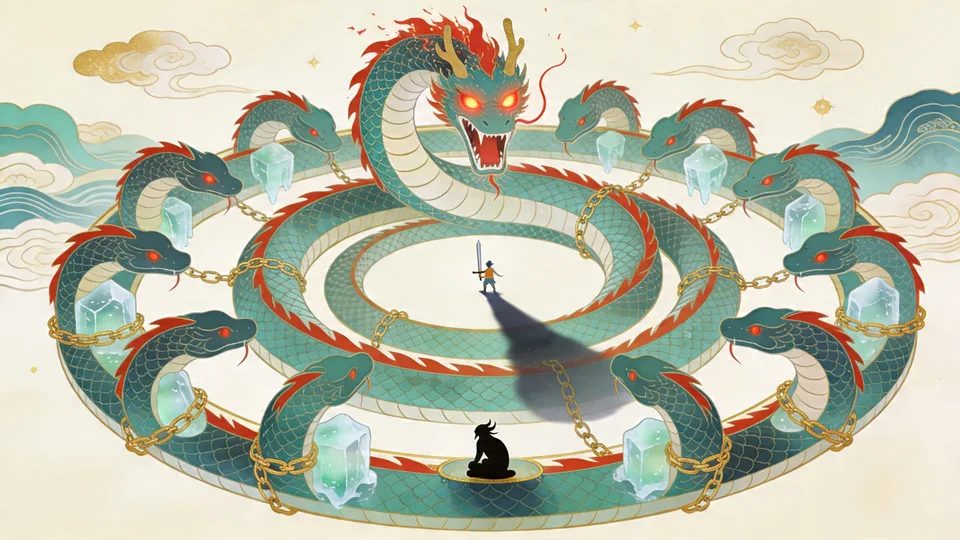
You can finish therapy about your father and still marry him.
Suppose someone spends years in therapy on a father who frightened them. They rage, they grieve, they understand, and at the end it feels finished: the monster has been faced and slain. Two years later they are with a partner who has the father’s edges, the same sudden coldness and the same way of making them small. They leave, and the next relationship produces the same shape. If the dragon was slain, what is this?
The usual answers are that the therapy didn’t work or that trauma is permanent damage. A better answer is that large traumas do not get killed. They get seasons. The fantasy trope of the Great Evil That Cannot Be Destroyed, Only Sealed, Returns Every Hundred Years is less a convention than a description of how trauma-slaying actually works.
The template casts new actors
The first season has the original monster, the original wound and the original hero, and it ends with a slaying. But the ecosystem that grew up around the monster, the narrative roles, the arousal register and the identity built on opposition, doesn’t disappear when the monster does. The body keeps the score at the level of pattern, not personnel. The father wrote a template, this is what danger looks like, this is what attachment feels like, this is how the story ends, and the template goes looking for actors who can perform the roles. Kill the actor and the template commissions another. The partner looks different. It is the same dragon.
So the dragon is not the villain. The dragon is the show, and the villain is an interchangeable role inside it.
Why the dragon returns
The work that would keep the dragon dormant is boring: not letting small resentments ignite, not letting the quiet condense into a new threat, carrying water on days when nothing happens. A nervous system calibrated for emergency doesn’t tolerate that well. Calm reads as prediction error. Dopamine fires hardest at the edges of unpredictability, not at the center of stability, so the absence of a threat registers as an absence of aliveness. The system doesn’t merely permit the dragon’s return; it mildly invites it, because genuine peace would require rebuilding an identity that was organized around opposing the dragon.
This is why therapy graduates often miss their symptoms. The symptoms were the structure, and losing them feels like loss rather than relief. The boredom of a life without the dragon is the untelevised part of healing, and it is the part most people exit early. Exiting early is how the new season begins: the person who felt finished with their father finds the quiet unbearable, and the partner with the right edges feels, at first, like coming alive.
Where the violence goes
There is a second reason the story doesn’t end cleanly. Slaying a dragon, even imperfectly, requires violence, and the violence has to go somewhere. It can go onto the original villain as rage, onto the self as collapse, or onto the current partner, who absorbs the displaced charge under the cover of intimacy. Most often it goes onto a scapegoat: someone assigned the role the original villain vacated. That route is the easiest to justify and the hardest to detect, and the slayer is almost never the one who pays. In other words, scapegoating is not a moral failing downstream of dragon-slaying. It is the core mechanism by which dragon-slaying is made bearable. Without somewhere to dump the violence, the slayer would see it whole and feel its full weight, and the slaying could not be as clean as the story says. So the hero who refuses to integrate the dragon projects it onto the nearest available body, slays it there, and calls that virtue. The dragon moves; the hero stays heroic. The same arithmetic runs at larger scales. When a generation grows ashamed of the machinery its grandparents used to absorb and dispose of their shadow, and dismantles it, the pressure the machinery absorbed doesn’t vanish. It returns in whatever form the new terrain supports, which is one reading of the hundred-year seal.
Sitting with it
None of this means the work is pointless, or that trauma is simply permanent damage to be endured. It means the goal changes, because trauma is a recurring narrative character who shows up in new costumes, and the work is not to kill the dragon but to recognize the shape-shift and refuse to externalize its violence when it returns. For the person in therapy, that means noticing the father’s silhouette in the new partner before the casting is complete, and declining to make the partner pay for the last season. It also means distrusting the cope that sounds most responsible, I will heal completely first, then get on with life, because it assumes a final kill that is not on offer.
What is left looks almost like doing nothing: tedious, unglamorous maintenance, indistinguishable from tending one’s garden. The dragon is eternal. The choice is whether you feed it with the small aggressions of daily refusal, whether you externalize its violence onto a designated carrier, or whether you sit with it in your own life, bored, for as long as the sitting lasts. Most people choose the second. The first is how the dragon grows. The third is what healing actually looks like, and it is rarely mistaken for healing at the time.