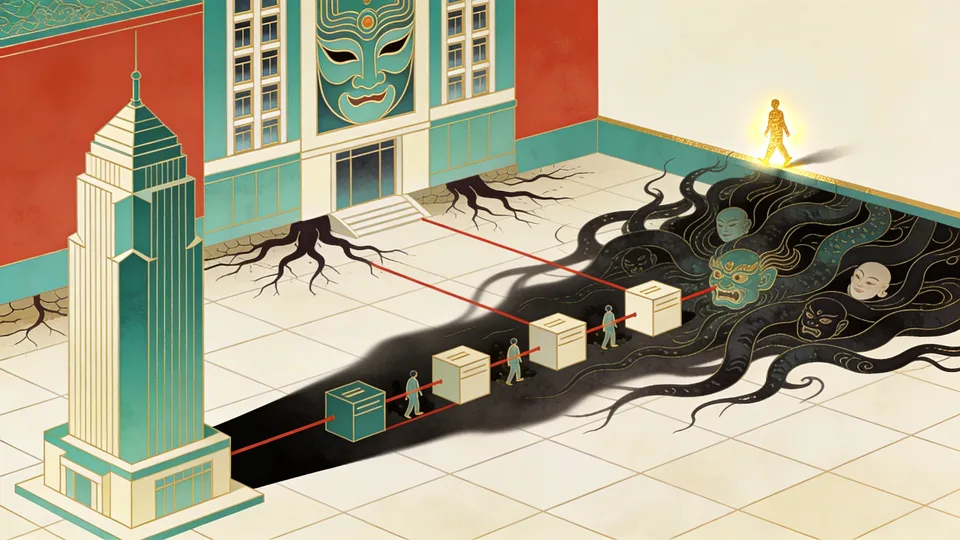
Shadow formation is a family technology before it is an individual one. The family that cannot face its contradictions routes them through the Identified Patient: the black sheep carries the shadow so everyone else can remain intact. What is true at the family scale is true at every scale above it. Organizations have shadows. They work the same way. The identified patient in an institution is the department that “always causes problems,” the role type that “doesn’t fit the culture,” the category of worker perpetually blamed for dysfunction that predates them by a decade. The shadow does not originate with the carrier. It is assigned there.

Simple Picture

A startup where the product team perpetually clashes with engineering. Leadership reads it as a culture problem, a hiring problem, a communication problem. They fire the product VP. Within six months, engineering is clashing with design. They restructure design. Now the CTO is in conflict with three senior engineers. The conflict has not been resolved. The shadow has been shuffled. The original tension — between a founding team that cannot agree on whether to optimize for speed or quality — is intact, finding successive carriers until someone names it or it collapses the company. No one names it because naming it requires acknowledging that the founders are the source. That is the one acknowledgment the system cannot make.

The Shadow Export Mechanism

Jungian shadow in an individual is all the material the person cannot acknowledge: the aggression the “gentle” person denies, the competitiveness the “humble” person suppresses, the contempt the “compassionate” person projects. In an organization, the shadow is all the contradictions the official narrative cannot hold: the company that professes customer-centricity while optimizing for short-term revenue; the team that values “honest feedback” while punishing anyone who gives it; the leadership that talks about “psychological safety” while running on fear.

These contradictions cannot be acknowledged because they would unmask the fiction that holds the institution together — the load-bearing story that the organization tells about itself. So the material is exported. It appears in whoever is most visible and least protected: the dissenting engineer who “doesn’t understand the business,” the sales team that “overpromises,” the customer service department that “can’t handle the complexity,” the legal team that “slows everything down.” In each case, the dysfunction is real — but it is the organization’s dysfunction, not the carrier’s. The carrier is doing exactly what the system has set them up to do.

The Rule of Triangulation applies at institutional scale: in times of stress, two organizational factions stabilize their alliance by jointly focusing on a third. The shared enemy converts the latent conflict between the factions into a productive project: fixing the problem department. Both factions get what they need — the alliance, the legitimacy, the narrative of competence — and the underlying tension continues undisturbed.

The Gervais Mechanism

The Gervais Principle’s “organizational dark matter” is the shadow, expressed in the language of power dynamics. Unaccounted sins — the decisions that don’t fit the narrative, the consequences that can’t be attributed, the patterns that don’t appear in any official document — accumulate in the institutional subconscious. The Clueless, who have externalized their moral sense to the institutional code, cannot see it. The Losers see it but keep their heads down. The Sociopaths know exactly where it is and route the blame accordingly.

The shadow accumulates through Dead Sea Effect amplification. The people most capable of naming the shadow — the ones who can see the dysfunction clearly enough to describe it accurately — are the first to leave, because they are the most willing to conclude that their clear-seeing is not welcome. The residue that remains has, over time, sorted for the inability to see the shadow: they are not incapable of perceiving it, but they have survived by not perceiving it, and the organizational immune system has progressively eliminated everyone who perceives too clearly. The shadow grows larger as the population capable of naming it shrinks. Each departure is not the loss of a difficult employee. It is the loss of a shadow-perceiver. The organization becomes progressively more blind to its own contradictions as the people who can see them choose survival elsewhere.

The Convergent Sabotage Connection

Convergent Sabotage is the shadow expressing itself at the operational level. The bureaucratic, process-heavy, control-obsessed behavior that produces sabotage-equivalent outputs is the institutional shadow of the organization that cannot acknowledge it is optimizing for control rather than output. The sabotage manual describes what the organization’s control apparatus is doing. The organization cannot read this description and recognize itself — not because the leadership is stupid, but because recognition would require acknowledging the contradiction between what the organization says it values (output, customers, results) and what it actually optimizes for (control, legibility, the interests of whoever sits above the system).

The shadow produces convergent dysfunction for the same reason it produces identified patients: the contradiction must go somewhere, and it goes to whoever is designated as the carrier of the organization’s problems. The engineer who “can’t work with ambiguity” is carrying the shadow of an organization that promises clarity and delivers chaos. The sales team that “overpromises” is carrying the shadow of a product team that cannot say no. The customer service staff that “isn’t empowered to solve problems” is carrying the shadow of a management structure that centralizes authority while distributing blame. Remove any one carrier and the shadow reassigns.

What Legibility Does to the Shadow

Legibility is the shadow’s enemy and accomplice simultaneously. Making a problem visible — putting a metric on it, assigning a name to it, creating a process around it — is the first move of institutional shadow suppression: the problem appears to be addressed because it is now managed. The identified patient department has a performance improvement plan. The dysfunctional culture has a culture committee. The shadow is not dissolved. It has been made legible, which means it has been made manageable, which means it can now be perpetuated with institutional blessing.

True shadow work at the organizational level requires a different kind of legibility: not the legibility that comes from measuring the carrier, but the legibility that names the contradiction. “This organization cannot simultaneously optimize for quarterly revenue and long-term customer relationships — these are genuinely incompatible at this growth rate.” That sentence is a shadow-naming. It is also a political act, because it implies that the narrative holding the institution together is a fiction, and fictions are load-bearing.

This is why the consultant who names the shadow accurately is rarely hired again, and why the internal employee who names it too clearly appears on the Dead Sea evaporation list. The shadow-naming is experienced as a threat to the structure, because it is one. The shadow cannot be integrated without modifying the load-bearing fiction that necessitated the suppression.

Formation at Institutional Scale

Formation is the individual fix: instead of suppressing the shadow trait, give it a form — a sword, an amulet, a deliberate object — so it can be wielded rather than unconsciously deployed. The institutional equivalent is acknowledging the contradiction and building deliberate structures around it.

The organization that genuinely cannot serve both short-term revenue and long-term relationships does not resolve this by finding better words. It resolves it by choosing one as primary and building an organizational structure that reflects the choice — which means some people will be building the wrong thing and need to leave, and the story that “we do both” needs to retire. This is formation: converting the ambient contradiction from a force that wields the organization (through identified patients, manufactured crises, and convergent dysfunction) into a constraint that is consciously held and designed around.

The organizations that do this well are almost always the ones where someone in power was willing to name the shadow in a room where naming it was expensive. That act — which looks like honesty and is structurally an act of shadow formation — converts unacknowledgeable material into acknowledgeable material, which is the precondition for any genuine change. Formation does not make the contradiction disappear. It makes it available to work with.

Dimwit / Midwit / Better Take

The dimwit take is “organizations have toxic employees — identify and remove them.”

The midwit take is “dysfunction is systemic — you need culture change and better processes.”

The better take is that organizational dysfunction is structural shadow: contradictions the official narrative cannot acknowledge, routed through carriers because the system has no mechanism for integration. Culture change programs are shadow management, not shadow formation — they produce a better story about the shadow without dissolving it. The identified patient changes; the shadow endures. The only intervention that dissolves organizational shadow is the one that names the contradiction the shadow is carrying — and that intervention is always, structurally, a threat to whoever benefits from the contradiction remaining unnamed. Which is why it almost never happens from within, and why the shadow tends to be clearest to the person who is carrying it.

Threads to Pull

Ideas, thinkers, and questions worth pursuing — and why.

  • Isabel Menzies Lyth, “Social Systems as a Defence Against Anxiety” — Lyth’s 1959 study of nursing organizations is the foundational document for understanding institutional shadow. She showed that the organizational structures of hospitals — task-based care, rotation systems, hierarchy — were designed not for patient welfare but to protect nurses from the anxiety of patient contact. The institution’s structure was a collective defense mechanism. This is organizational shadow formation in reverse: the structure was built to maintain the suppression, not to dissolve it. The connection to convergent-sabotage and organizational dark matter is direct.
  • The Kleinian “organization as container” — Object relations theorists, following Melanie Klein’s work on group psychology, argue that organizations function as containers for the projective identifications of their members. The organization holds what individuals cannot. This is the macro-level version of the identified patient — the organization itself as the container for collective anxieties that no member can hold individually. The implication: shadow formation in an organization requires strengthening the container, not just naming the shadow. What does a sufficiently strong organizational container look like?
  • Philip Selznick’s Leadership in Administration — Selznick distinguishes “organizations” (technical instruments for defined purposes) from “institutions” (organizations infused with value beyond their technical purpose). The institution’s shadow is the gap between the value it is infused with and the value it actually produces — and that gap is always the most politically dangerous thing in the building. Selznick’s concept of “character” applies here: an institution’s character is what it does when no one is watching, which is the shadow under good lighting.
  • What shadow formation would require at civilizational scale — China’s party-state cannot acknowledge its contradictions (political control vs. economic dynamism, national dignity vs. dependence on foreign technology, ideological legitimacy vs. functional governance) and routes them through identified patients: entrepreneurs, independent journalists, ethnic minorities, the financial sector. Each purge is a shadow reassignment. The question is whether formation is possible for a system whose load-bearing fictions are also its governing ideology — or whether every large institution eventually chooses shadow management over integration, because integration requires acknowledging what the institution cannot afford to be.
  • The relationship between Dead Sea Effect and shadow accumulation — If the people who can see the shadow most clearly are also the ones most likely to leave, there should be an observable relationship between talent evaporation and shadow accumulation: as the clear-seers leave, the shadow grows; as the shadow grows, the environment worsens; as the environment worsens, more clear-seers leave. This suggests that talent evaporation and shadow accumulation are not two separate organizational pathologies but a single self-reinforcing cycle. Has anyone tracked this empirically?