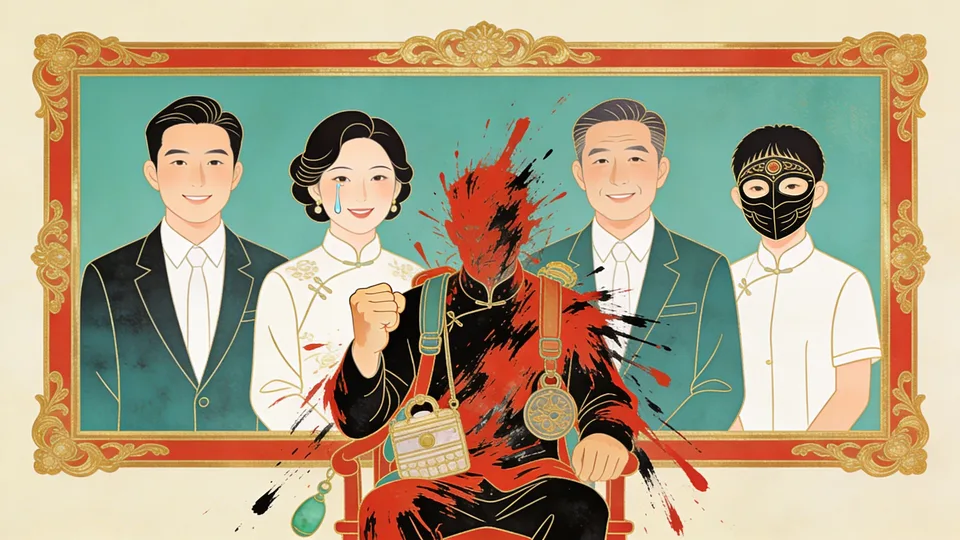
The Identified Patient (IP) in family systems theory is the member who carries the family’s exported dysfunction. They are not the broken one. They are the one designated to hold everything the system refuses to see in itself. The black sheep’s “problem behavior” is the structural glue that holds everyone else’s fragile bonds together.

Simple Picture

A family is a machine that produces a shared reality. When the machine has a defect it cannot acknowledge — a narcissistic father, a codependent mother, a marriage running on mutual avoidance — the defect has to go somewhere. The machine selects one member, routes all its unprocessed material through that person, and then points at them and says: “See? That’s the problem.” The family has not fixed the defect. It has outsourced it. The outsourcing is the fix.

How Triangulation Works

Consider a family where the father is a covert narcissist with repressed rage and the mother is codependent, terrified of conflict, harboring massive repressed resentment toward her husband. If they faced this reality, the marriage would end. Instead, they triangulate their teenage son.

The father covertly antagonizes the son. The son, absorbing the father’s repressed rage, explodes — acts out, gets arrested, fails out of school. Now the parents have a shared project: “Fixing the broken son.” They sit at the kitchen table, bonded in shared tragedy and mutual concern.

The mechanics are precise: the father expresses his rage under the guise of “discipline.” The mother exercises her codependency under the guise of “maternal care.” The shadow — the parents’ toxic dynamic — is fully externalized onto the son. They never have to integrate their own flaws because the son provides a permanent distraction.

This is the Rule of Triangulation: in times of stress, two family members stabilize their bond by jointly focusing on a third. The black sheep knows, with absolute certainty, that they are the subject of conversations they are not present for — serving as the adhesive for other people’s fragile relationships.

The Shadow Export

The Jungian shadow consists of all traits a system deems unacceptable. A rigid, status-obsessed family represses chaos, emotional vulnerability, and failure. Because these traits cannot be acknowledged without destroying the family’s self-image, they are exported — projected onto the designated carrier, who then acts them out on the family’s behalf.

This is NPD’s replication pattern at the family level: the narcissistic parent causes pain and refuses accountability, denying the child’s emotional reality in exactly the way their own reality was denied. The family needs someone to be broken so that everyone else can feel intact. The IP’s dysfunction is not a personal failing — it is a systemic function.

The JADE Trap

The black sheep falls into a characteristic trap: trying to Justify, Argue, Defend, or Explain their reactions to the group. This is a fatal structural error. The group’s consensus reality has already been decided. Logic is not a weapon in this context — logic is additional surface area for the system to attack.

The matrix is immune to reason because its purpose was never truth. Its purpose is stability. The black sheep who explains why they acted out is providing the family with ammunition, not evidence. Every explanation confirms the family’s frame: “See how defensive they are? See how they always have to make it about themselves?” The anger addiction cycle feeds itself — the more the IP protests, the more material the system has to process through the scapegoat channel.

The self-justification engine runs at full speed here: the IP accumulates evidence that they were wronged, guards it like treasure, and invests every ounce of energy in proving the system wrong — energy that could be spent on actually leaving.

System-Breaking Events

Two events destabilize the scapegoat structure:

The Golden Child’s Collapse. If the compliant, high-achieving sibling fails catastrophically — severe burnout, public scandal, professional disgrace — the family’s projected ideal shatters. The black sheep’s “failures” are suddenly recontextualized. The system scrambles to reassign the shadow, and the results are ugly.

Irrefutable Asymmetric Success. If the black sheep achieves wealth, status, or power that vastly eclipses the family’s combined metrics, the system cannot process it. Two responses are available: frantically rewrite history to claim credit (“we always believed in them”), or aggressively attack the success as illegitimate (“they got lucky / they changed”). There is no third option, because the third option — acknowledging that the system was wrong about the IP — would collapse the entire architecture.

The Monsters

Within family systems theory, a monster is a caregiver who subconsciously cannibalizes a child’s psychological development to regulate their own nervous system — prioritizing the survival of their fragile ego over the actual safety of the child.

Imagine being a gazelle raised by lions who insist, with absolute conviction, that they are vegetarians. Every day you are bitten, scratched, and bled. When you cry out in pain, the lions look at you with deep concern and tell you that you are clumsy, that you have a rare skin condition, and that you are hurting the family’s reputation by bleeding on the grass. Being “raised by monsters” is the slow realization that the lions are eating you. The secondary consequence: by the time you escape the savanna, you possess a Ph.D. in the predatory mechanics of the lion.

Two archetypes dominate:

The Emotional Cannibal — the devouring archetype. This parent does not want the child to achieve independence. They consume the child’s autonomy to generate narcissistic supply, using weaponized guilt, manufactured crises, or financial entanglement to keep the child tethered as a permanent emotional battery. In eristic terms, this is love addiction turned parasitic — the parent’s extended self has absorbed the child so completely that the child’s separation registers as amputation.

The Reality Warper — the architect of gaslighting. This parent maintains control by destroying the child’s epistemology — their capacity to know what is true. They rewrite history, deny observable facts, and project their own malice onto the target. The monstrosity is the deliberate fracturing of the child’s sanity to avoid parental accountability. The memory system becomes compromised at the root: the child cannot trust their own perceptions because the primary attachment figure has systematically trained them that perception itself is unreliable.

Their shared quality is cowardice — trading the child’s soul for a quiet evening at the dinner table.

The Escape

Physical distance does not sever the systemic role. A black sheep can live on another continent and still subconsciously organize their life around rebelling against the family matrix — travel as avoidance rather than exposure therapy. In a single-child system where there is no sibling to triangulate, the dynamics mutate into something even more claustrophobic — the phantom child trap, where the child is triangulated against an idealized version of their own future.

True escape is emotional differentiation: achieving a state of detached observation where the family’s operating system is viewed as anthropological data rather than a personal threat. This is the integration move — not rejecting the family, not performing loyalty, but seeing the machine clearly enough that it loses its power to determine your internal state.

Once the label is permanently applied, an unexpected asymmetry emerges. Because expectations are already sub-zero, the social and emotional cost of taking massive, unconventional risks drops to zero. The system that was designed to contain you becomes, paradoxically, the thing that sets you free.

Dimwit / Midwit / Better Take

The dimwit take is “some families just have a bad apple.”

The midwit take is “family scapegoating is sad, but understanding the dynamic is enough to heal it.”

The better take is that the IP dynamic is not a failure of the family — it is the family succeeding at its actual goal: maintaining the system’s stability at the cost of one member’s sanity. Understanding the dynamic is necessary but not sufficient. The cooling infrastructure of the family — therapy-as-management, “they mean well,” “honor thy parents” — will absorb any amount of understanding without changing. What changes things is the IP’s refusal to carry the shadow — not through explanation, but through the quiet withdrawal of participation. The system will escalate. It will try guilt, rage, love-bombing, and finally dismissal. Each escalation is evidence that the withdrawal is working.

Tiamat Dragons names the deeper mechanism: the scapegoat route is not a moral failing of dysfunctional families — it is the core mechanism by which the family’s ambient trauma is kept bearable. Without the IP to route the violence through, the family would have to see its own shadow whole, which is the one thing it was organized to avoid. 富不过三代 extends the pattern temporally — where the IP is the family’s karma dump in the present, the third-generation heir is the bloodline’s karma dump across time, the point at which a silence the grandparents never broke finally becomes impossible to keep.

Main Payoff

The IP’s deepest wound is not the scapegoating itself but the epistemological damage — years of being told that their accurate perceptions of the family’s dysfunction are evidence of their own dysfunction. The recovery is not learning that the family was wrong. It is learning to trust your own perception again after the people who were supposed to teach you how to see spent years teaching you to doubt your eyes.

The depressive defense often follows: the psyche chooses numbness over the devastating knowledge that the people who raised you were feeding on you. The invisible wound is the absence of the thing that was supposed to happen — the attunement, the recognition, the simple act of being seen as a person rather than a container. Arriving at that knowledge is the hardest part. Surviving it is easier than you think.