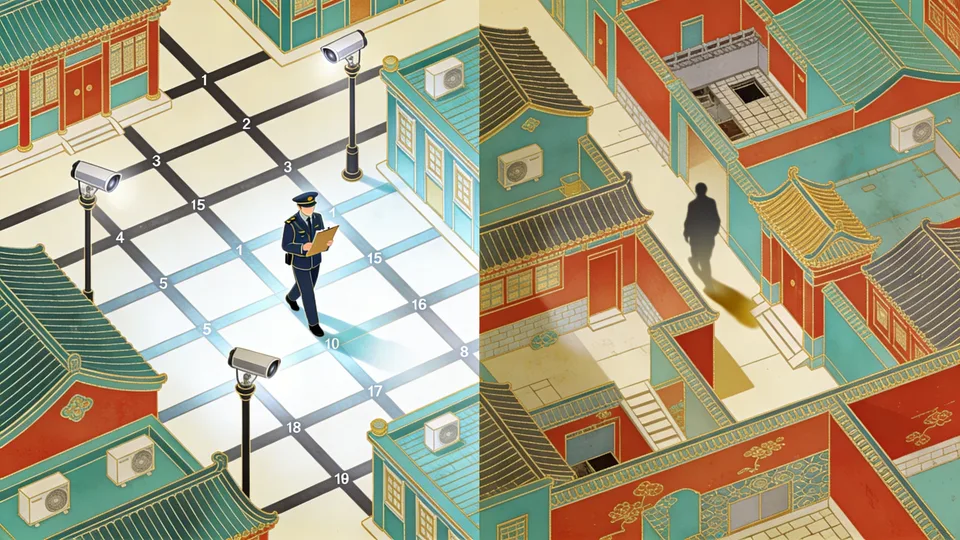
Every map is drawn for someone, and it is rarely the people on it.
For most of history, most people had no street address. A village lane was known by the families who lived on it, and a stranger who wanted to find someone had to ask a neighbour. Then states began naming streets, numbering houses, fixing surnames, and surveying land. It is hard to see this as anything but progress. The post arrives, the ambulance finds you, and land can be bought and sold with a clear title. So why did so many of the people being mapped treat the mapping as a threat?
James C. Scott’s answer in Seeing Like a State is that the officials drawing the map were not mainly thinking about the post. A named street and a numbered house let a distant clerk find one particular household in order to tax it, conscript its sons, or settle a land dispute in favour of whoever held the paper. The village became readable, and the question that matters about any readable system is who gets to read it. The powerful want the world to be legible because they are the ones doing the reading.
Who the map is for
Seen from above, a city of numbered streets is better than a maze of alleys: more efficient, more navigable, more rational. But “better” always hides a “for whom”. The grid that helps the ambulance also helps the police patrol and the tax collector call. The villagers gained some navigability from their new addresses, and they also gained visibility, and for people without power, visibility is mostly vulnerability. Order oppresses the powerless. Disorder defends them. The weaker your position, the more you need organization that outsiders cannot read, or actual chaos.
What makes this hard to see is that the act of mapping looks the same whoever does it, so the power in it hides in plain sight.
One person projecting their internal reality onto the world is psychosis. A government projecting street names and addresses is power talking.
Both impose a private map onto shared reality. The difference lies in who has the enforcement apparatus to make the map stick. A government’s street names become true because its courts, taxes and records all use them, and after a generation nobody remembers the old names at all.
Why the weak prefer the maze
The alley maze defends the fugitive for a structural reason. Every extra turning is another route the pursuer has to cover, and nobody can cover all of them at once.
The more dimensions there are, the easier it is to continue the game. 4D chess is easier than 2D chess because the king cannot be pinned. The higher the dimensionality, the more you should play not to lose rather than to win.
The guerrilla wins by not losing, because in a high-dimensional space the army cannot close every escape. That is why systems built for control keep reducing dimensions. Standardized testing turns a child into one number, and a corporate dashboard turns a worker into one row. Each reduction makes the people inside easier to read and easier to pin, and it is the street grid all over again, applied to a person instead of a neighbourhood.
The powerful make the world legible. The powerless survive in the cracks of that legibility. Every act of mapping is also an act of enclosure — and every unmapped space is a refuge.
Not an argument against order
The tempting conclusion is that all order is oppressive and should be torn down. That gets the villagers wrong too. Many of them came to rely on their addresses, and a city with no map is a city where nobody can call for help. Disorder protects the weak from the state, but it also protects the local strongman from accountability, because he is just as hard to find.
So order and disorder are better treated as power technologies than as moral categories. Order concentrates power at the top of the legibility stack, and disorder spreads it across the margins that the map leaves blank. The useful question about a new street plan, metric, ranking, or standard is therefore not whether it is accurate. A survey can be perfectly accurate and still serve only the surveyor. The question is who becomes more visible, and to whom.
Kings and gods were once protected by taboos against looking at them directly. Modern power needs no taboo, because it has made itself look like nature. Nobody now experiences their address as a decision someone else made about who could find them; it feels like a plain fact about where they live. The credit score, the performance dashboard and the class ranking are on their way to feeling the same. Each began as a choice about who would be read and who would do the reading, and the people inside each one increasingly experience it as a description of reality.
References:
- Venkatesh Rao, various essays on Ribbonfarm and Breaking Smart
- James C. Scott, Seeing Like a State