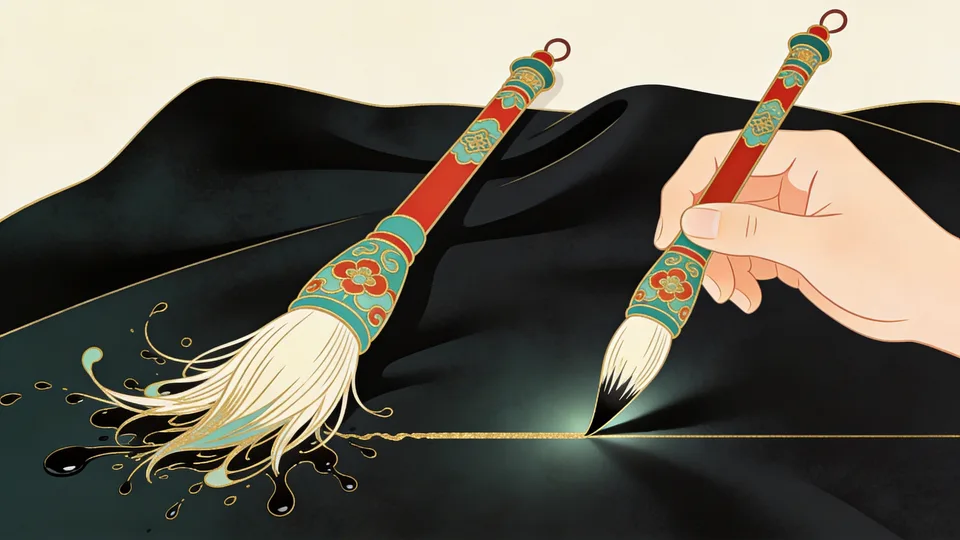
Nobody asks a surgeon to use duller knives.
Imagine someone who catches everything. At work it makes her invaluable: she finds the flaw in the plan, the bug in the model, the number that doesn’t add up. At dinner the same capacity spots the inconsistency in a friend’s story, and before she has decided anything, she has pointed it out. The friend goes quiet.
She has two standard options, and neither works. She can reject the trait: suppress it, disown the judgment, try to become a gentler person. But as Self-Acceptance argues, rejection is a strategy, and what you reject stays frozen rather than gone, so the suppressed critic leaks out sideways as sarcasm or silent contempt. Or she can accept it, which in practice slides into “that’s just how I am,” and her friends keep getting cut. Knowing that rejection fails does not tell her what to do instead.
The alternative is formation. Instead of rejecting a shadow trait, give it a form — wrap it into a tool you can wield deliberately. Her analytical tendency becomes a sword, placed at her side, drawn when precision is needed and sheathed when it is not.
Knives for fingers
The image behind this is Edward Scissorhands: a person with knives for fingers, sensitive, capable of extraordinary precision, and unintentionally cutting everyone he touches. The solution is not to cut off the fingers. It is to learn when to extend them and when to make a fist. The knives do not become less sharp. You become less drunk.
That matters because the trait cannot be unbundled. The pattern recognition that finds the bug is the same pattern recognition that finds the flaw in the friend’s story. As Natural Maniacs argues, the trait that makes you valuable is the trait that makes you dangerous. So the danger is not a defect to be eliminated. It is a feature without a safety.
This is also why the obvious self-improvement move backfires. Sharpening the knives further, with more knowledge and more analytical sophistication, makes her more dangerous. What helps is sobriety: the capacity to choose when and how to deploy the trait, rather than having it deploy itself.
Giving it a form
Formation turns that sobriety into a practice. First, feel the trait: not the story about it, but its somatic signature. The analytical tendency has a physical quality, perhaps a lean forward and a tightening just before the correction comes out. Second, give it a shape: a sword, an amulet, a bracelet. The specific image matters less than the act of containment, which converts an ambient force into a discrete object. Third, assign it a place, at your side or around your neck. An object with a location has boundaries. It is no longer you. It is yours. Fourth, practice wielding it: draw the sword in the design review, leave it sheathed at dinner.
A judgmental fire can become an amulet, its heat converted to warmth; a controlling streak can become a crown, set aside until needed. In IFS terms, these traits are protector parts with legitimate functions. Formation gives them a job description instead of firing them, which, as IFS insists, is what they have been asking for all along.
Extreme sober
None of this is possible in the state where the trait usually fires. The moment she corrects her friend is a small intoxication: absorbed in being the one who sees, deaf to timing. Formation needs the opposite, an extreme form of sober. It is the state in which your usual drugs (distraction, stimulation, numbing, performance) are suspended long enough to see your own pattern clearly, not to condemn it but to understand what it is doing.
The strongest objection is that this sounds like permission: own your dark side, keep being cutting, and call it a sword. But formation asks more than acceptance does. A trait with a form can be put down. “That’s just how I am” makes the trait an identity, and an identity can’t be sheathed. The difference between a person with knives for fingers and a surgeon is not the knives. It is the deliberateness.
Formation is also a commitment. Instead of tolerating the trait while hoping it goes away, she accepts it as a permanent part of her equipment and learns to use it well. Rilke saw the promise before the method:
Perhaps all the dragons of our lives are princesses who are only waiting to see us once beautiful and brave.
The dragons do not disappear when you form them. They reveal what they always were.
References:
- Personal ceremonial insights on shadow integration through formation