Nobody lies awake at midnight replaying what the rain said to them.
Suppose you walk to work in the rain and arrive soaked. You are annoyed, but by lunch you have forgotten it, and you never once hate the cloud. Then a colleague belittles your work in a meeting, and at midnight you are still replaying the remark, composing replies, feeling the heat rise again. Both events cost you something. Only one of them produces a grievance, and the difference is a belief you probably never examined: the colleague could have done otherwise, and the cloud could not.
Baruch Spinoza built an entire philosophy in which that belief is false. Everything that happens, including the colleague’s remark, follows necessarily from what came before. A world without free will sounds like a world without blame, merit, or morality. Yet Spinoza called his major work the Ethics, wrote it as a path to blessedness, and treated the loss of free will as the beginning of a better life rather than the end of one. So the question is how believing that nothing could have been otherwise is supposed to make a person freer and calmer, rather than smaller.
One substance, many waves
Descartes had split reality into thinking mind and extended matter, and then struggled to explain how the two touch. Spinoza collapsed them into one substance, with mind and matter as two parallel descriptions of the same events. That one substance is everything there is, and Spinoza was willing to give it the oldest name available. Deus sive Natura — God, or Nature: the same thing, called by different names.
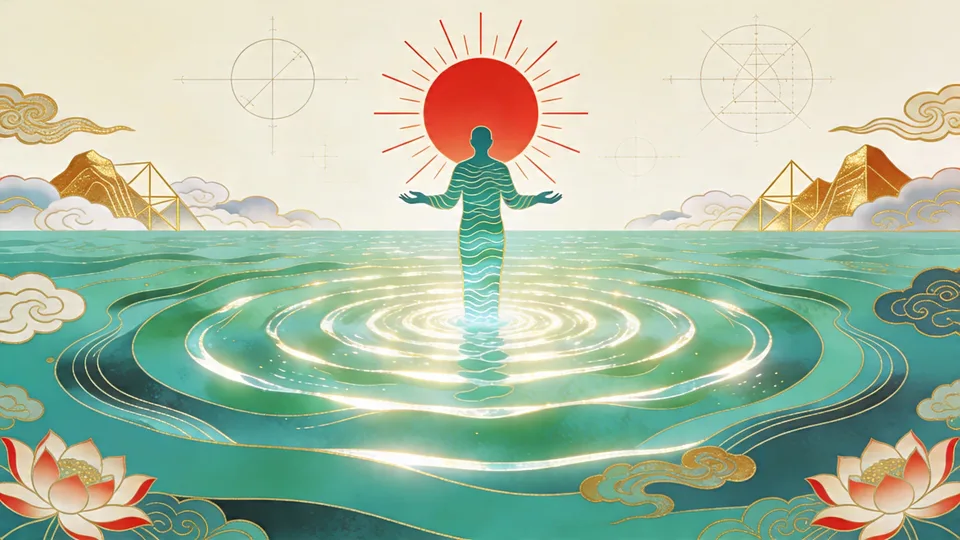
Most people picture themselves as ships on an ocean, steering. Spinoza’s picture is closer to a wave made of the ocean’s water. The wave does not decide to crash on the shore; wind, gravity, the moon, and the shape of every other wave decide it. The colleague who belittled you is a wave in the same water, necessitated by temperament, upbringing, the meeting’s pressures, and everything upstream of those.
Freedom, on this picture, cannot mean the wave commanding itself. It can only mean the wave understanding the physics, and so no longer raging at the rocks when it hits them. The angry wave is not free; it is the wave that has not yet noticed it is water.
If everything is necessitated, what is left for an ethics to talk about? Spinoza answers with conatus, the drive of every thing to persevere in its own being. From it he derives the emotions without a single moral primitive. Joy is the feeling of passing to a greater power of acting, and sadness the feeling of passing to a lesser one. Good is whatever increases that power, and evil whatever decreases it. There is no good or evil written into the universe — there is only the local physics of what feeds you and what depletes you. You find out what your conatus wants by noticing what produces joy, not by inventing a self from nothing, so the good life is found, not chosen.
Now the meeting looks different. The remark really did lower your power: it threatened your standing, your confidence, perhaps your next project. That drop is sadness, and it is real information. But Spinoza defines hatred precisely as sadness accompanied by the idea of an external cause. The midnight replay is sadness that has fastened onto a picture of the colleague as its free author.
Why the grievance has nothing to hold
Here determinism turns out to be therapeutic rather than bleak. You do not get angry at a cloud for raining on you, because you understand it had no choice. Once you fully take in that the colleague’s remark was as strictly caused as the weather, hatred loses the thing it binds to. That is not moral indifference. You can still talk to the colleague or raise it with a manager, for practical reasons such as deterrence. What dissolves is the felt outrage that the world should have been other than it was. The illusion of free will is the metaphysical battery that powers resentment; cut the battery and the appliance stops.
Yet anyone who has tried this at midnight knows that telling yourself “it was determined” does not stop the replay. Spinoza anticipated the failure. In Part IV of the Ethics he argues that an emotion can be restrained or removed only by a contrary emotion that is stronger. The intellect, on its own, describes but does not move. So his prescription is to cultivate a feeling strong enough to absorb the passion, which he calls the intellectual love of God: a sustained, joyful understanding of the necessity of things that outweighs the passing storm. Put plainly, reason is not a hammer that crushes feeling — reason is the cultivation of a single overwhelming feeling that absorbs every other feeling into itself.
The God who judges no one
The same deletion that frees you from hating your colleague has a larger target. Spinoza’s God has no intentions, performs no miracles, issues no revelation, and judges no one. Such a God exists as surely as nature does, and can do none of the work the clergy had been employed to interpret.
Spinoza had already been excommunicated by his synagogue with the most violent cherem on record, and he wrote in a Holland where heresy was still prosecuted. He wrapped the argument in Euclidean axioms and corollaries, a pious geometric demonstration of God’s nature, and in doing so made clerical authority structurally inoperative without arguing against the clergy at all. It was an assassination of orthodox theology disguised as an absolute proof of God. It worked because the word “God” was so densely compressed that Spinoza could fill it with a mechanical universe and leave the priesthood defending a shell whose contents had been swapped out. Neither “pantheist” nor “determinist” captures what he did: Spinoza performed a linguistic exploit and a determinism so total that it functions simultaneously as a metaphysical thesis, a covert dismantling of Abrahamic theology, and an undefeated cognitive-behavioral toolkit for the individual.
Where the system strains
The hardest objection follows from the same move. If “good” means whatever increases a thing’s power, and whatever happens is a necessary expression of the one substance, there is no external ground from which to condemn atrocity or tyranny. The Spinozist who does not swerve here ends at an amoral realpolitik that is uncomfortable to defend in public and hard to refute on the system’s own terms. The usual escape is that understanding is what increases human power most reliably, and atrocity destroys the conditions for understanding, so the system has internal reasons to oppose what it cannot condemn from outside.
The metaphysics may yet be revised by physics nobody has discovered. What has held up for three and a half centuries is the practical part: a freedom that does not depend on having been able to do otherwise, only on seeing why things went as they did, and on making that seeing a stronger joy than the grievance. The remark still happened, and you may still need to act on it. But hatred needed a free author to aim at, and once there is none, the people who quietly run on this tend to outlast everyone still angry at the weather.
References:
- Baruch Spinoza, Ethics, Demonstrated in Geometrical Order (1677, posthumous)
- Baruch Spinoza, Theological-Political Treatise (1670)
- Stewart, The Courtier and the Heretic — on Spinoza, Leibniz, and the seventeenth-century context
- Damasio, Looking for Spinoza — the affective physics revisited through neuroscience